The Morning-Gift, chapter 4 of Offered to the Viking
Thorvald called the moot for the next new moon, on the green by the beck where Eskwick had always held its moots, under the old ash with an iron nail driven into it that nobody could remember the reason for.
Everybody came: the whole village and most of the Northmen, English on one side of the green and newcomers on the other, a strip of trampled grass between them like a river nobody wanted to be first to wade. Children sat on the wall. Dogs wandered through. It was a bright, blowing morning, cloud-shadows chasing each other over the grass, and every time the sun broke through, the Northmen’s arm rings flashed along their side like a shoal turning.
Thorvald sat on a bench under the ash with Orm on one side and, at his request, Father Wigmund on the other. The priest looked like a man asked to sit beside a bear. He kept folding and unfolding his hands.
It was meant to be about land: which strips went to whom, which newcomers would farm the high fields left fallow since the fever year, where the common pasture ended and the jarl’s began. For most of the morning it was. Men stood and said their piece, Orm cut marks on a tally stick, and Thorvald listened to each of them as if nothing else in the world needed him that day, and ruled, and most sat down looking satisfied, or at least not robbed.
Then Cenred stood up.
I’d known he would. I’d been waiting since the moot was cried. I’d put my keys on my belt that morning and my mother’s pin in my headrail and sat at the end of a bench near the front with my hands in my lap, and when he stood my whole body went cold and still, like a pail left out on a frosty night.
“I claim the house by the beck,” Cenred said loudly, “and the brewhouse, and the acre behind it. They were my brother Leofric’s. He’s dead. I’m his kin and his heir. She”—he didn’t look at me—“has no husband. A woman can’t hold land without a man to answer for it. And she was given. Everyone here saw it. A woman who’s been given away has no claim to anything she had before.”
A murmur went round. Not all of it against him, and that was what frightened me. Some of the older men were nodding. It was how things had always been done, wasn’t it? A widow went back to her kin, her kin took care of her, and the land went where land goes.
Thorvald looked at Cenred. Then at me.
“I will judge it,” he said. “But not yet. Aldith. Speak for yourself.”
He didn’t say it kindly. He said it like a man handing someone a sword hilt-first: here, you’ll need this.
I stood up.
My knees were water. I locked them. I looked out over the green at the faces of people I’d known my whole life, people whose babies I’d helped into the world and whose fathers I’d helped out of it, and I thought: you stood on that beach and said nothing. Well. Now you’ll listen.
“The house was never Leofric’s,” I said.
That stopped the murmuring.
“It was mine. He gave it to me the morning after we married. My morning-gift. The house, the brewhouse and the acre, given to me at the church door, before witnesses, and blessed.” I made myself breathe. “Everyone here knows what a morning-gift is. It’s the wife’s. Not the husband’s, not his kin’s. A husband can’t take it back. He can’t leave it away in his will. And his brother,” I turned and looked at Cenred, and kept my voice level, “his brother can’t take it at all.”
“She’s a woman alone,” Cenred said. “She can’t—”
“I’ve been a woman alone for two winters. In that time I’ve paid my food-rent to Godric on the nail every Martinmas. I’ve brewed for every feast in this village. I’ve set Wat’s leg when it broke and sat with your own father when he died, Cenred, when you were too drunk to come. Nobody asked who answered for me then.”
Someone at the back laughed. Not unkindly. I didn’t dare look to see who.
“As for being given.” I held up my wrist. The bruises were yellow now, going green at the edges, but you could still count the fingers. “I wasn’t given. I was walked to the waterline by this wrist and offered without my knowing, and when I was asked, I said no. You all saw it. And that same night he came back to my door with two of Godric’s cousins and a rope, and broke my bar to take me to his house. Ask them where the rope is now.” I looked at the jarl. “He has it.”
“Witnesses,” Thorvald said. “You said witnesses.”
My heart dropped. The witnesses had been Leofric’s friends, mostly, and his mother, and two were dead and one had gone to her sister’s in Ripon, and the rest…
Father Wigmund stood up.
He is seventy-three, half deaf, with hands that shake, and he had stood on that beach and said nothing while I was sold, and I hadn’t been able to look at him since. He stood up beside the jarl he was so afraid of, cleared his throat, and said in his high old voice, which carried better than you’d think:
“I blessed the gift. At the church door, on the morning after Saint John’s Day, eighteen years ago this summer. Leofric son of Wulfstan gave his wife Aldith the house and the brewhouse and the acre, and I blessed it, and he carved his mark on the boundary stone himself, there, at the top of the acre. You can go and see it.” He sat down, then stood up again. “And the Church forbids a man to marry his brother’s widow. He asked me. I said no. I would say no again.”
He sat down for good, trembling, and folded his hands.
And then Mildryth stood up, at the back, with her arms crossed over her big chest and her chin out.
“I was there,” she said. “At the church door. I was her bridesmaid and I was sick on the way home from too much of her mother’s mead, and I remember every word Leofric said, because I made fun of her about it for a month after.” She glared at Cenred. “And I was on the beach too, and I stood there like a fool and didn’t say anything. I’m saying it now. It’s hers.”
She sat down. She was red to the roots of her hair.
Silence on the green. The wind blew. A dog barked somewhere up the village.
“One more thing,” I said, because I’d come this far and my legs hadn’t given out yet. “After Leofric drowned, Cenred came to my house with a ring and asked me to be his wife. The priest said no. I said no. I’d like everyone to know that. So that when you wonder why my husband’s brother walked me down to the sea in my best dress, you’ll know the answer.”
Cenred went the colour of a boiled crab.
Thorvald stood up.
“The land is hers,” he said. “The house, the brewhouse and the acre. Her morning-gift, by her own law, and I will keep her law in this. Anyone who says otherwise,” and he didn’t look at Cenred, he looked out over the whole green, slowly, English side and Norse side, “says it to me.”
Nobody said anything.
Afterwards I walked down to the beck to be alone, and he came after me, and I let him.
The water runs fast and brown over the stones there, under the alders, loud enough to talk without being overheard. I sat on a rock and put my hands in the cold to stop them shaking. He stood a little way off with his arms folded.
“You could have just ruled,” I said. “Why make me stand up?”
“Because it is yours,” Thorvald said. “If I had given it to you, it would be my gift. They would say I bought you with a house. Now they say you took it back yourself. That is a different thing.”
I looked up at him. He was right. I hated how often he was right.
“There’s something else,” I said, and I told him about the moor road, and the rider in the wolf-pelt cloak, and the brooch, and the sack.
He didn’t look surprised. He heard me out, and nodded slowly.
“Ordric,” he said. “Yes. I know the name. He has a burh up the dale, and forty men, and he is not the only English lord who wishes we were at the bottom of the sea.” He crouched down on the other side of the beck from me so his face was level with mine. “Thank you.”
“Aren’t you going to tell me to stay out of it?”
“Would you?”
“No.”
“Then I won’t waste my breath.”
I laughed, which surprised us both. The corners of his eyes creased.
“About the brewhouse,” I said. “I’m sorry I threw you out.”
“You were right to.”
“You were right to ask.” I took my hands out of the water and looked at them. Red with cold. Scarred across the back of the left one where I’d spilled boiling wort on it the year I was married. “It was half paying. I didn’t know it till you said it.”
“And now?”
I didn’t answer him. I stood up, and I dried my hands on my skirt, and I went home.
I went to the hall that night after dark.
I took nothing with me. I walked up the hill under torn cloud with the moon coming and going, and the guards at the door looked at me, then at each other, and stood aside without being told. The hall was mostly asleep, men snoring along the benches, the long fire burned down to red. Orm sat awake by the hearth, whittling. He watched me pass without a word and went back to his knife.
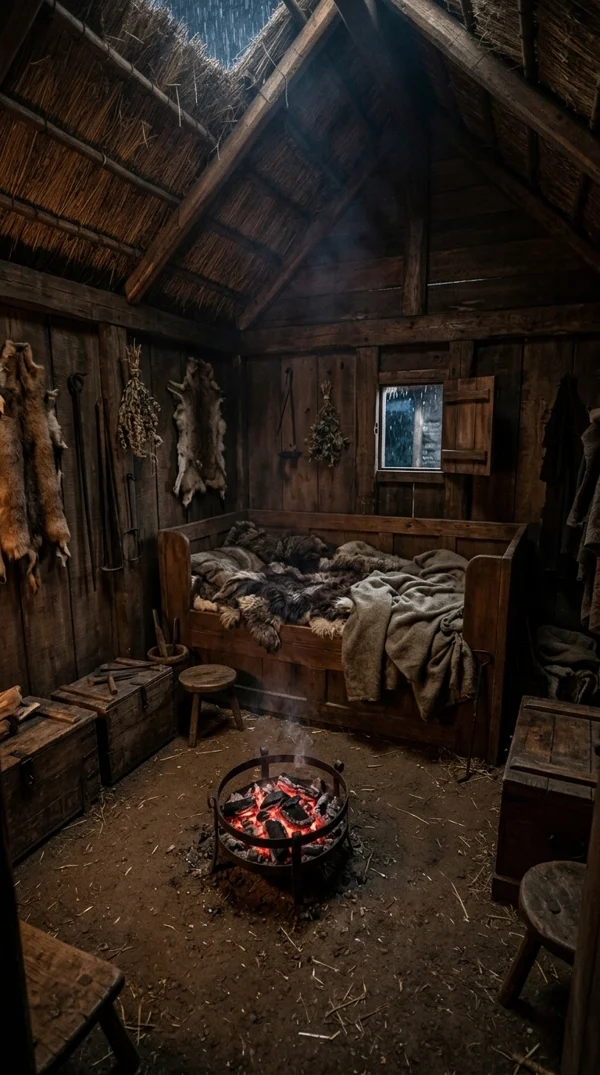
Thorvald’s chamber was at the far end, behind a wall of planks with a door in it. Godric’s old chamber. Light showed under the door.
I knocked.
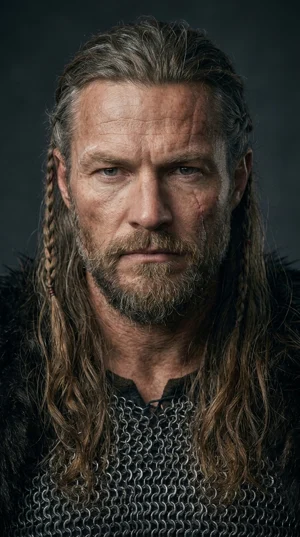
He opened it in his shirt, hair loose to his waist, a bone comb in his hand. Lamplight behind him. Neither of us said anything.
“I’m not paying you, Thorvald,” I said. “I’m asking. Ask me again if you like.”
What did you think?