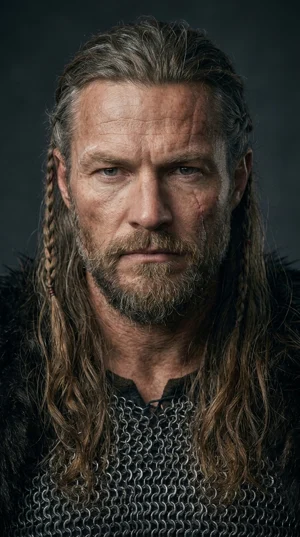
Thorvald
The king’s hall at York was too hot, too loud, and full of Danes.
I sat halfway down a bench with my twelve men, drinking the king’s mead, which was too sweet, and listening to jarls swear oaths for land they’d won by killing the men who used to farm it. I had sworn mine that morning: Eskwick and the coast from the burned abbey to the river, the moor behind as far as the old stone crosses. Oath given, oath taken, the whole of it written down by a Frankish priest who wrote faster than any man I’ve ever seen. Mine. I had never owned so much as a field.
I should have been glad. I kept thinking about her ale. The king’s mead tasted of honey and nothing else. Hers tasted of the moor in August, bitter and green underneath, as if she’d brewed the whole hillside. I kept thinking about her hair coming down. About the sound she made in the cove when I gave her back my hands. I am forty-four years old and I sat in a king’s hall counting the days to an alewife’s door like a boy.
Hroald found me that night.
He held the coast north of mine, beyond the river: a big red-faced Dane, a good fighter and a better farmer. He sat down beside me without asking and slung his arm round my shoulders.
“Thorvald Ketilsson,” he said. “Our land touches. Our ships will pass each other every week. We should be bound.”
I knew what was coming. I’d seen his daughter that morning, a tall fair woman of twenty or so, standing behind her father’s seat with her eyes on the floor.
“My Gyda,” Hroald said. “And forty hides of my best land along the river, as her portion. You’d be the richest man on this coast inside ten years. What do you say?”
I looked at her. She was still looking at the floor. I thought of my mother in the byre.
“Does she want it?” I said.
Hroald stared at me as if I’d spoken Irish.
“She’ll do as she’s told.”
“Then no.” I took his arm off my shoulders and gave it back to him. “I’m sorry, Hroald. I’ve chosen.”
“Chosen who?”
“A brewer. In Eskwick.”
He laughed so hard that men turned round on the benches. “An alewife? You’d turn down forty hides for an English alewife?”
“She hasn’t said yes yet,” I said. “I’m waiting for her answer.”
He stopped laughing and looked at me as though I’d gone mad. Perhaps I had.
Before dawn the next morning one of Orm’s men rode into York on a lathered horse and found me in the stable yard. He’d ridden all night. He gave me Orm’s message word for word, as Orm had made him learn it, and the message was what she’d heard on the cliff path.
All of them in one hall, drunk, with the doors shut.
I didn’t wait for the king’s leave. I left four men to make my excuses and rode for home with the rest, and we stopped for nothing but fresh horses. A king can be sorry later. She couldn’t.
Aldith
I went straight to Orm that night with the kelp still in my basket.
He heard it all with his one eye half closed, whittling the same stick he’d been whittling for a week. When I’d finished he put the knife down.
“I send a man to York tonight,” he said. “Now.”
“And the feast?”
“The feast.” He looked at the floor of the hall, the long benches, the doors at either end. “If I say no feast, Godric knows we know. And Ordric goes away and comes back another night when we are not ready.” He shook his head slowly. “Better we have the feast. Better we are ready. I double the watch. Every man who drinks, drinks only what you pour.”
It made sense. It frightened me half to death, but it made sense.
So for one more day I sat on my vats like a hen on eggs, and Orm’s men sat on me, and I slept in the brewhouse with my knife under my hand and woke at every owl.
He came home a day early, and Godric, who had set boys on the moor road to watch for him, had the feast called before his horse was through the village.
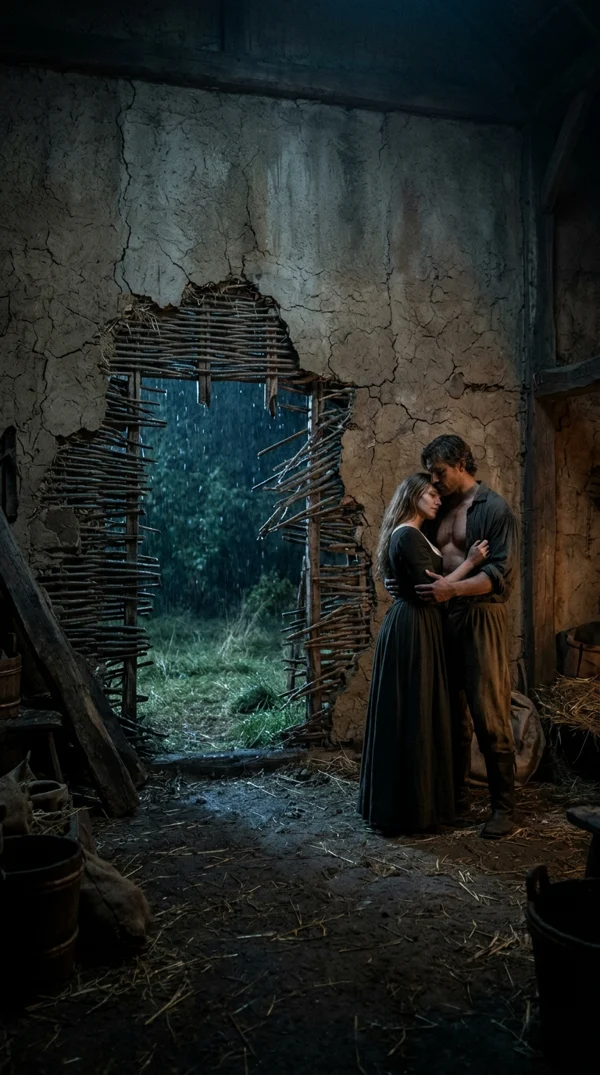
He didn’t come with the sun, the way kings do in songs. He came late in the afternoon, his horse lathered and blowing, mud to his knees, his hair half out of its braids. He didn’t go to his hall. He rode straight down the village to my door, swung off, and came in without knocking, and I didn’t mind.
“Are you hurt?” he said. “Is anyone hurt?”
“No. Not yet.”
He put his arms round me and held on, there in my brewhouse among the malt sacks. He smelled of horse and sweat and two days of road. I pressed my face into it.
“Hroald offered me his daughter,” he said into my hair. “And forty hides.”
I went stiff. “And?”
“And I told him I was waiting on an alewife.” He pulled back and looked at me, and his mouth did the thing it did instead of smiling. “He thinks I’ve lost my mind.”

 100 to start reading with.
What did you think?