Gildenhollow, chapter 2 of One Kiss to Kill the Dragon King
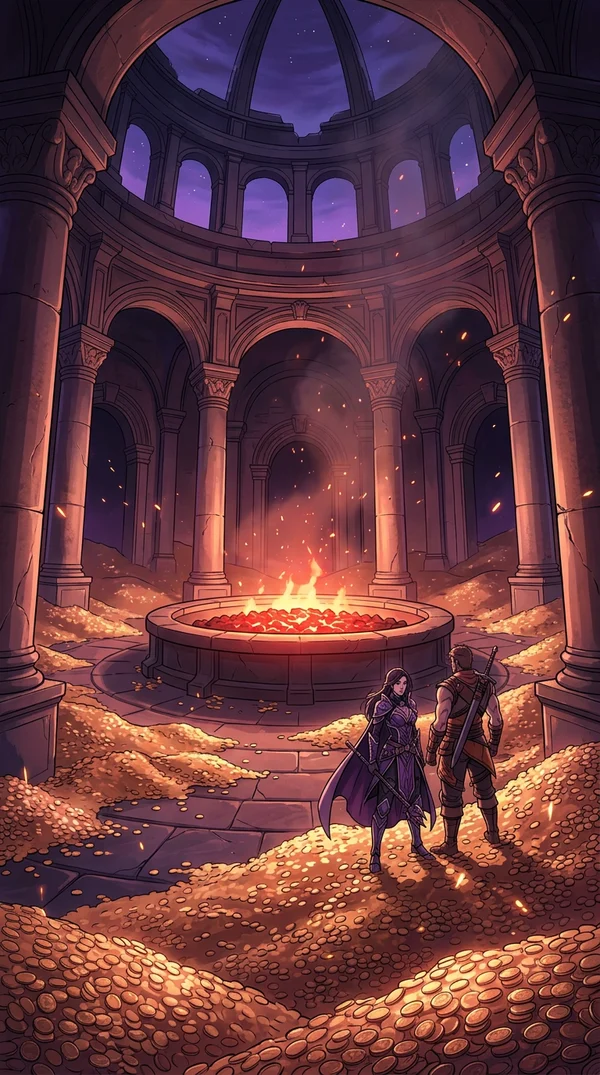
The dragon’s palace was inside the mountain, and the mountain was hollow, and the hollow was full of light.
I hadn’t expected light. In Orlen the stories put the dragon in a cave, on a bed of bones, with the gnawed crowns of seven-year brides rolling about underfoot. Nobody in Orlen had ever been inside. That, I would learn, was the point of the stories.
We came through a gate cut into the rock at the top of the Steps, down a passage warm as a bread oven, and out onto a gallery, and I stopped so suddenly that Dorrit walked into my back.
Gildenhollow went down. Floor after floor of carved galleries ringed a great open shaft, and at the top of the shaft, impossibly far above, there was a round of real sky, and down through it fell a column of afternoon sun that struck the bottom of the mountain and turned it into a garden. Trees. Actual trees, pears and figs and something with white flowers, and water running between them in stone channels, and people walking the paths as if it were nothing to have an orchard at the bottom of a mountain.
Everything else was gold. Not gilt; gold. The rails of the galleries, the lamps, the hinges of every door I could see. It caught the falling sun and threw it from floor to floor until the whole hollow hummed with it.
“Close your mouth, Princess,” said Ilka, going past me. “Something will fly in.”
The king had already walked on. He did not look back to see if I followed. That, I would also learn, was a kind of manners: in Gildenhollow you did not watch a guest as if she might steal something.
The court came out to look at me.
They lined the gallery outside the royal apartments, a hundred dragonkin in velvet and leather and silk, and they looked like people the way a knife looks like a spoon. There were scales at their throats and wrists, every color a fire can be. Only the king, Ilka told me later, could take the whole shape; the rest of them wore their dragon on the outside of their skin, a few scales’ worth, and were vain about it. Their pupils were slit. When they bowed, the heat came off them in a wave, and I smelled cloves and hot metal and perfume laid on to cover both.
They were watching the king’s eyes. I saw it after the third bow. Every one of them came up from the curtsy and looked straight past me to him, and then away, fast, and then at each other.
His eyes were still gold.
“The Hoardwarden,” said Ilka at my elbow, low. “Behave.”
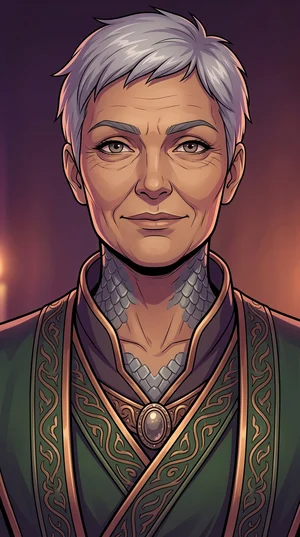
A woman came down the line toward us. She was the oldest dragonkin I had seen, though old for them meant a face of fifty, handsome and lined, with silver hair cut short as a man’s. She wore dark green and an iron ring of keys at her belt, heavy as a saddle. The scales at her throat were the color of old pewter.
“Your Highness.” She took both my hands. Hers were very warm. “I am Vesca, Hoardwarden of Gildenhollow. Anything you need, ask me. Anything you want, ask me twice, and I’ll see what can be done about the king.” She smiled, and there was real warmth in it, and honey, and keys clinking. “We’ve been so looking forward to you.”
“Have you?” I said. “In Orlen they told me you’d be looking forward to me with gravy.”
There was a breath of silence. Then Vesca laughed, a full, delighted sound, and the court laughed with her, and a little of the tightness went out of the gallery.
Behind me the king said, dry as a cinder, “She’s like that.”
“Then she’ll do beautifully,” said Vesca. She turned my hands over in hers like a pair of gloves she was pricing. Her thumb paused on the inside of my right wrist, where the skin was thin. “Such small hands. Rest, Highness. We feast you tonight.”
My rooms were bigger than the dye-house where I had grown up, and warmer than anywhere I had been in my life. The bed had a canopy of copper silk. The window was a door, and the door opened onto a balcony hung over the shaft, so that I could stand in the falling sun with the orchard nine floors below me and nothing but a gold rail between me and it.
Dorrit closed the door, put her back to it and said, “What did he mean?”
“Which part?”
“Don’t.” She came across the room fast, and the bone-handled knife was in her hand, not raised, just held, like a pen she wasn’t writing with yet. “He knows you’re not her.”
“He knows I’m not her. He doesn’t care. He needs a bride for his court and I’m the one who climbed the steps.” I sat on the edge of the copper bed because my legs had opinions about the eleven hundred steps. “He’s offering me exactly what Grennet wants. Seven nights and a Rite. He’s going to stand in front of his whole court and let me get close enough.”
“He’s going to stand in front of his whole court and not kiss you.”
“He’ll have to,” I said, with more confidence than I had. “It’s the Rite. There’s a custom. Kings like customs, Dor. They’re like rules that flatter you.”
She looked at me for a while. Then she put the knife away.
“Tonight,” she said. “Before the feast. Morning and night, Neve. Don’t make me hold your nose.”
The feast was in a long hall with a ceiling of living rock and a table of a single slab of something black and glossy that rang like a bell when you set a cup on it. I sat at the king’s right hand. Vesca sat at his left. The court filled the benches below us, two hundred bright, hot, watching faces.
I tasted everything.
I couldn’t help it. Eighteen years of habit don’t stay in the dye-house. The bread was rye with caraway, and the baker had been in a hurry. The venison had been hung four days and was a day short. The sauce on the trout was sorrel and cream and very good, and whoever had made it had been laughing. There was no ashlily in any of it. I checked the wine twice. Clean, a red from the far side of the mountain, rough and young and honest.
“You eat like a spy,” the king said, low, without looking at me.
“I eat like a woman who’s climbed a thousand steps.”
“Eleven hundred and six.”
I put down my fork. “You count them?”
“I built them.” He drank. “Badly, I’m told.”
“By everyone with knees.”
That got me the beginnings of the smile again, there and gone. Below us I saw a dozen dragonkin notice it, and lean together, and whisper.
“They’re watching you,” I said.
“They’re always watching me. Tonight they’re watching you watching me. Lean on my arm and laugh at something.”
“You haven’t said anything funny.”
“Then I’ll say something true and you can decide.” He tilted his head toward me. His voice dropped so low it was mostly heat. “You’ve checked every dish on this table for poison, and you’re good at it, and you’re annoyed that you didn’t find any.”
I laughed, bright and false and charming, and leaned on his arm. It was hard as the black table, and hot, so hot through the velvet that I nearly took my hand back.
Below us, two hundred dragonkin looked at his eyes, and they were gold, and whatever that meant made a sound go round the hall like wind through a wheat field.
Vesca, on his other side, lifted her cup to me and smiled.
After the feast, when the king had gone wherever kings go, I went looking for the kitchens.
I told Dorrit I wanted to thank the cook. That was true. The other truth was that a kitchen is where a household keeps the things it doesn’t say at table, and I wanted to know what this one tasted like underneath.
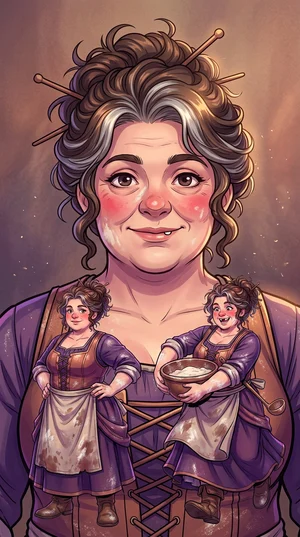
I found it by smell: three floors down, through an arch, a cavern of copper pots and bread ovens and steam. Dragonkin scullions ran about with trays. And in the middle of it, with her sleeves rolled to the elbow and flour to the wrist, a woman of about forty was shouting at a pan of sorrel sauce as if it had insulted her mother.
She was human. Round-faced, red-cheeked, with gray coming in at the temples and an Orlen accent you could have spread on toast.
“Who let you in?” she said, not looking up. “Out, unless you can whisk.”
“I can whisk.”
“Then whisk.” She shoved a bowl at me. I whisked. She looked at me then, properly, and her hands went still in the flour.
“Oh,” she said. “Oh, love. They sent you.”
“I’m Amarante.”
“You are not, and I’m not a spoon. I was presented to Princess Amarante when she was two, and she sicked up on my shoulder.” She wiped her hands on her apron. “Magdalen, Lady of Orlen. Fourteen years ago that was me in the pearls, coming up those blessed steps thinking I’d be dinner.” She grinned. Two teeth were missing at the side. “Turned out I was cooking it. Mags, to everyone here. Keep whisking, you’ll split it.”
The bowl had gone still in my hands.
“You’re alive,” I said, stupidly.
“Last I checked.”
“The others?”
“Brightwater, mostly. Far side of the mountain. There’s a town there now. He gives you a year here, then gold and a choice. Ottilie, she came seven years back, she’s got a vineyard. Makes that red you were sniffing at tonight like it owed you money.” Mags took the bowl from me, looked at the sauce and nodded. “You did all right. You’ll do.”
“Why doesn’t anyone in Orlen know?”
The kitchen noise went on around us, clatter and steam and a scullion singing, and Mags didn’t answer that. She just looked at me, and something in her round face closed, like a pantry door.
“Go to bed, love,” she said. “Ask him. Not me.”
Dorrit was waiting in my rooms with the spoon. Night dose. Burnt honey. I swallowed it smiling and went to bed in the copper silk, and lay a long time listening to the mountain breathe, and thinking about a woman with two missing teeth who had been dinner fourteen years ago.
I didn’t sleep well. At dawn I went out onto the balcony in my shift, to watch the sun find the top of the shaft and pour itself down.
Someone was already there.
Vesca stood at the rail, keys at her belt, looking down at the orchard. She must have come through the gallery door; there was no other way. She didn’t turn.
“You tasted every dish last night,” she said. “The trout, the venison, the rye. Your tongue went to the wine twice. I’ve only ever seen one kind of woman do that, Highness, and it isn’t a princess.”
The stone was cold under my bare feet. I said nothing. Stopping is a confession; so is talking.
“Don’t be frightened.” Vesca turned and smiled, and it was the same warm, honeyed smile from the gallery, and that was the worst thing about it. “I know what you are, little taster. I know what you carry, and where, and when you mean to give it to him.” She touched my cheek with one hot finger. “Your Lord Grennet and I have an understanding.”
She walked past me, keys chiming softly, and went in through my bedroom as if it were hers. In a sense, I suppose, it was. She kept every key in the mountain.
I stood at the rail with the orchard nine floors below and the first sun coming down the shaft like a slow gold fall.
Yesterday I had come up the mountain to kill a monster alone. This morning I had an ally inside his walls who wanted him dead as much as I did.
And I had never in my life been so frightened of anyone.

What did you think?