He came to my door after midnight. Not the balcony. The door.
I knew it was him before I opened it. I’d been lying awake in the copper silk with a cup of ashlily sitting in my stomach, thinking about who in that hall had the keys to the king’s wine, and the knock came low on the wood, as if whoever knocked was leaning on it.
He was. When I opened the door he nearly fell through it.
“Sorry,” he said. “Wrong room.”
“It’s my room.”
“Yes. That’s why it’s wrong.”
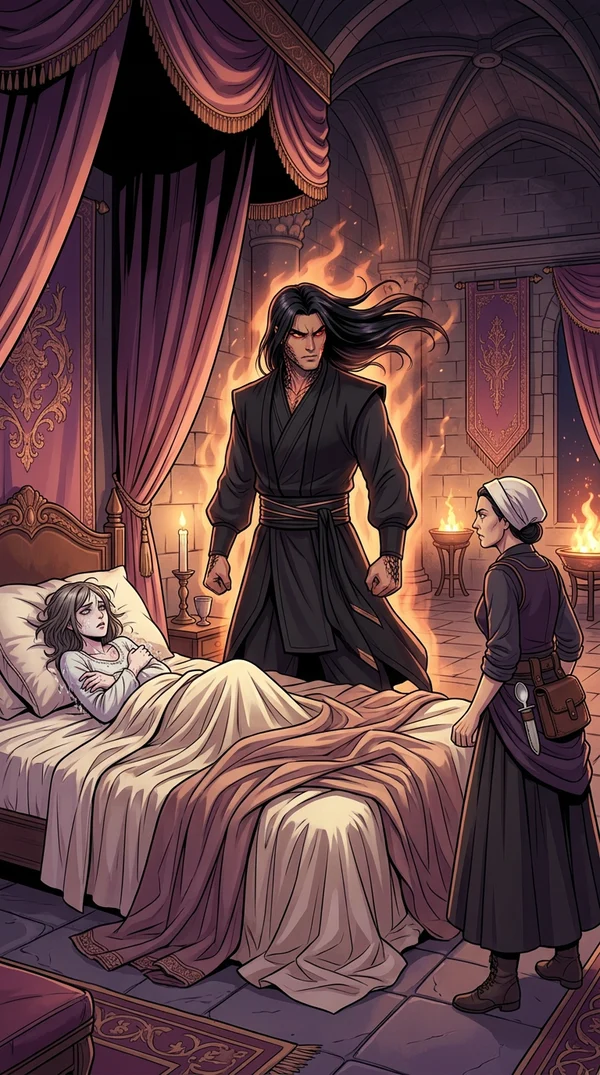
He was in his shirt, no coat, barefoot. The scales were up on his throat and they had spread: down under his collar, along his jaw to the ear, over the backs of both hands, copper and black and gleaming wet. Heat came off him like a forge. His eyes were gold, but the gold had gone strange and swimming, the pupils shrinking to slits and then blowing wide and then shrinking again.
I took his arm. It burned my palm, and I held on anyway, and I pulled him inside and shut the door.
“You shouldn’t,” he said. “I’m not, it’s not safe, when it’s like this I’m not always…” He lost the end of the sentence. I watched him reach for it and not find it, and shut his eyes.
“Sit down,” I said.
He sat on the floor, because it was closest. I knelt in front of him. I had nursed tasters through the clean-fever since I was ten; I knew what a body looked like when it was fighting something it had swallowed. The sweat. The shaking. The way the eyes slid. Ashlily does the same thing to a dragon as to a girl, only faster, and bigger, and with more teeth.
“Look at me,” I said. “Theron. Look at me.”
It was the first time I’d said his name. It stopped him. His eyes came to my face and held there, and the pupils steadied.
“There,” I said. “Stay there.”
I soaked a cloth in the washbasin and wrung it and put it on the back of his neck. It hissed. Steam came off it. He let out a breath that was half a groan and leaned his head back against the end of the bed, and I wet the cloth again and laid it on his throat, over the scales, and they hissed too, and very slowly, under the cool, some of them began to sink.
“You’ve done this before,” he said, with his eyes shut.
“Hundreds of times.”
“Not for dragons.”
“No. You’re bigger. Same idea.” I wrung the cloth. “Talk to me. Keep your words. What’s the river at the bottom of Brightwater called?”
“The Wend.”
“What does Ottilie put in her red?”
“Too much oak.” The corner of his mouth moved. “Don’t tell her.”
“What’s my name?”
He opened his eyes. They were still gold, but clear now, and fixed on me, close. “Neve,” he said. “Neve of Thornby. Who drank my wine.”
“Good. What did you have for supper?”
“Nothing. I watched you eat. You moved the venison around and ate all the bread and half of mine.” The corner of his mouth went up. “You hum when something’s good. Very quietly. I don’t think you know.”
“I do not hum.”
“The pear tart, at the first feast. You hummed two bars of something from the river towns. I had to drink half a cup to keep my face straight.”
I wrung the cloth out harder than it needed. “You’re delirious.”
“Probably,” he agreed, and leaned his head back, and for a while neither of us said anything at all, and the only sound was the hiss of the cloth on his skin and the drip of the water back into the basin, and it was, heaven help me, the most peaceful I had felt since I was six years old: kneeling on a floor beside a poisoned dragon.
Then he said, without opening his eyes, “Neve.”
I kept wringing the cloth.
“Why did you drink my wine?” he said.
There’s a thing tasters learn early. When a lie won’t hold, give them a truth. A small one, true all the way through, that will sit in the mouth heavy enough that nobody looks for the rest.
“I’m a taster,” I said. “I’m not a princess. I’m not a lady. I’m a bound taster of the Queen of Orlen. I’ve eaten her food before her since I was six years old.”
He didn’t look surprised. He looked like a man listening very hard.
“There was ashlily in your wine,” I said. “Dragonbane. It’s the court poison in Orlen; we’re raised on it so we can find it. It tastes of burnt honey, if you know it. Not much. A little. The kind of little you’d put in every cup for years if you wanted someone to die slowly and have it look like something else.”
The room was quiet. The cloth on his throat had stopped steaming.
“Fevers,” I said. “Getting worse every season. Losing words. The scales. Three years of it, Vesca says. Your court thinks it’s the long dark. It isn’t. It’s somebody with a key to your cellar.”
He shut his eyes again. For a moment I thought the fever had him. Then I saw his jaw, and understood it was something else, something that had been held in a fist for three years and was only now being allowed to open.

 100 to start reading with.

What did you think?