Itinerary, chapter 2 of Please Don't Condemn the Sky
“It’s an uncalibrated toy,” I said.
“It’s calibrated against the Charter Office standard,” said Bastian Reyne, “and the Cinder Deep standard, and the Kestrel Yards standard, which is the strictest in the Reach. Three times. Before I left.”
“Then the Ring is very slimming. I’ll tell my brides. They’ll be thrilled.”
He didn’t laugh. I hadn’t really expected him to. It was a quarter past five in the morning, Turning 222, and I was standing on the step of the guest cottage the Steward’s office keeps in Landing, holding two cups of coffee and a folder, and he had answered the door already dressed, coat buttoned, as if he slept like that, standing up in a cupboard.
I handed him a coffee. I handed him the folder.
“Your itinerary,” I said. “I did it last night.”
He opened it under the porch lamp and read it. I’d done it in my wedding format without thinking, because that’s the format my hands know: cream card, the Ring’s little sunburst at the top, each day a column with times down the side. Day Two. 5:40, sunrise at the Veils. 9:00, the Steward’s office, records. 12:30, lunch among the Founders’ Blush peaches, Asante Orchard. 18:10, sunset from Bride’s Island. There were little drawings. I couldn’t help the drawings.
He turned the page. He turned it back.
“This is a honeymoon,” he said.
“It’s a tour.”
“Sunrise at a waterfall. Lunch under fruit trees. Sunset on an island. There’s a line here that says walk along the shore, no hurry.”
“People like the shore.”
“Who,” said Bastian, “is the other person?”
“There isn’t another person. There’s you.”
“Then it’s a honeymoon for one, which is worse.” He took out his notebook. “Finding Three.”
“What happened to Two?”
“Two is for after I’ve seen the Steward’s records. I’m told I’ll have one.” He wrote, briefly, and I read it upside down: Finding Three: the liaison has planned the inspection as a honeymoon. Then he closed the notebook and drank half his coffee in one go and looked at me over the cup with those flat grey eyes. “Thank you for the coffee. It’s very good. I’ll still need to see the Underneath.”
“Of course,” I said. “It’s on the list.”
It was not on the list.
The Veils fall from the Fore Wall into the far end of the Overmere, nine ribbons of white water dropping two hundred meters out of the old rock, and because the Ring turns underneath them as they fall, they drift sideways on the way down and land a little to the left of where they started, like a veil caught by a breeze that isn’t there. At sunrise in Turning they go amber. Couples weep. I’ve seen a best man weep.
Bastian looked at the base of them, where they hit the lake, the whole time. He didn’t look up once. I thought he was being difficult.
At nine the Steward gave him the records himself, in a box tied with a ribbon. I’d tied the ribbon. The Steward was charm itself: pressure logs, gravity logs, the Weatherworks’ readings since the storm, every one of them neat, every one of them saying exactly what the boards said. Bastian went through them at the Steward’s table for an hour while the Steward and I talked about the Fair. When he was done, he squared the pages, retied my ribbon, rather well, and wrote something down. I didn’t see it. He’d learned to tilt the notebook.
“Everything in order?” asked the Steward.
“Everything agrees with everything,” said Bastian. “Remarkable.”
He said remarkable the way other people say drains.
My parents fell in love with him over lunch, which I should have expected and didn’t.
The Asante Orchard climbs the slope round the foot of Stem Two in long green terraces, and in Turning the Founders’ Blush peaches hang so heavy that we prop the branches with forked sticks. My mother put him at the end of the table under the oldest tree, where the shade is deepest, and I noticed that he sat down quickly, and that under the leaves, with branches over his head, his shoulders came down from round his ears for the first time since the dock.
My father asked him what an assessor actually did, and he told us, because he loves explaining it. You could see it. He put down his fork and laid it out on the tablecloth with the salt and the pepper and a peach stone.
“A habitat is chartered to stay safe for the people who live in it,” he said. “The Charter Code sets the lines. For a spinning habitat the first line is weight. Below nine tenths of one weight, bones thin, water won’t drain where it’s meant to, the machines aren’t built for it. A Ring under ninety hundredths is condemned. Everyone leaves.”
“Everyone,” said my mother.
“Everyone. There’s one exception. Section 9. If the habitat has a credible plan to restore its weight, the assessor can hold off condemnation until the first day that plan could work. Never more than a hundred and twenty days. And he can set a stricter line for the window, if he thinks the margin’s too thin.” He moved the peach stone. “My report’s due the morning after your Fair. Turning 234.”
“And what will it say?” asked my father.
“What’s true,” said Bastian. He picked up his fork again. “These are the best peaches I’ve ever eaten.”
My mother put three more on his plate. My father told him the story of the Founders’ Blush, how Ondine Ferrow herself carried the first stone up from the expedition’s seed vault in her pocket, which my father tells everyone and nobody minds. I told him about the Hundred-Couple Wedding, because it was my turn, and I heard my own voice go up a note the way it does.
“A hundred couples,” I said. “On Bride’s Island, at the Turning Fair, with the whole Long Meadow watching from across the sky. A hundred couples and a hundred guests. After the storm, every feed in the Reach said the Ring Gardens were a place where weddings drown. This is the answer. Two hundred people saying yes at once.”
“And a hundred people watching them.”
“And twelve thousand people watching from the Meadow. Upside down, from their point of view. It’ll be the most beautiful thing anyone’s ever seen.”
He looked at me for a while across the table, under the peach leaves. Then he said, “I believe you,” and I didn’t know what to do with that, so I passed him the salt.
I saw Isla and Rook coming along the Overmere shore at half past two and knew exactly what they wanted.
You can see the pair of them from a long way off. Isla Marlowe walks like someone forecasting the next ten minutes and Rook Adair walks like a tree that’s decided to go somewhere. They’d been engaged since Bloom 140 and they were, I say this with love, unbearable: they finished each other’s arguments. Isla was still Senior Rainwright on paper and suspended in practice, with six thousand names on Tully’s petition and the Almanac still printing her name in a couplet and her charter hearing put off until after the assessor, and Rook had planted one of the Grandmother’s seedlings beside her stump, and since the storm they’d both been trying to get the Charter Office to listen to them about the spring. I’d heard Isla say it at the Gate: I just need ten minutes with the assessor. Alone.
The spring was precisely what I was not putting in front of him.
“Del!” called Isla. “Is that him?”
“Assessor Reyne,” I said, “would you like to meet a goat?”
He looked at me. He looked at the two of them coming. He looked at the goat, which had followed us down from the orchard because it follows anyone carrying paper. My father named it Councillor, for its appetite for documents.
“Not especially,” said Bastian.
“He’s very historic,” I said, and steered him by the elbow up the path toward the terraces, talking about Councillor’s grandmother, who once ate a marriage license in the middle of a ceremony and had to be counted as a witness.
Behind us Rook said, quite loudly, “She’s doing it again.”
“Mr. Reyne!” Isla called. “I’m the Senior Rainwright. I’d really like a word—”
“Tomorrow!” I called back over my shoulder. “He’s fully booked! Put it in writing! Rook loves writing things!”
Rook threw an apple after us. I don’t think he meant it unkindly. It’s his party trick: on the Ring a thrown thing curves, because the floor turns under it while it’s in the air, and Rook can throw an apple so it bends round and comes back to the left. This one swung in a long lazy arc across the path, missed Bastian’s ear by a hand, and dropped into Councillor’s mouth. Councillor was delighted.
Bastian watched the apple’s path the whole way, head turning, with an expression I hadn’t seen on him yet. It was interest. Pure and bright, the way a child looks at a magic trick.
“Coriolis,” he said. “Anything dropped from height lands antispinward. Rain must fall on a slant.”
“It does. Isla writes the slant into it.”
“Then I’d like to talk to Isla.”
“Tomorrow,” I said, and kept walking.
We came down to the shore at sunset after all, because I’d promised him the island and he’d said no, not today, and the shore was the compromise.
He walked along the water looking at his boots.
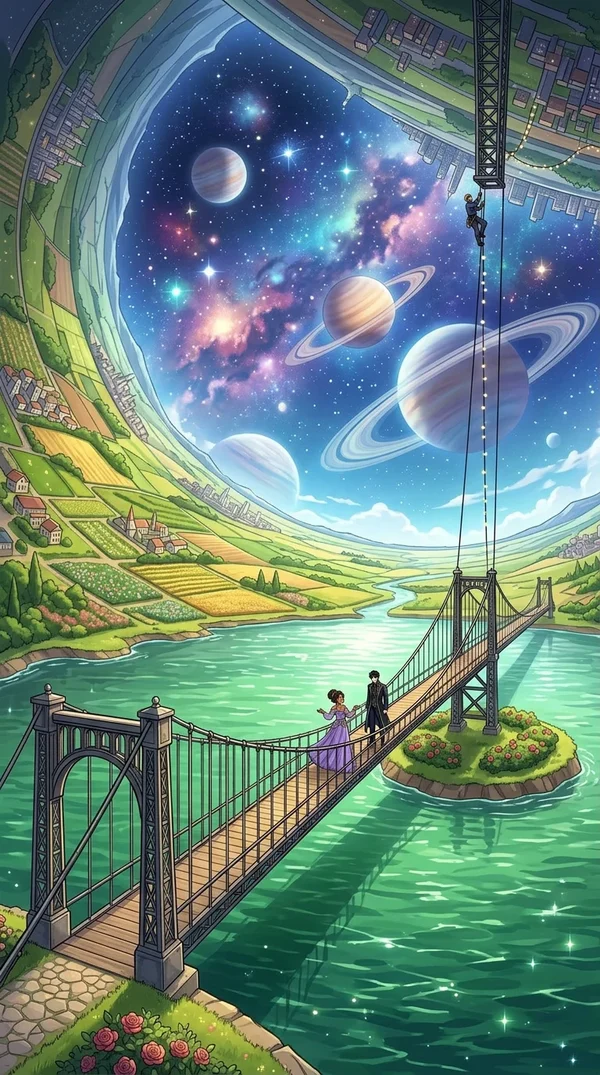
I’d half noticed it all day. Now, at the end of it, I couldn’t stop noticing. The Overmere lies along the floor here, and the far side of the Ring rises up off the other shore and keeps going, up and over, the whole sky full of fields and roofs and the amber light coming off the Lamp. People come from all over the Reach to see it. He walked through it with his chin on his chest and his hands in his pockets, as if it were raining on him.
“You don’t like it,” I said.
“I like it fine.”
“You haven’t looked up since the dock. Not at the Veils. Not at lunch. I’ve watched you.”
“That’s your job,” he said. “Watching me.”
It stung, a little, because it was true. I let it sting. Then I said what I say to brides.
“Don’t look at all of it. Nobody can look at all of it. When a bride gets to the end of the aisle and turns round and sees three hundred people, I tell her: don’t look at the room. Look at one flower. Just one, in the arch. Then, when you’re ready, one more.” I pointed. There was a clump of late asters at the waterline, purple, a little ragged. “That one.”
He stopped. He looked at the aster for a long breath. Then, carefully, as if lifting something heavy, he moved his eyes to the next one, a little higher up the bank. Then a rosebush. Then the roofline of a boathouse.
He got as far as the top of the boathouse, where the land starts to curve up into sky, and stopped, and breathed, and looked down at me instead.
“Where I grew up,” he said, “the sky is rock. Thirty meters of it, everywhere you go. I’ve never lived anywhere you could fall up.”
“You can’t fall up.”
“My stomach disagrees.”
“Your stomach,” I said, “is welcome at any of my weddings.”
The corner of his mouth moved. It wasn’t a smile. It was the place where a smile would go if he ever planned one.
“Ms. Asante,” he said. “Tomorrow I’d like to see the Underneath. The pumps, the cisterns, the Spinner galleries. All of it.”
I thought of my father’s signature upside down on the Steward’s desk. I thought of my mother putting peaches on his plate.
“Of course,” I said, and that night in my studio, I opened his itinerary and wrote the Underneath in, in my good handwriting, on Turning 234, the morning after the wedding. Then I filled tomorrow with the Ribbon Bridge.

What did you think?