Smudge Pots, chapter 6 of Please Don't Condemn the Sky
He started where the cold was. Of course he did.
“Cold air runs downhill,” he said, crouched at the edge of the lowest terrace with his hand flat on the grass, as if feeling for a pulse. “Like water. It’ll pool in the bottom rows first and fill up from there. You’ve got your pots spread evenly from top to bottom. Move half the top ones down here.”
“My father always spreads them evenly.”
“Your father,” said Bastian, “has never had a frost in Turning.”
My father, who had come down to see what the assessor was doing in his orchard, looked at the grass and at the slope and at Bastian’s flapping boots, and said, “He’s right,” and went to get the cart.
My parents adored him from that moment. I watched it happen. He counted the pots, all five hundred and twelve, walking every row with Isla’s map and his pencil. He timed the old frost fan on the middle terrace with his watch and worked out how far its draft reached, and told my father where to angle it so it pulled the warmer air from above the trees down into the low rows instead of blowing it off into Sweetwater. He lit pots. He carried oil. He did not stop, not once, for the next ten hours, and he did it in boots two sizes too big that came off in the mud every twenty minutes, so that half the volunteers on the Asante terraces spent the night handing a Charter Office assessor his own footwear.
My mother brought him tea in a jam jar at ten and called him dear. I heard her ask him, by the fan, whether his own mother knew where he was tonight.
“She knows I’m on a garden habitat,” he said. “She writes every week to ask if I’ve seen a real sky yet.”
“And what do you tell her?”
“That I’m working on it.”
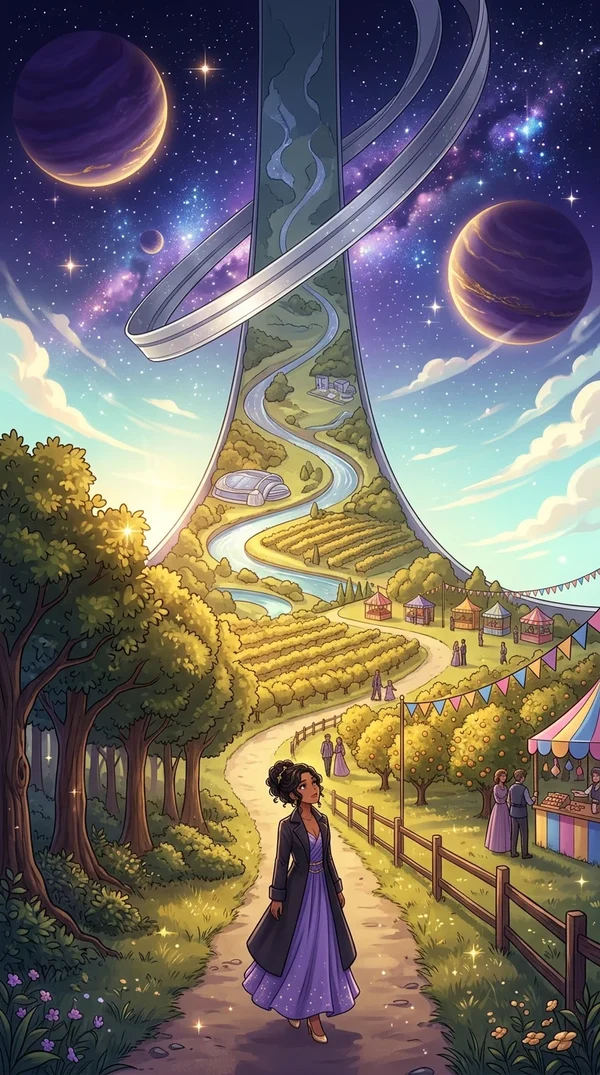
My mother patted his cheek with a sooty glove and told him he’d come back for the picking, which was not a question, and he said, “Yes, Mrs. Asante,” which I don’t think was a decision either. My father showed him the original Founders’ Blush, the tree in the corner of the top terrace that Ondine Ferrow grew from the stone in her pocket, and Bastian put his palm on its bark the way he’d put it on the bridge tower, and stood there a while.
Isla and Rook ran the top rows. At midnight, when I went up with a can, Isla caught my sleeve.
“Del. I need ten minutes with him. Tonight. It’s important.”
“After the frost,” I said. “Please, Isla. Look at it.”
She looked at the trees, and at my face, and let go. “After the frost,” she said. “Swear it.”
I swore it. I meant it, too, for the first time. I just didn’t know yet what I was promising.
By two in the morning the frost had come.
It came out of the grass first. One minute the bottom terrace was dark and wet and the next it was furred white, every blade, glittering in the pot light like sugar on a cake board. It climbed the trunks. It crept along the low branches toward the fruit. We fought it a meter at a time: light another pot, move another pot, top up the oil, stand by the fan. My hands stopped working properly at three. I couldn’t feel my feet. I didn’t care.
And there was the smoke.
Five hundred and twelve smudge pots make a great deal of smoke. It rose off the terraces in thick dark columns and spread out over the top of the trees and hung there, a low black ceiling that the pot light lit from below, orange and soft. It hid the Stem. It hid the lake. It hid the whole far side of the Ring, the fields and roofs and the amber curve of the world. For the first time in my life I stood in my parents’ orchard and couldn’t see the sky.
Bastian stood under it and looked up.
I was beside him, filling the pot in the lowest row, and I saw him do it, and stopped. He tipped his head back slowly. All the way. His eyes went over the black smoke and the orange light on the underside of it, and his face, which had been white and set since dusk, came apart.
“Oh,” he said quietly.
“Are you all right?”
“It’s a ceiling.” He laughed, low and astonished, the first time I’d ever heard it. “It’s the first night here I’ve felt like I’m indoors.”
I put down the oil can.
“That,” I said, “is the most romantic thing anyone has ever said to me.”
He looked down at me. There was soot on his cheek and frost in his eyebrows and his coat was ruined. “Is it?”
“I plan nine hundred weddings. You’d be amazed what people say to each other. Nobody’s ever told me they felt indoors.”
“I’m sorry,” he said. “I’ll try to do better.”
“Don’t you dare.”
At four in the morning the cold was at its worst, and so was I.
The lowest row is the coldest place in the orchard, right down against the lane wall where the air sits like water in a jug. There were twelve pots on it and I’d been tending them since midnight. I’d stopped being able to feel the can. I was crouched by the last pot with my hands nearly in the flames, shaking so hard my teeth clicked, and there was frost on my eyelashes; I could see it, little white sparks at the edge of everything when I blinked.
He came down the row with an armful of fresh oil cans and saw me and put them all down in the grass at once.
“Your hands.”
“They’re fine.”
“Del.”
He knelt in the frost in front of me, by the pot, and took my hands in his, both of them, and held them together between his palms, and breathed on them. Once. Twice. Warm. I felt it go into my fingers like light coming back into a room.
He looked up from my hands to my face.
It’s very quiet at the bottom of an orchard at four in the morning, with the pots breathing and the fan turning slow up the slope and the smoke making a roof over everything. You can hear the fruit hanging. I could hear his breath, and mine, and the frost cracking very faintly under his knees.
I’ve watched nine hundred and four first kisses at the ends of aisles. I’ve timed them. I know exactly how long the pause is before, when two people look at each other and decide. It’s about as long as a bride’s walk from the last row of chairs to the arch. I’ve never once been on the inside of it.
He looked at me with frost in his eyebrows and soot on his face. I looked at him. Neither of us had planned any of it.
He kissed me. Or I kissed him. I’ve gone over it, and I honestly couldn’t tell you, which has never been true of any kiss I’ve ever seen. His mouth was warm and tasted of smoke and my mother’s tea, and his hands were still round mine, holding them against his chest, where I could feel his heart going quite as fast as my own, and the smoke hung over us like a canopy over a bed, and for the first time in nine years I wasn’t counting anything.
When we stopped, he didn’t let go of my hands.
“Finding Nine,” he said, a little unsteadily.
“What was Eight?”
“The pendulum. Yours.” He pressed his forehead against mine. “I’ll think of a number for this later.”
At six the Lamp came up through the smoke, brown and gold, and the frost went off the grass in a long white sigh, and we walked the rows with my parents to see what we’d saved.
Most of it. The bottom row was lost, the twelve trees by the lane wall, their peaches gone brown and soft on the branches. Two more on the second terrace. My father stood under the lane-wall trees with his hands in his pockets for a minute and then said, “Well. The rest of them.” My mother cried, but only a little, and mostly at Bastian, whom she hugged until his ruined coat creaked.
The volunteers went home in twos and threes, sooty and laughing. Isla and Rook were coming down the slope toward us, and Isla had her mouth set the way it gets before a storm, and I remembered my promise, and something cold went through me that had nothing to do with the frost.
Bastian and I were at the bottom of the lowest terrace, beside the dead trees. He was rubbing soot off his hands with a rag. He wasn’t looking at me. He was looking at the ground.
“I’m going into the Underneath today,” he said. “I’m not asking permission. I’ve been here five days and I’ve seen every flower on the Ring and the readings don’t lie and the boards do, and somewhere under this floor is the reason. I’ll go in at Coldharbor through the Drop. I’ll tell the Steward when I’m already there.” He looked up. “I’d like you to come. If you want.”
And there it was. There was the moment.
I had a save. I could feel it, ready, the way I can always feel one. I could say yes, of course, and go with him, and help him, and he’d never need to know anything about the tea in the Steward’s office on the first morning, or the loan papers on the desk, or my report every evening, or what I’d said yesterday under the pergola that wasn’t no. It would be a good save. It would even be a kind one. I would make it beautiful, and nobody would have to look at the crack.
Isla and Rook were twenty meters away.
“The Steward asked me to keep you away from the machinery,” I said.
He went still.
“On the first morning, before you landed. If I kept you in the gardens and out of the Underneath until the Fair, the bank would forgive my parents’ loan. That’s why there was an itinerary. That’s why I kept you away from Isla. That’s why the Underneath is booked for the morning after your report’s due. Yesterday I went to him about the stars and he said it was a small drift and he was fixing it, and asked me for nine more good days.” I made myself keep looking at him. “I didn’t say no.”
That was all. No flowers. No plan. No joke. It was the ugliest thing I’ve ever said, and I said it beside twelve dead peach trees, with soot on my face.
He didn’t say anything for a while. Behind him the smoke was thinning off the terraces, and the sky was coming back through it in pieces, amber and blue, the far side of the Ring hanging over us again with nothing in between.
“Thank you for telling me,” he said.
He said it at the volume you’d use to ask someone to pass the bread. Then he took out his notebook, and wrote one line in it, and closed it, and put it in his pocket.
And then he turned and walked away from me up the terrace, between my parents’ trees, in the borrowed boots, under the open sky he couldn’t look at, and he didn’t look back once.

What did you think?