Page Two, chapter 1 of Pregnant With the Wrong Billionaire's Baby
My husband didn’t come into the transfer room. He stood in the clinic hallway with his car keys in his hand and told me, in the voice he used for tradesmen, that Kelsey was eleven weeks along and he wasn’t going to waste any more money on me.
Eleven weeks. I knew exactly where I’d been eleven weeks ago: on my kitchen floor after our third round failed, while Mark worked late.
“You can keep the house,” he said, as if he were giving me something. “Just sign what my lawyer sends.”
Then he left, and a nurse named Dolores came out with my paper gown folded over her arm and asked if I wanted to go home.
I was thirty-nine. I had a flower shop on Clark Street, a mortgage, and a slot on the clinic’s calendar I’d waited four months for. The year before, as a backup Mark called morbid, I’d chosen a donor.
“No,” I said. “I want to go in.”
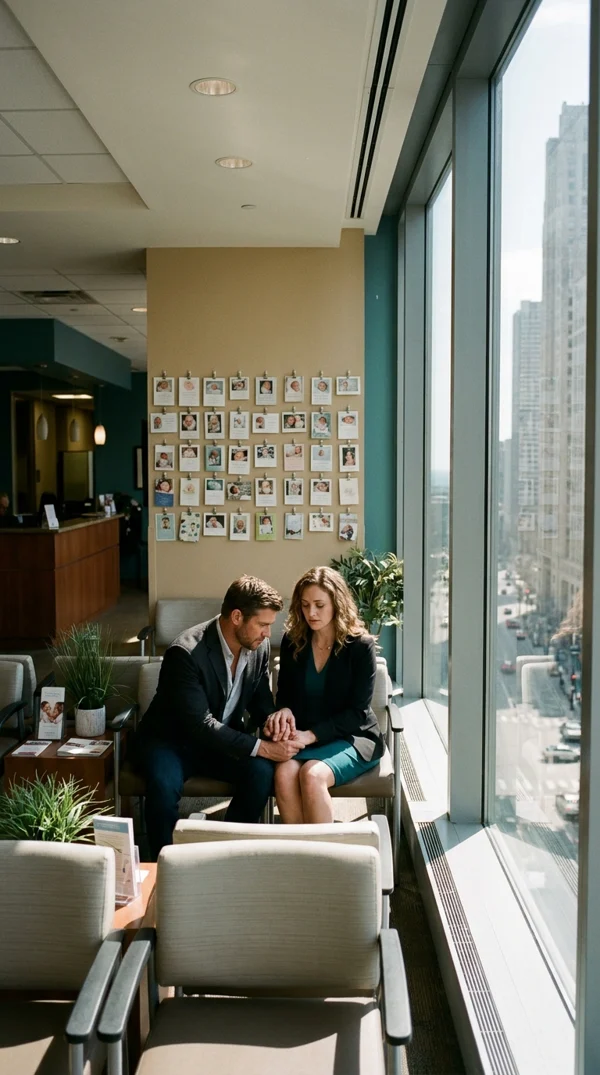
I did it alone. I held Dolores’s hand and stared at a water stain on the ceiling shaped like Lake Michigan, and I didn’t cry until I was in the car.
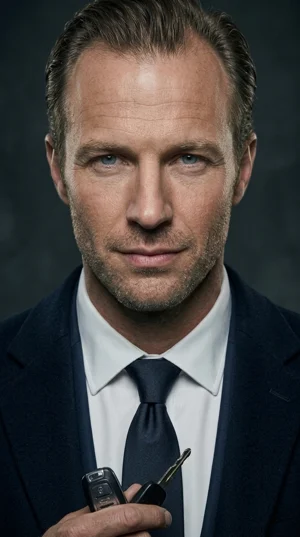
Seven weeks later, on a Tuesday, the bell over my shop door rang and a man walked in out of the sleet in a charcoal coat that cost more than my van. He didn’t look at the roses. He looked at me, then at my hands flat on the counter, then back up.
“Nell Dunmore,” he said. It wasn’t a question.
“We close at six.”
“I’ll be quick.” He set a folded letter on the counter, the clinic’s logo at the top. “My name is Callum Pierce. Eight years ago, before chemotherapy, I stored the only chance I’ll ever have at a child.”
He waited until I looked up.
“Your clinic gave it to you.”
I laughed. I want that on the record, because later I would be accused of a great many things by a great many lawyers, and not one of them ever said I’d taken it badly. I laughed the way you laugh when a customer asks whether the peonies are real.
“Okay,” I said. “Who sent you? Is this Luz? Is this a bit?”
He didn’t smile. He had the kind of face that had decided a long time ago that smiling was a negotiating position, and he wasn’t negotiating. Mid-forties. Gray at the temples and nowhere else, as if it had been told where it could go. Sleet melting on his shoulders. He unfolded the letter with two fingers and turned it so it faced me, and he did it slowly, the way you’d set a glass down in front of somebody whose hands were shaking.
Mine weren’t shaking. They were flat on the counter, where they’d been when he walked in, because I’d been about to sweep the stem ends into the bin and I’d forgotten how.
NORTHPOINT FERTILITY CENTER, it said, in the same soft teal as the folders they gave you, the folders with the smiling babies on the front that you learned not to look at. Dear Mr. Pierce. We are writing to inform you of a specimen handling incident. There was a paragraph about the center’s deep commitment to its patients. There was a paragraph about an internal review. There was a vial number, PRC-0417, and a date, July fourteenth, and the words was thawed in error and used in the treatment cycle of another patient.
July fourteenth was my retrieval. Round three. I had woken up from the sedation asking the nurse for a grilled cheese and been told I’d given them eleven eggs, which I took personally, as a compliment.
“No,” I said. “No. I picked my donor. I picked him for a year.”
I took my wallet out of my apron and found the card behind my driver’s license, where it had lived since the day Mark had looked at it over my shoulder and said Jesus, Nell, why don’t you just pick out a coffin while you’re at it. Donor 4171. Six foot one. Brown hair, hazel eyes. Graduate student in chemistry. Enjoys hiking and the cello. I had liked the cello. I had thought a man who played the cello would be patient.
I put the card on the counter next to the letter.
He looked at it without touching it. “Four one seven one,” he said. “Mine is oh four one seven. Your donor’s vial is still in their tank. They found it last month, when I asked for mine.”
“Why did you ask for yours?”
He was quiet for longer than I liked.
“I’m forty-five,” he said. “I’d decided to stop waiting for the right time.”
The radiator under the window knocked twice. Out on Clark Street a bus went by, throwing gray slush at the curb, and the light in the shop went orange and then white again. I had twelve dozen roses in the cooler for a funeral on Thursday and a wedding consult at nine and a mortgage payment due on the fifteenth, and none of it seemed to belong to me.
“How do you know my name?” I said.
“They told me.”
“They’re not allowed to tell you.”
“No.” He turned the letter over. There was a second page. Most of it was a table of dates and initials, the lab’s chain of custody, and in the middle of it, typed into a box where it had no business being, was Recipient: DUNMORE, ELEANOR K., and my date of birth, and my patient number. “Page two,” he said. “I don’t think anyone at Northpoint read page two.”
A stranger in a coat had known I was pregnant before my mother did.
That was the part that made me want to throw something. Not the vial number. Not the cello. My mother was in Tucson thinking I was getting divorced, which I was, and that I’d given up, which I hadn’t, and I’d been saving the news for Christmas the way you save the good wrapping paper. And a man I had never met had been reading about me on page two.
“I’m keeping it,” I said.
I said it before he could say anything else, because I’d seen enough men walk into rooms with folded papers to know that whoever spoke first set the price.
“I wanted this baby before I knew your name. I wanted it on the kitchen floor. I don’t care whose vial it was. I don’t care what you’ve stored or what you’re worth, and I don’t care what Northpoint’s lawyers want to call it. It’s mine, and it’s my decision, and I’ve made it.”
“I know,” he said.
“You don’t know anything about me.”
“I know you went in alone.” His eyes went to my left hand on the counter, where there was a pale band of skin and no ring, and came back. “It’s in the nurse’s notes. Also on page two.”
My stomach turned over. I thought for a second it was rage, and then I knew it wasn’t, because I had been nine weeks pregnant for five days now and I knew the difference. I said, “Excuse me,” with enormous dignity, and walked into the walk-in cooler and shut the door and was sick into a five-gallon bucket among the funeral roses.
When I came out, wiping my mouth with a paper towel, Luz was standing in the back doorway with the van keys in her hand and sleet in her hair, staring at him the way she stared at wholesale prices.
Luz Arredondo had been my head designer for nine years. She had been my father’s before that. She kept a list taped to the inside of the cooler door, in Sharpie, titled MEN WHO WILL BE SORRY, and Mark’s name had gone at the top of it on the thirteenth of October with three underlines.
“Who’s this?” she said.
“A customer,” I said. “He’s leaving.”
He took a card out of his coat and laid it on the counter beside the letter, beside my donor and my wallet and my ruined dignity. Plain white, a name, a number written on the back in black ink in a hand like an architect’s.
“I’m not here to take anything from you,” he said. “I want you to understand that. Whatever you’ve heard about men like me.”
“I haven’t heard anything about men like you. I sell flowers.”
Something in his face moved, and was put back.
“Then what do you want?” I said. “Mr. Pierce. Since you’ve come all this way out of the Gold Coast in the sleet.”
He buttoned his coat. He looked at the bucket of white roses by the register, and the stem ends on the counter, and my hands, and then at me, and when he spoke his voice was perfectly level and not quite steady underneath, like ice on the lake in December, holding.
“I want to hear its heartbeat,” he said. “You have a scan on Thursday. Eight-fifteen.”
“How do you know that?”
The bell rang over the door as he opened it, and the cold came in.
“It’s on page two.”

What did you think?