Rush, chapter 5 of Pregnant With the Wrong Billionaire's Baby
I didn’t answer him. Connie said not to.
“You don’t confirm, you don’t deny, you don’t send him a thumbs-up,” she said on the phone at seven the next morning, Christmas Eve, while I wired gilded pinecones onto a wreath for a dentist in Lincoln Square. “Anything you write to Mark Haskett, you’re writing to Doug Tarrant. Anything you write to Doug Tarrant, you’re writing to a judge.”
“What if he shows up?”
“Then you call me, and you call your billionaire, and you lock the door.”
“He’s not my billionaire.”
“Honey,” Connie said, “I saw that house. Somebody’s got to have him.”
Mark didn’t show up. After four texts on a Wednesday night he went silent, through Christmas and New Year’s and into the long gray tunnel of January, when the slush at the curbs on Clark Street freezes into black ridges you could break an ankle on. Doug Tarrant sent Connie a one-line letter saying his client was reviewing the amended disclosures, and then nothing.
“Quiet’s worse,” Connie said. “Quiet means he’s counting.”
Dr. Ifeoma Amadi had an office at Larrabee Women’s Hospital with a window that looked straight down onto the roof of a parking garage, and a framed poster of a uterus on the wall that she called my landlord. She was tall and fast and had a laugh you could hear in the waiting room. At my first appointment, in January, I’d invited Callum, and she’d shaken his hand and then pointed him at a chair by the door with two fingers, like a dog trainer.
“Dad sits there,” she said. “Dad does not ask about percentiles.”
“I wasn’t going to—”
“Every man in your income bracket asks about percentiles,” said Dr. Amadi. “It’s my one rule.”
He sat. He did not ask about percentiles. He did, I found out later, buy every book about pregnancy that had been published in English since 1990, and read them at night in the library with no books in it, so that by the end of January he could tell me what the baby was the size of in four different fruits and one vegetable. He didn’t tell me unless I asked. I started asking, because his face when he answered was worth it.
“A mango,” he said at seventeen weeks, carrying a crate of tulips in through the back door. “Or a turnip. The literature is divided.”
“I’m growing a turnip.”
“A very well-regarded turnip.”
Luz, who had worked out who he was in the first week and never once said so out loud, put a mango on my design table every Monday for a month without a word.
The Cornerstone Gala was the one I’d wanted for eleven years, and that January I needed it. January is when a flower shop finds out whether it will live to see Valentine’s. I had my half of three rounds of IVF still sitting on two credit cards and a spring order book that was mostly white space.
It was the Northside Housing Trust’s big night, every May, in a glass ballroom on the river where every developer and lender in the city came to be seen giving money away. The flowers were always done by one of three shops, and none of them was mine.
In the second week of January, the gala’s events director came into the shop. Simone Moreau was in her fifties, with silver hair cut like a blade and a camel coat, and she’d been at a wedding in Evanston in October where I’d done the flowers: an arch of white quince branches and garden roses over a lake-shore deck, in a wind that should have taken the whole thing into Lake Michigan and didn’t.
“I wanted to know who wired that arch,” she said.
“I did. My designer and I. At five in the morning, in the rain.”
“I’ve had three florists tell me that couldn’t be done in that wind.”
“It can’t,” I said. “We used fishing line and a lot of swearing.”
She asked to see what I’d do with the ballroom. I didn’t have anything to show her, so I took a pencil and the back of an invoice and drew it for her right there on the counter: branches. Not centerpieces. A ceiling of them. Flowering quince and magnolia forced early in the cooler, hung upside down from the ceiling grid over every table so the whole room would feel like walking under spring before spring had arrived in the city. Peonies on the tables, the first of the year, flown in from somewhere warm. You’d come in out of a cold Chicago May and look up.
Simone turned the invoice around twice, the way you’d turn a vase to find its good side, and then looked at me.
“Send me a number,” she said.
I sent her a number. I sent her an honest one, the real one, with my labor in it, and she called two days later and said yes, and I sat down on the floor of the cooler and cried among the eucalyptus, and Luz came in and patted my head and then stood on a bucket and added the three other florists to the bottom of her list.
It was a week later that I saw the program.
Simone emailed a draft for the menu cards so I could match the colors. Page one: The Northside Housing Trust honors and then a name, a photograph, a paragraph about four thousand units of affordable housing on the West Side.
Callum Pierce.
He was in the alley at six the next morning with the ginger tea, and I didn’t take it.
“Did you do this?”
He looked at the printout in my hand. Then at me.
“No.”
“You’re the honoree. At the gala that walked into my shop out of nowhere and gave me the contract of my life. Term five, Callum. You don’t send business to my shop. You signed it.”
“I know what I signed.”
“Then—”
“Call her,” he said. “Ask her when she decided. Ask her when they told her about me.”
I called her, standing in the alley in the cold with my phone pressed to my ear and him standing there holding a cup of tea he wasn’t allowed to give me. Simone picked up on the second ring, and when I asked, she laughed.
“The honoree? They told me on the twentieth. I hired you on the fifteenth. I hire arches, Ms. Dunmore, not names. Why? Do you know him?”
“A little,” I said.
I hung up. Callum was still standing there. He didn’t say I told you so. He didn’t say anything. He held out the tea.
“I’m sorry,” I said.
“Don’t be. You were right to ask.” He waited until I took it. “You’ll always be right to ask.”
Mark came on the tenth of February.
He came at two in the afternoon, which was smart: the dead hour, Luz out on deliveries, the shop full of Valentine’s stock and nobody in it but me. He came in the front door with the bell ringing over him, in his good navy overcoat, holding two coffees from the café on Foster.
“Hey, Nellie,” he said.
Nobody had called me Nellie in four months. I’d forgotten that I hated it.
He set one of the coffees down on the counter in front of me. Vanilla latte. I had never once in eleven years of marriage drunk a vanilla latte. Kelsey drank vanilla lattes. I knew because I’d seen her once, in October, outside his office on Wacker, holding one.
“I’ve been thinking,” he said. “A lot. About everything.”
He’d lost weight. He looked tired in a way he’d have called working hard. He stood as he stood in front of clients, one hand in his coat pocket, so you’d have to come to him.
“I made a mistake,” he said. “In that hallway. I was scared, okay? We’d been through so much. I panicked. And Kelsey is—it’s complicated, with Kelsey. It’s not what I thought it was.”
“She’s still pregnant, Mark.”
“I know. I know. And I’ll do the right thing there, obviously. But you and me, Nell. We had eleven years.” He looked at my stomach, round now under my apron at twenty weeks, and his face did something I was meant to find moving. “That’s our baby. I know the science stuff, I know it’s not, technically. But we started this together. We picked that donor together—”
“I picked the donor. You called it a coffin.”
“I want to come home,” he said, “and raise our baby. With you.”
I looked at him. I looked at the vanilla latte. Then I looked at his hand in his coat pocket and I understood what he was holding in it, and it wasn’t a ring. It was his car keys. It was always his car keys.
“No,” I said.
He let a silence go by, the way he did in negotiations, to see if I’d fill it. I didn’t. I had been married to him for eleven years and I’d filled every silence he ever left, and I wasn’t going to fill this one.
His face changed. It didn’t change much. That had always been his gift.
“Okay,” Mark said. “Okay. But I want you to think about something, Nell, because I don’t think your little lawyer has explained it to you. I’m your husband. Legally? That’s my kid.” He picked up his own coffee. “Think about what that means. For everybody. Tell your friend I said hi.”
The bell rang over the door behind him. I stood there with my hands flat on the counter, the way they’d been the day this all began, and I didn’t throw the latte. I want credit for that, too.
Valentine’s Day is a florist’s Super Bowl, and the four days before it are the war.
We had sixteen hundred stems of red roses in the cooler by the eleventh, and they’d cost me three times what they’d cost in January because every grower in Colombia knows what February is. We had two extra drivers, and Luz’s nephew, home from college in Champaign, processing stems nine hours a day with headphones in. We had the phone, which rang the way a fire alarm rings.
Callum took the phone.
I didn’t ask him to. I came out of the cooler on the twelfth with my arms full of roses and he was standing behind my counter, in his shirtsleeves, with the sleeves rolled to the elbow, writing an order on my pad in that hard architect’s hand and saying into the receiver in the same voice he probably used on city aldermen:
“Dunmore and Daughter. No, sir. We don’t do carnations on Valentine’s Day. Because she said so. Would you like to hear about the tulips?”
He hung up. He saw me watching.
“Is this buying something?” he said. “I’m not buying anything. I’m unpaid.”
“You’re taking orders.”
“I’m taking your orders,” he said, and the phone rang again.
He worked four days. He did the deliveries in his own car when one of the drivers went down with the flu, ten-dozen-rose boxes in the back seat of a car that cost what my building cost, Malik riding shotgun with the map. He learned to tie a bow. Badly. He learned the difference between a red Freedom and a red Explorer and told a woman from Edgewater about it at length while she stared at his forearms. On the fourteenth we did four hundred and eleven orders, the most the shop had done in its forty years, more than my father ever did, and at seven forty that night I locked the front door and turned the sign and sat down on the floor behind the counter, because there wasn’t anywhere else left to sit.
He sat down next to me. The shop was a wreck. Petals everywhere, red and pink and white, like the end of a parade.
“Give me your feet,” he said.
“Term four.”
“Then ask me.”
I looked at him. His shirt was ruined. He had a scratch on his forearm from a rose and a bit of ribbon stuck to his shoulder, and he’d been on his feet for fourteen hours in my shop for no money because I’d told him I didn’t want his money.
“Please rub my feet,” I said.
He took my boots off one at a time and put my feet in his lap and pressed his thumbs into the arch of the left one, and I made a noise that was frankly indecent and put my head back against the cabinet and closed my eyes.
That was when she moved.
For weeks I’d felt flutters I wasn’t sure of, bubbles, maybe nothing. This wasn’t nothing. This was a knock, low and to the left, like somebody tapping on a door from the other side to say, hello, I’m here, I’ve been here all along.
I grabbed his wrist.
“What,” he said. “What, are you—”
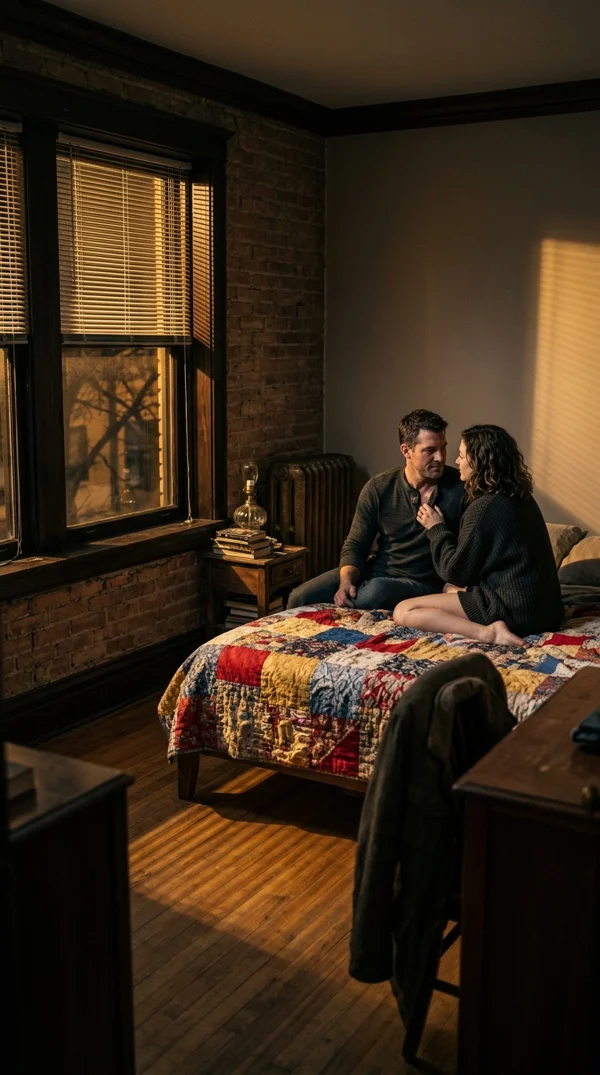
I didn’t say anything. I pulled his hand off my foot and put it flat on my stomach, low on the left, under my sweater, and held it there with both of mine.
He stopped breathing. I felt him stop.
We waited. The cooler compressor came on in the back. A petal slid off the counter. And then she knocked again, right under his palm, hard, unmistakable, and Callum Pierce made a sound like he’d been hit, and bent forward until his forehead was against my shoulder, and didn’t move.
I put my hand on the back of his neck. His skin was warm. He was shaking very slightly, the way the roses shake in the cooler when the compressor runs.
In eleven years of marriage Mark had touched my stomach for one reason: to pinch a fold of it and put a needle in, on the nights my own hands wouldn’t do it. He used to count out loud. Like a man finishing a job.
“Callum,” I said.
He lifted his head.
I didn’t let myself think about it. I’d been thinking for four months.
“Stay,” I said.

What did you think?