Six o’clock came and went on Saturday, and nobody wired anybody anything.
I was standing in the middle of a glass ballroom on the river at the time, in flats and a pair of my father’s old overalls let out at the sides, with my hair in a scarf and a clipboard on my stomach, watching four men on scissor lifts hang the last of three hundred forced quince branches from the ceiling grid. Upside down, so they’d look like they were growing down toward the tables. The quince was a deep coral, almost red, and in between it hung the magnolia, white and pink, the buds I’d been forcing in the cooler for three weeks with warm water and patience and, toward the end, prayer. Luz was up a ladder I wasn’t allowed up, shouting. Callum was in the corner by the service doors on the phone with Theo, not shouting, and every so often he looked up at the ceiling and stopped talking.
At six-oh-two he put the phone away and walked over to me.
“It’s six,” he said.
“I know.”
“Theo thinks we should have Malik keep him out. Theo thinks we should give Doug Tarrant the texts tonight and end it on paper. Theo thinks a lot of things.” He looked down at me. “What do you think?”
He’d stopped asking what I wanted to do about Mark at the end of February. He’d started asking what I thought. I don’t know if he noticed the difference. I did.
“I think he should come,” I said. “I think he’s been waiting since October to stand in a room full of people who matter to him and tell them who I am. I think he should get to try.”
“Nell.”
“You stood in the corner for me once,” I said. “When I told you to. Can you do it again?”
He was quiet for a second. Then he said, “Yes,” and went to put his tie on.
At eight o’clock the doors opened and eight hundred people in black tie came in out of a cold Chicago May and looked up.
I watched it happen from beside a pillar near the bar, in a long dark green dress that Luz had found for me and that did its best with thirty-two weeks of baby. Every single person did it. They came through the doors talking and checking their phones, and they took three steps in under the branches and stopped, and tipped their heads back, and went quiet. A man who owned half of River North stood under the magnolia with his mouth open. Simone Moreau, at the doors with her headset, caught my eye across the whole room and put her hand over her heart.
It was spring, in there. Before it had come to the city. I’d made it come early, with my hands.
Callum found me by the pillar. He was in black and white, and I’d never seen him in a tuxedo before, and I lost the power of speech briefly, and he noticed and looked pleased with himself.
“You did this,” he said, looking up.
“Luz did half.”
“Luz says you did all of it and she did the swearing.” He took my hand. “Do you know what I’d like to do right now?”
“In front of eight hundred people?”
“Yes,” he said, and kissed my knuckles, in front of eight hundred people, and went to find his table.
He spoke at nine. Not long. He talked about the four thousand units on the West Side and the families in them, and he didn’t say I once that I could hear. Then at the end, at the podium under the quince, he looked up at the ceiling, and then out at the room.
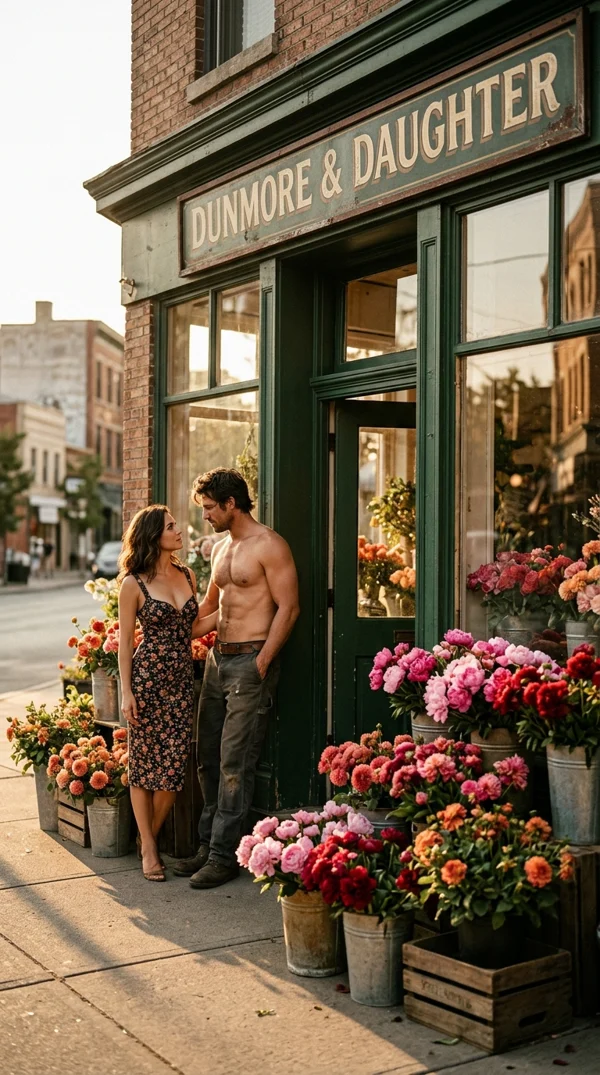
“One more thing,” he said. “The flowers tonight are by Dunmore and Daughter, on Clark Street in Andersonville. The designer would want me to tell you she won this contract before anyone in this building knew my name. So I’m telling you.” He found me by my pillar. “She’s very particular about that.”
People laughed. People turned to look. I stood there with my face on fire and I have never in my life been so happy to be embarrassed.
That was when I saw Mark.
He’d come in with Neil Kemp. Of course he had. Neil was in his sixties, red-faced and silver-haired, a man who’d built Kemp Rourke out of handshakes and steakhouses, and he’d been trying for two years to get a meeting with Pierce Development about the river towers. Mark stood at his shoulder with a drink, laughing at something a lender said, in a tuxedo I’d paid for. I heard him over the band as they came toward the bar.
“Two,” he was saying. “Can you believe it? A son two weeks ago and a daughter due in June. Two kids in one summer. I know, I know. It’s complicated.”
Then he saw me, and the laugh stayed on his face a second longer than the rest of him.
He came straight over. He brought Neil, which was a mistake. Callum, at his table thirty feet away, stood up, and I looked at him across the room and shook my head once, and he stayed standing, but he stayed where he was.
“Nell,” Mark said. “You look—big.”
“Mark.”
“Neil, you remember my wife. Nell. The florist.” He put his hand on my shoulder, the way he used to at parties, and I let it sit there, because I wanted Neil to see me take it off. I took it off. “Did you get my message?” he said, lower. “Because I didn’t get anything at six.”
“I got it.”
“Then you know where we are.” He was smiling. He was always smiling in rooms like this. “Doug filed this afternoon. Emergency hearing, Monday. It’s going to be in the papers by Tuesday, Nell, and it’s going to say that your boyfriend over there bought himself a baby from a clinic and took a man’s wife to get it, and I’ll be the father on that birth certificate unless a judge says different, and you know what judges are like. You want that for him? Tonight, of all nights?” He raised his voice, just a little. Just enough. A woman nearby turned her head. “Ask him. Go on. Ask him how Callum Pierce gets his kids.”
The woman nearby wasn’t the only one. A circle of quiet was spreading out from the bar the way rings spread on water. A developer I recognized from the program looked from Mark to Callum’s table and back. Somebody’s wife put her hand on somebody’s arm. For a second, a long one, I watched it work: the way Mark had always made it work, the charm and the hurt look, the reasonable man wronged. I could see Neil Kemp deciding to believe him.
Mark saw it too. I watched him see it. I watched him think he’d won.
“Neil,” I said. “You sent Mark a photo of my shop in December. Out of your car window.”

 100 to start reading with.

What did you think?