Four Days, chapter 1 of Sworn to the Man Who Buried My Husband
Rosaria Rios said it over my husband’s coffin, out loud, in front of the priest.
“A widow of a Rios carrying a Rios is kept in the name.” She had one hand flat on the coffin lid to steady herself on the crest, where the ground was soft. “The brother keeps her or the brother keeps the child. That’s the rule. It’s older than any of us.”
The rain came sideways off the ridge and made everybody’s coats shine. Sixty people stood around the hole at the top of the cemetery, and not one of them moved. Every one of them knew the words. They’d just been waiting for her to say them.
Eight weeks gone. I hadn’t told a soul but Vito, and Vito told his mother everything, so of course she read it out at the grave like a bill she’d been holding since April. My throat shut. Who else had he told? Half of fucking Carbury, by the look of them.
Nilo came and got my arm. He is thirty-five, with his brother’s shoulders and a better coat, and he took my elbow the way you take a child’s. His mouth came close to my ear, kindly. “Nobody’s going to make you do anything, Zara. But Ma’s right. There’s a bench and there’s a rule.”
I had the order book in my coat pocket. I’d come straight from the shop, and when I went for my handkerchief my fingers found the cloth cover instead. I held on to it until my knuckles ached.
Somebody had shot Vito twice on Friday night at nine twenty, on the creek bridge, by the rail. Four days ago. My feet were wet through my good shoes and I could barely feel my toes. I stood in the mud and pressed on Friday the way you press a bruise.
Father Boyle waited with the book open and his thumb in it. He knew better than to fight a rule over an open hole. “Earth to earth.”
They lowered my husband, and the straps creaked, and one of the mill men behind me breathed, “Ah, Vito,” the way you do. Then the whole crowd prayed a Hail Mary into the rain, and we went down the hill.
You should know the shape of Carbury, because everything after happened inside it. Six thousand four hundred people on the side of a ridge, one road in and one road out, and at the bottom of the hill, Halstead Paper. Four hundred and eighty people go through that mill gate every day. There is no other work.
At the gate is the scale house. Every truck in and every truck out stops at that shack, is weighed, and pays a ticket: three seventy-five. The ticket has been the family’s since 1963. So has the canteen in the break room, and the rents on Delaware Street and Mechanic Street. That includes the rent on our shop, which the family has never once raised and never once put in writing.
That is what Carbury means by the family. The guns come second. The ticket comes first.
St. Aloysius smelled of wet wool and old plaster. We prayed the rosary for Vito with the town packed into the back half and the aisles, and Rosaria knelt in the front pew with her beads going like a woman doing a job properly.
Nobody tells you this about the day: everybody wants to hold your hand and nobody wants to sit next to you. All through the rosary there was a gap on my left the width of a man. The town stared at it. I sat in it.
When it was over, my mother came and held my head against her collarbone. “Oh, my girl, my girl.” Her arms were shaking, and I stood it as long as I could.
Then the door opened and the cold came up the aisle.
Two men came in first and took a side of the door each. Then Cos Bavaro, fifty-eight, the family’s man, who reads the Wall Street Journal at our counter every morning and leaves without paying. Behind him, the Don.
Dante Sabatini is not a big man. He’s broad through the shoulders from the woodyard, where he worked until he was twenty-five, and he wears a good gray suit, and his hair has gone gray at the sides. He was forty-three in June. He has run this town since he was twenty-nine, and he has never once in my life hurried.
He came up the aisle with the whole church watching him and his eyes on nobody, and at my pew he stopped. “Mrs. Eames.”
He set a ring down on the ledge by the hymn books. A plain gold band, thin, worn thinner at the back where a woman’s hand wears a ring out.
“Four days. Saturday, four o’clock, here.”
Four days? Prask gives me longer than that on a flour bill. Somebody at the back hissed, “Jesus!” and somebody else hissed, “Hush.”
My mother had hold of my arm. “She’s twenty-one, Mr. Sabatini, she’s not——”
“Four days.” To her this time, and then to me. “On the fifth the family sits. If they sit before the wedding, the rule’s the only paper there is.”
The rule. Of course he’d had it straight from the grave. Half the men at that grave were his.
“And if I say no to four days?” My voice came out steady and strange.
“Then on Sunday the family sits on the bench rule and Nilo’s the answer to it, and you go to Youngstown in October.” There was no weight on it at all. “That’s not a threat, Mrs. Eames. That’s the calendar.”
Nilo, in the aisle: “She’d be well kept.”
Rosaria: “She’d be kept in the name.”
The church made the small noise churches make when the thing is out. Dante hadn’t turned his head for either of them.
“The ring’s not new.” It was the only thing that would come out in a line.
“It’s a good ring. It’s been kept.”
Then he did the thing that decided me, though it took me two days to know it. He picked the ring back up and held it out flat on his palm, at my height, and just waited.
Not on one knee. No speech. His hand was close enough that the warmth came off it onto the skin of my wrist, and I hated that it did. There was a woodyard callus at the base of his thumb, and the ring sat dead in the middle of his palm, and his hand did not shake. My breath went short and stayed short. What the hell was wrong with me? My body had no business noticing a single thing about a man at my husband’s funeral, and it noticed his hand.
My eyes went to the ring, and to the church full of people who had come to bury my husband and stayed to watch me get a second one before the mud had settled, and I did the sum. Take it now, and it’s the family’s. Refuse it, and it’s Nilo’s, and Youngstown.
“I’ve four terms.”
The church made a noise like a man sitting down hard.
Dante closed his hand over the ring and slowly put it in his pocket. “Say them.”
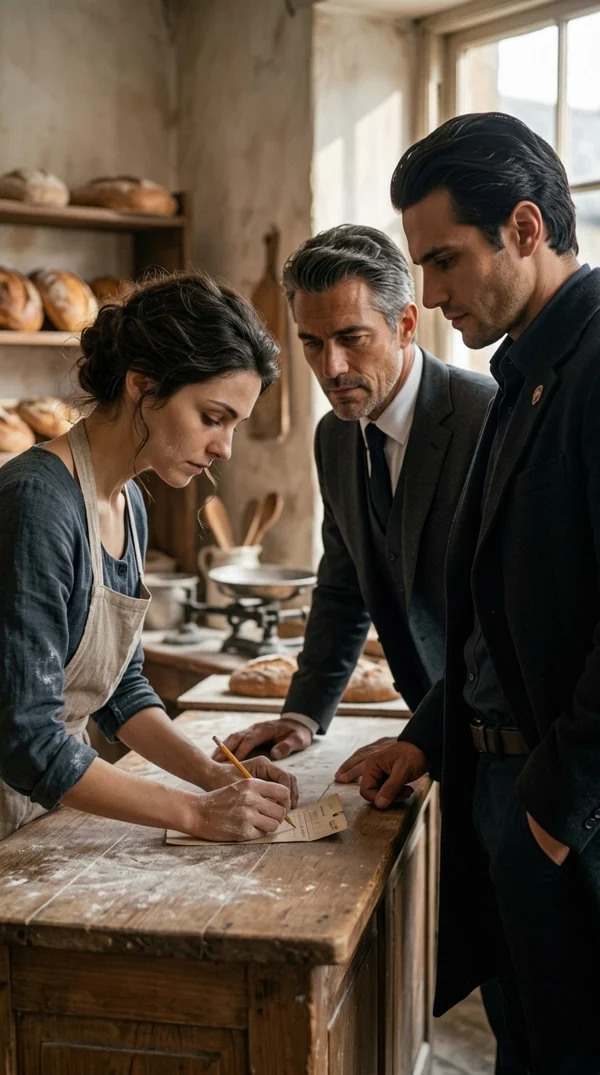
“Not here. At the shop, in the morning, with the book in front of me.”
“All right.”
“My grandmother keeps her room. The shop stays Eames.”
“All right.”
“And I keep the book. Mine. Nobody takes it off me.”
His eyes came to mine then, properly, for the first time, and it was like being read down a column. “You’ll keep it.”
“The fourth I’ll tell you in the morning.”
“Then I’ll be at the shop in the morning.”
He went back down the aisle, and the two men went out after him, and the door shut, and the cold stopped. The whole church let its breath out at once and turned to me with an expression I would come to know very well in Carbury: well, then.
Behind me, Rosaria leaned to the woman beside her. “He never even asked her!”
“He asked her terms.” My grandmother was in the doorway in her plastic poncho, chin up. She’d come up the step on her own stick just to say it.
I took the order book out in the pew, after, with the church emptying around me.
Green cloth over board. ORDERS on the front in my grandmother’s marker. The last entry was Friday’s, in my own hand, and the pencil had gone in hard enough to shine:
4 doz rolls — shut weighbridge — 9.20.
Four dozen? The canteen takes forty. The old weighbridge at the top of Ridge Road has been shut since 1998, and there is nothing at it but a scale plate in the mud and a hut with the door off, a few yards short of the creek bridge. Who orders four dozen rolls to a shut weighbridge on a Friday night? Nobody. Just me, apparently, in pencil.
I’d written it at six ten on Friday morning, with Vito at the counter drinking his coffee. I’d read it back to him, forty-eight to the shut bridge, and he’d taken the cup from his lips and nodded. “That’s right.” Then he’d gone. It was the last thing my husband ever spoke to me in the shop.
At nine twenty that night he was on that bridge.
I wrote the load that killed my husband. In my own hand.
What did you think?