The Slovak Club’s ninetieth was in November, and Fabian Grieco wanted the menu from 1971 reproduced for the anniversary. The menus are in the old order books. Anton Grieco wrote out the anniversary orders in them every year in his own hand, as a boast.
The old books are in the flour room on the top shelf, thirty-nine of them, cloth over board. There’s a strip of lead over the shelf because of the damp off the outside wall.
I went in on the Monday morning at ten-thirty with the stepladder. The room is eight feet by six. It smells of paper and flour and the outside wall. The shelf is at the top, where it’s been since my grandmother built it. It holds the thirty-nine, green like the one on the counter’s chain, and the green has gone to gray on the ones at the back.
I got the 1971 down and it was, naturally, the wrong year. Of course it was. So was 1970. Fabian’s menu was the thirty-fifth’s, and the thirty-fifth was 1971, so the menu should have been in the 1971 book. It wasn’t. It was in 1972, with a note in Anton’s hand saying last year’s and a drawing of a fish.
Then the ladder moved slightly on the flag. I put a hand on the shelf to steady myself and got the 1994 out by the top edge, and it came apart in my hand.
Not out of the shelf. The book came off the shelf and the spine came off the book — all of the spine, front to back — and it went down onto the floor, and it went down heavy.
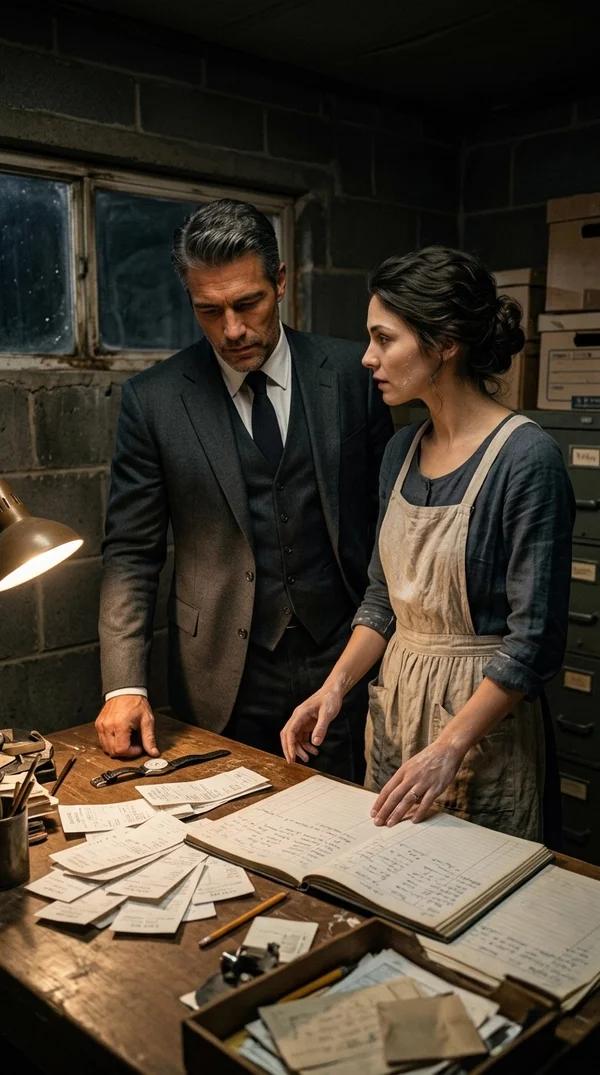
A spine doesn’t go heavy. I got down off the ladder and picked it up gingerly. The cover was off and the pages were loose in a fan. The spine board was thick in the middle, and soft. Down the inside of it, glued and folded into the cloth, there was paper.
Not pages. Tickets!
I sat down hard on the step of the ladder with the spine in both hands, and my knees went, and my breath went with them. What the hell had he done? What had he done, and when, and why in God’s name in a book about bread?
They were folded tightly in four and glued edge-on into the cloth with a clear gel. They came out one at a time, and they came out whole, because the fold was at the top where the glue was and the fold opened last.
Forty-one of them. The pad’s blue. PLATE. GROSS. TARE. NET. HOUR. HAULER. Four copies to a pad, and two of the four come off when it’s torn. So a torn ticket has the middle two, the pad’s number in a corner, and a man’s initials in the box.
Every single one of them was in Vito’s hand in the boxes Vito wrote: the tare, the hauler’s mark, the hour. I’d have known that hand in the dark. I’d read it on every Friday order in the book.
On the back of each one he’d written the mill’s sheet’s figure for the same load. Then the difference. Then the date.
I’ll put the first month of it down here, because it’s the only thing in this book that has to be exact.
Wednesday, August 5. Two tickets. Nine four and eleven nine. The mill’s sheet has eleven nine and eleven nine. On the back of the nine four: mill 11.9 — gate 9.4 — diff 2.5.
Thursday, August 6. One ticket, eight nine and eleven four. Mill 11.4. Gate 8.9. Diff 2.5.
Friday, August 7. Three. Nine four and eleven nine. Nine seven and twelve two. Nine six and twelve one.
Monday, August 10. Two.
Tuesday, August 11. One.
The hours were all between nine-thirty at night and four-thirty in the morning. There was no Sunday in it. The Wednesdays and Fridays were the heavy ones, because that’s when the lagoon’s full and the sludge goes.
Halstead pays the cartage a haulage rate by the ton on the docket. The mill weighs every truck going out on its own bridge, for its own sheet. The gate’s plate is at the gate. Between the two there’s ninety feet of yard.
The load takes on wire and rejects at the yard’s rail dock. It goes over the mill’s bridge with every bit of it aboard. The mill’s sheet says eleven or twelve ton, because the mill’s sheet says what the bridge says. Ninety feet on, it goes out of the gate, and the gate’s ticket says nine. The shack’s man writes what the docket shows, not what the plate shows, and the docket is the load less the wire.
Same load. Exactly two and a half ton apart. No man in this valley had ever put the two on one line before. How had nobody seen it? Because nobody counts twice, that’s how.
The difference was two and a half ton a load, every load, every night. It went out over the ridge road on a three ton bridge, and it went to Cleveland at twenty-seven and a half the ton, cash the same week.
On the back of the last ticket, the twenty-ninth of August, at the bottom, there’s the sum.
Aug: 18 nights. 41 loads. 102.5 ton. 27.50 the ton. $2,818.75. I am going to be in trouble.
My eyes went over it three times before the numbers would stay still. Twenty-seven and a half a ton. A hundred and two ton a month. Twenty-eight hundred dollars a month that the gate’s ticket never saw, and the mill never paid a haulage rate on.
I sat on the flag with the tickets fanned out carefully round me, the stepladder at my back and the 1971 book still in my lap. The cold of the stone came up through my skirt and into the skin of my hips. I worked the rest of it out, because there’s just nothing else to do with a number that size. What else was I meant to do, cry on it?
Twenty-eight hundred a month.
Thirty-three thousand eight hundred a year. Just sitting there.
Three hundred and four thousand dollars over nine years. Three hundred thousand fucking dollars, in a spine.

 100 to start reading with.
What did you think?