The renewal’s papers went in on Sunday the fifteenth, by hand, to a borough office that’s shut on a Sunday. Bevan only found them in the tray on the Monday morning. The same morning the mill’s office wrote to the cartage about the repair.
The mill has had its attention drawn to the plate bridge on Ridge Road and to the weights on the counts of the fourteenth. The mill’s position is that the bridge is a borough bridge and the highway authority’s, and that the hauler’s rate is the hauler’s rate, and the mill would be glad of the cartage’s view before the ash tender for the year is let.
The ash tender. Prask had warned me, and Prask had been right. The tender for the mill’s ash was going out, and the mill had found a way to put the bridge in it. Clever bastards.
Cos read it out slowly and carefully in the office and laid it face down on the blotter. They’d want the cartage to carry the repair and a rate cut, he reckoned. They couldn’t have both, I objected, and he agreed. They’d ask for both and take one, and the one they’d take was the repair if the cartage was slow with the rate.
He took his glasses off and pinched the top of his nose. “It’s a good letter. Four sentences and nothing in it to quarrel with. It’ll be a term of the ash tender by Friday.”
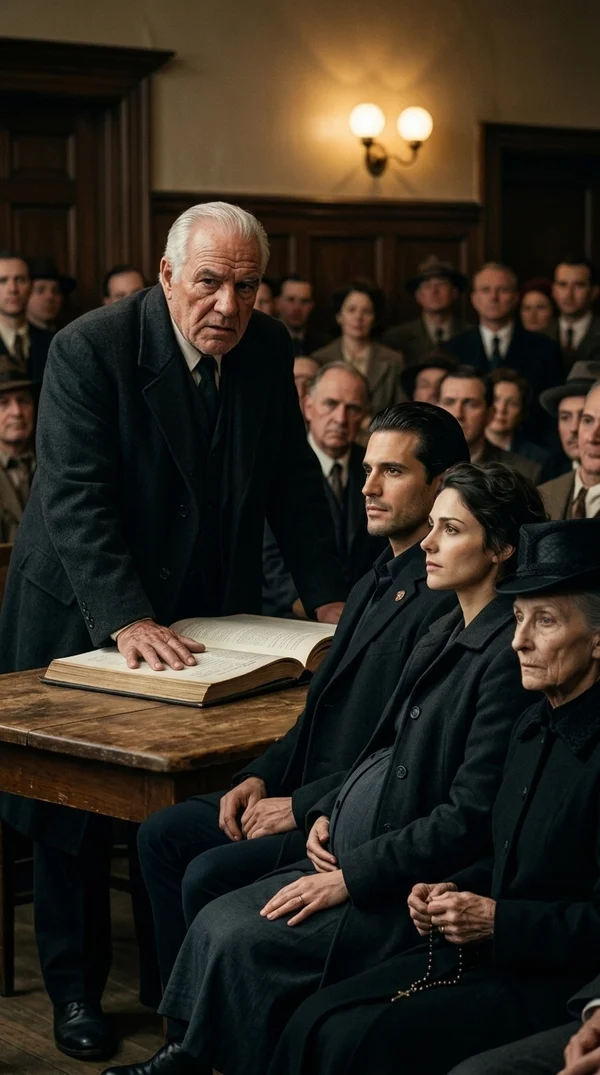
At four on Friday the bench read the will, and I was not in the room.
They read it in the back room at the hall with the door shut. Sel and Fabian Grieco and Fermina were there, and Cos with the original and a copy for each of the three. It took ten minutes.
Dante was in the front room with the men. I was at the shop with a bake on and the telephone on the counter. Essie brought me the news a piece at a time, the receiver tucked tightly against her shoulder.
At four ten it was read, and Cos had taken it in a folder. At four-twenty there was a clause about the hall, a rent of a dollar a year to the society for ninety-nine. At four-thirty-five Essie’s eyes came up to mine over the receiver.
“There’s Piet in it. Piet twice!”
At four-forty Sel had read the codicil question out, and Dante’s reply was that there wasn’t one, and Fabian wanted to know why the hell not. At four-fifty it was over. Cos had taken the original back, to be in the room on the twenty-second with the copies, under the process.
Essie put the phone down and stood with her hand still on it.
It was all to Piet, she told me. The house, the yard, the cartage, the rents, the gate, the scale house concession, the canteen. Her thumb rubbed the receiver nervously. And there was a bit that barred the gate’s concession from being sold, and the cartage too without the society’s consent, for ninety-nine years.
Ninety-nine years? It caught in my throat. The hall to the society, and the rents to Piet, and I’d be a hundred and twenty. I sat down on the flour bin. The dough on the bench had come up over the rim of its bowl, and I didn’t knock it back.
“I’m not in it. Nilo had it right in October, and now it’s read.”
“You’re not in it.” Essie’s voice had gone quiet. “And the baby’s not in it.”
The house that night at six thirty. Dante came in and hung his coat and went to the sink. He ran the tap and stood with his hands under it, and the water ran, and he didn’t turn it off.
I stayed by the door. “Say it.”
He turned the tap off. It was read, and under the process, and it would be in the room on the twenty-second with the copies. He got the towel and dried each finger as if it mattered. A competent will, drawn by a competent man, signed in 2019 in Cos’s office with two witnesses, Cos and a Mrs. Moynihan who was dead now. There was a clause about the society he’d forgotten he put there. “It’s a better will than most men’s.”
“It’s got a boy in it. He’s eleven.”
“He’s eleven, and he’s got a name and a father.” He hung the towel on the hook. The father was Ger, he went on, and Ger was a councilman and a council president’s son. Ger was a Kocher, so Piet was a Kocher, and the will was a Kocher inheritance. “That’s no mistake. It’s what it was made for.”
In 2019 there’d been nobody, and a family has to have a next. The next was Chiara’s boy, and Chiara was Lucrezia’s sister, and Lucrezia had the name. As near as the name could get.
“And now?”
“Now there’s a wife, and a child in April, and it’s a codicil. A codicil’s a week.”
“It’s been a week. It’s under the newspaper.”
Dante went very still, and his eyes came up to mine. “Has it.”
“It’s been under the Journal since Wednesday. Wednesday’s paper, and nobody’s opened it.” Did he think I couldn’t read an envelope through a sports page?
His eyes went to the kitchen table and the Journal on it. He didn’t go to it.
“Say the rest.”
I had my hands on the back of a chair, and the wood was cold under my palms. So I gave him the rest. Sel and Fermina and Fabian would read the will on the twenty-second. A hundred and forty years of Sabatini would come out of a desk, and it’d be a boy of eleven and a hall in trust for ninety-nine years. The room would call it a good will.
“A family that’s provided for itself. The child’s not in it, and neither am I. And Nilo won’t even have to open his mouth.”
“That’s it.” Dante sat down heavily at the table and put both hands flat on it.
“Change it tonight.” I didn’t let go of the chair. “Cos’s late wife’s cousin is in Pittston, and the phone’s in the hall. A codicil can be signed in a kitchen with two witnesses, and it can be in Sel’s hand by Sunday morning.”
“It can.”
“Then why isn’t it? Why the hell isn’t it?”
His eyes stayed on the newspaper. “Because Sel’s right, and I’ve been not saying it.”
Sel. Of course it was fucking Sel.
His voice went low. The will was what held Ger. Ger was a councilman himself, and Ger’s father was the council president, and there were four votes on that council that went on Fred Kocher’s word. Fred Kocher’s word, on a Sabatini will with his own grandson in it, had been a word in the family’s favor for seven years.
He turned one hand over on the table, palm up, and studied it. “A codicil puts the boy out of all of it. Ger becomes a man whose son’s been took out of a will by a wife of two months. Fred will hear it from Ger at a Sunday dinner before he hears it from a document. And there’s a renewal on the twenty-eighth.”
“So the will’s a council vote?”
“The will’s a council vote, and a codicil’s a council vote lost. That’s the arithmetic.” He closed the hand.
In April the child would be born, and the codicil signed in May. Nobody a penny the worse, and the vote held. It was right, he insisted quietly, and it was exactly what he’d been doing since a Friday in August. “And every time I’ve done it right, it’s been somebody else’s paper.”
I stood at the table with my eyes on him, and on the newspaper, and on all of it.
So it was simply the will that would be read on the twenty-second, a boy’s name in it and not the child’s. Just like that? The child would be a Rios if Nilo got his way, and nothing if he didn’t. Five months to April, and the bench deciding in two days.
“And you’ll not sign it.”
“I’ll not sign it before the vote.”
The clock in the hall did the thing it does before it strikes, and the house creaked. The kitchen had the two of us in it, and the second table under the window with two of everything on it. The Journal lay on the first table with the envelope under it.
“Say what you want.” His hand was flat beside mine on the table. Not touching. A finger’s width off.
I wanted to be angry, and it was the wrong night for it. He was right, and being right is what he does instead of talking. Isn’t it always? And I’d been in a shop since four in the morning, and the shop was the only place all week where anything had been mine. What did I want? God. I wanted one hour where nobody read me a figure.
“Not upstairs. Down.”
“Down where?”
“The cold room.” I had my coat off the hook behind the door. “It’s the only room in that building with a bolt on the inside and no window on the street. And there’s to be no will in it.”
He got his coat, and we went down the hill quickly and without a word. The street was wet and there was nobody on it, thankfully, because what would Mechanic Street make of the Don’s wife out at that hour with her coat open? He got the shop door, and I got the cold room’s.
The shop was dark and the till was out and the trays were stacked. The cold room’s door stood open a hand’s width, the way it’s left for the sponge. The cold came out of it into the passage like water off a step. I went in and put the bulb on and shut the door and drew the bolt across. Then I got my boots off at the door and left them. The slate was so cold through my stockings that my toes curled under.
It’s six feet by nine, with slatted shelves on three sides. The sponge sits in its bowls under cloth on the top one. Along the end wall the flour stands against the shelving, fifty-pound sacks stacked to my shoulder. It smells of yeast and cold slate, and my breath went out white.
“Every time it’s been say what you want.” I leaned back against the door. “Tonight I’ll say it.”
I got his coat off him and hung it on the door’s hook. Then I put my hand flat on his chest under the shirt. His skin was warm, and his heart was going under my palm, quicker than his face, and he stood still for it like a man being read to.

 100 to start reading with.
What did you think?