Four Hundred Meters, chapter 1 of Sync With Me, Liar
The first time I lied to Kade Ilyan inside the Lodestar, we fell four hundred meters.
It was a small lie. I want that on the record. It was the kind of lie you tell a dentist.
We were two thousand meters over the Shelf Sea on a clean blue morning, twenty-two meters of experimental war frame hanging in the sky on its thrusters, and Chief Engineer Pilar Mendez said over the channel, “Bridge is live. How are we feeling, Captain Solis?”
And I said, “I’m fine with this.”
The frame died.
Not exploded. Not shut down. Died, the way a fish dies in your hands: every limb going slack at once, the thrusters coughing and cutting, the horizon tipping up past the canopy like a dropped plate. The yoke went dead in my hand. My stomach went up into my teeth. Beside me, in the second seat, close enough that our shoulders touched through the flight suits, Kade Ilyan made no sound at all.
The altimeter spun. Eighteen hundred. Seventeen.
Then the frame woke up, as suddenly as it had died, and the thrusters caught and the limbs locked and we hung there at sixteen hundred meters, swaying, with the sea a long way down and very blue.
“Stall,” said Pilar, in the voice of a woman writing something down. “Point nine seconds. Captain Solis, I’m going to ask again. How are we feeling?”
“Great,” I said. “Never better.”
We dropped again.
This time I screamed. Not a lot. A professional amount. When the frame caught us at twelve hundred, my hand was clamped over Kade’s on the center yoke, which was a thing I had not decided to do, and I took it back so fast I hit my own helmet with my knuckles.
“Stall,” said Pilar. “One point three. Saint, sweetheart. You’re going to kill my frame.”
“Stop lying,” said Kade Ilyan.
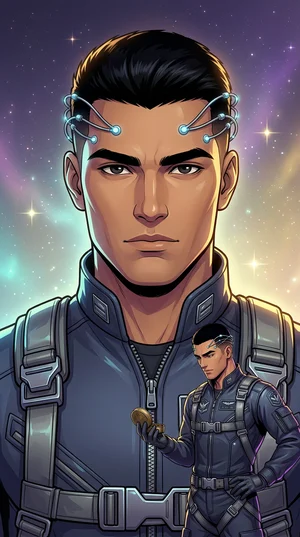
It was the first thing he’d said since we strapped in. He said it as he said everything, which is to say barely, in a low flat voice that came less through the headset than through the crown, the circlet of contacts sitting cold on my scalp, so that it seemed to arrive in the middle of my own head.
I turned and looked at him. Through his visor I could see his profile: the straight nose, the dark brows, the mouth I had spent two years wanting to punch. He was looking ahead at the horizon as if I were weather.
“Fine,” I said. “I hate you.”
The sync readout in the corner of the canopy, which had been sitting at a sullen thirty-eight percent, jumped to sixty-one.
The frame came alive under us like a horse that has finally decided you’re allowed on it. The yoke warmed. The thrusters steadied into a low, even roar. I felt, all at once and from somewhere that was not my body, a flicker of something dry and private and amused, and I understood with total horror that it was him.
“Better,” he said.
You need to know about the Board.
In the officers’ mess at Tidewall, on the wall between the coffee urn and the window that looks out over the catapult deck, there is a sheet of steel with the names of every active frame pilot in the Tethys Defense Fleet painted on it, and next to each name, a number. The number is how many Choir machines you’ve killed. It is not official. It is not encouraged. Admiral Voss has tried twice to have it taken down, and both times it was back up by breakfast.
For two years, the top two names on the Board had been SOLIS, R. and ILYAN, K.
That morning, both numbers said 41.
I’d been at Tidewall nine years. I’d come out as an enlisted deckhand at twenty, put in for flight at twenty-two, and been flying Striders for Lantern Squadron since I was twenty-four. My callsign was Saint, because my first commanding officer had overheard me tell a chaplain where he could put his blessing, and pilots are not a subtle people.
Kade Ilyan flew for Wolf Squadron. His callsign was Monk, because he almost never spoke on comms, and because nobody had ever seen him in the bar after midnight, and because pilots are not a subtle people. He was thirty-one, from the hab towers of Meridian, and he landed a frame like he was setting down a full cup of coffee. Everyone said he was the best pilot in the fleet.
Everyone except me. I said it was him or me, and I said it loudly, and I said it most nights at the Board with a drink in my hand.
And then there was Halcyon Gate, which I don’t talk about, and which is the reason the Board was the only place I ever said his name.
We landed at Tidewall twenty minutes later, after an hour of maneuvers I would describe as tense and Pilar would describe, in her official notes, as “a marriage in its third bad year.”
The hangar was a cathedral of steel and noise, open to the sea on one end, salt on everything. Lodestar knelt in her cradle-dock with steam coming off her joints. She was beautiful, I’ll give her that. Taller and leaner than a Strider, white armor with a blue stripe down the spine, a head shaped like a helmet with a long, thoughtful visor. Two seats inside, side by side, sharing one yoke between them, which was either brilliant engineering or a practical joke.
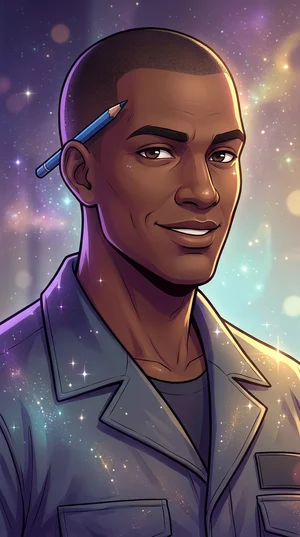
Pilar was waiting at the foot of the ladder with a slate. She was forty-six, short and square, with gray in her black braid and grease to the elbows, and she had the expression of a woman who had built a miracle and then watched two idiots drop it into the sky twice.
“Debrief,” she said. “Now. Both of you. Before you start lying again.”
She took us to a corner of the hangar where somebody had set up a folding table and a whiteboard, and she drew on the whiteboard a stick figure of the frame and two smaller stick figures inside it.
“The Bridge,” she said, tapping the line between the two little figures. “It links your intent. Not your thoughts, I don’t care about your thoughts, I’ve met pilots. Your intent. You both want to turn left, the frame turns left, faster than either of you could make a Strider do it, and the Choir can’t read it, because it’s not one rhythm. It’s two, braided. They’ve learned every single-pilot habit in this fleet. They haven’t learned this.”
“And the falling?” I said.
“When you say something into the link you know is false, your speech and your intent disagree. The Bridge doesn’t know which one to obey. So it obeys neither.” She drew a little line under the frame, going down. “Stall.”
“That’s insane,” I said. “You built a war machine that can’t handle a lie.”
“I built a war machine that can’t handle two minds lying to each other in combat. That turns out to be the same thing.” She looked at me over the slate. “I’d love to fix it. I’ve been trying for three years.”
“What about jokes?”
“The Bridge knows sarcasm. Sarcasm you both understand isn’t a lie, it’s a dialect. It’s like being married.” She glanced at Kade. “You’ll notice the Captain didn’t stall.”
“The Captain didn’t say anything,” I said.
“Exactly,” said Pilar.
Kade, leaning against a crate with his arms folded, did not smile. Something in the back of my head did, though, very faintly, like a light seen through a curtain. I shook it off.
“And if I need to get out,” I said. “If he’s lying and we’re falling and I want to be anywhere else.”
“You eject.” Pilar pointed at the stick figure’s seat. “Each seat is its own pod. Ejection is the only hard break. Under load, the crowns won’t come off. You can’t just yank them and walk away.” She paused. “That’s on purpose.”
“Why on purpose?”
She looked past me then, at the wall behind the table. I followed her eyes. There was a plaque there, steel, no bigger than a hand, bolted to a girder at head height where you’d see it every time you came in from the deck.
LT. CMDR. ARUN DESAI. XF-01. HE HELD FOR 94 SECONDS.
“The first frame had one pilot holding the whole load if the other dropped out,” Pilar said evenly. “One mind can fly it. One mind can fly it for about ninety seconds before it burns. Arun flew it for ninety-four, so that it landed and didn’t fall on me.” She put the cap on her marker. “So now you don’t get to take the crown off and leave your partner holding. Questions?”
There were a hundred. I didn’t ask any of them. Kade, beside me, had gone very still, and in the back of my head, the light behind the curtain went out.
Admiral Voss came down to the hangar himself, which he never did, and stood in front of Lodestar with his hands behind his back.
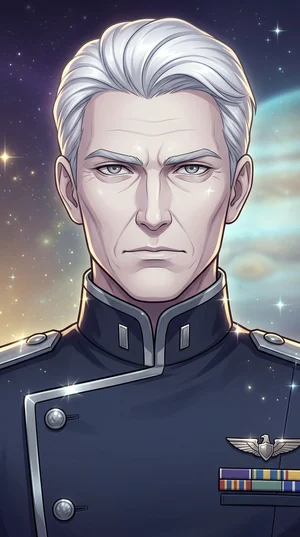
He was sixty-one, tall, white-haired, with the kind of face you’d put on a coin. He’d lost three colonies in four years, Kell and Tarrow Point and the Ardent Reach settlements, to a thing nobody could talk to, and he looked like a man who kept the count in his head.
“The Choir,” he said, “has spent four years learning us. Every pilot, every habit. They copy our voices on open channels. They know when a pilot is going to break left before the pilot does. Our kill rate is falling every month.” He nodded up at the frame. “This is the first thing we’ve built that they cannot predict. Two pilots, one machine. Captain Solis, Captain Ilyan, you are the highest compatibility pairing the program has ever recorded. Ninety-one percent baseline.”
“Ninety-one,” I said. “With him.”
“Your brains like each other, Captain,” Voss said dryly. “I’m sorry if that’s a shock.”
Behind him, Petty Officer Ike Mbeki, who ran the hangar’s maintenance board, had wheeled a fresh whiteboard into the light. He had written STALL BOARD across the top in blue marker, and under it, in a neat technician’s hand:
0947:12 SOLIS: “I’m fine with this.” 0.9s 0947:31 SOLIS: “Great. Never better.” 1.3s
The deck crew, who had stopped pretending to work, made a noise like a stadium.
I took a breath and decided not to murder anyone in front of the Admiral.
I found Pilar in her office after, a steel box above the hangar floor with a window that looked down on Lodestar’s bowed white head.
“Reassign me,” I said. “Pair him with someone else. I don’t care who. Priya Rao. Anybody.”
“Priya scores sixty-one with him. Sixty-one stalls if someone sneezes.” Pilar didn’t look up from her screen. “There isn’t anybody, Saint. We ran every pilot in the fleet.”
“Then you assigned me knowing. Knowing what he did.”
She stopped typing then. She looked at me with her tired, clever eyes, and then she reached into a drawer and took out a single sheet of printed paper and slid it across the desk without a word.
It was a personnel request form. REQUESTED CO-PILOT, XF-02 PROGRAM: CAPT. R. SOLIS, LANTERN SQN. NOTE: DO NOT INFORM CAPT. SOLIS OF THE REQUEST. SHE WILL REFUSE.
The signature at the bottom was a neat, upright K. Ilyan. It was dated six weeks ago.
“I didn’t assign you,” Pilar said. “He asked for you.”
He was still in the hangar when I came down. Of course he was. He was standing under Lodestar’s left hand, looking up at her the way people look at weather they intend to fly into, his helmet under his arm.
I held up the form.
“Six weeks,” I said. “You asked for me six weeks ago. You knew I’d say no, so you went around me. Why?”
He looked at the paper. Then he looked at me, and for a second his face did something I couldn’t read, like a wave changing its mind just before it breaks.
“Pass,” said Kade Ilyan, and walked away.


What did you think?