Nine Hundred Acres, chapter 2 of The Alpha Who Let Me Go
Edie never locked her door in eighty-eight years, so of course somebody had locked it after she died.
I sat in my rental car at the top of her drive at nine on Sunday morning with the engine running and the heater roaring, looking at a house I couldn’t get into. It was the same house. White clapboard, green trim gone gray, a porch that ran the whole lake side, a brick chimney with no smoke coming out of it. Below it the yard fell away to Copper Lake, which was steel-colored and dead calm and steaming faintly in the cold, and at the bottom of the slope, where it had always been, the boathouse and the dock.
I didn’t look at the dock.
I’d tried the front door, the porch door and the mudroom door. I’d tried the window over the sink, which used to stick and now didn’t open at all. I’d called the funeral home, which was closed on Sundays. Then I’d sat in the car and laughed, a little wildly, because I’d flown two thousand miles and buried my grandmother and survived my ex-husband at a coat rack, and I was going to be defeated by a Schlage deadbolt.
A truck came up the drive behind me. It was a dark green pickup with RHYS MARINE on the door in plain black letters, and it parked a respectful distance back, as if I might be crying.
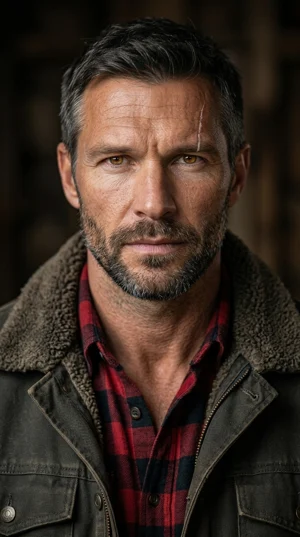
He got out with a cardboard box under one arm. In daylight he looked even bigger, and older, and more tired. Jeans, the canvas coat, a flannel shirt open at the throat, no hat in weather that wanted one. He came to my window and waited until I rolled it down.
“Funeral home asked me to bring these,” he said, and held up the box. Then he held up a single brass key on a loop of red string. “And you’ll want this.”
I looked at the key. “Why do you have a key to my grandmother’s house?”
“Somebody had to lock it.”
“She never locked it.”
“No,” he agreed. “But she was alive.”
I made him stay on the porch.
It was childish and I knew it, and he didn’t argue. He set the box on the porch rail and stood beside it with his hands in his coat pockets while I went inside, and I left the door open a crack because I am not, whatever Graham says, a monster.
The house was cold in a way houses only get when the stove has been out for two weeks. It smelled of woodsmoke soaked into old plaster and of Edie: Jergens lotion, pipe tobacco she’d quit eight years ago, and the dry paper smell of the little room off the kitchen where she kept her desk. Her boots stood in a row in the mudroom with her house slippers at the end, as if she’d just stepped out of them. Her barn coat hung on its hook. Her watch was not on the windowsill over the sink, where she always took it off to do the dishes, and for a second that was the thing that nearly finished me: not the funeral, not the dirt on the lid, but a windowsill with nothing on it.
It was in the box. When I brought it in I found it on top, in a plastic bag with a hospital-style label: her old Timex with the cracked crystal, stopped. Under them was her wedding ring, which she’d worn for sixty years after my grandfather drowned, and her silver pin from the Postal Service, forty years, with the little eagle.
I put the ring on my thumb. It fit there.
Then I went back out on the porch, because I had questions and he was the only one in this town who seemed to have the answers and not mind me knowing he had them.
He was looking at the lake. I stood at the other end of the porch, ten feet of painted boards between us, and crossed my arms against the cold.
“All right,” I said. “Tell me why the whole town watched you fold that card and nobody blinked.”
He didn’t hurry. He never had. At twenty-two he used to think so long before answering a question that I’d answer it for him out of impatience, and he’d let me, and then tell me I was wrong.
“The land’s already yours,” he said. “Edie signed a deed in twenty-fourteen. It passed to you the minute she died. No court, no waiting. Arne Sundquist in Marquette has the paper. He’ll tell you tomorrow.”
“I know what a life estate deed is.” I did. I’d traced assets through enough of them. “That doesn’t answer my question.”
“There’s a ridge,” he said, “between the two lakes. Up behind the house, under the old hemlocks. You used to call it the dark woods.”
I had. I’d been eight. Edie told me never to go up there alone and I never had, because Edie didn’t make many rules and when she made one she meant it.
“It’s a denning ground,” Bowen said.
“For what?”
“Wolves.”
I waited for the rest. He let me wait.
“There are wolves all over the Upper Peninsula,” I said, with the careful patience I use on opposing counsel. “Seven hundred of them. The DNR counts them every other winter. My grandmother sent me the clippings. If there’s a den on the ridge, that’s lovely. Why does that mean I can’t sell?”
“Because it’s ours,” he said. “The Copper Lake pack. Sixty-one of us, give or take a birth. My family.” He said it as plainly as he might have told me the marina’s hours. “I’ve been their Alpha since my father died. Fourteen years in August.”
He looked up at the hemlocks. “We’ve used that ridge for a hundred years. Halloran women have kept it for us since nineteen-nineteen. Your great-great-grandmother Nora. Then Edie, for sixty-five years. She never told you, because she never brought you to the stone.”
Alpha. A man I’d last seen dropping drill bits off my grandmother’s dock had just used the word about himself on her porch, with a straight face, and the sound that came out of me was half a cough and half a sob, and once it started I couldn’t stop it. I laughed until I had to hold the porch rail. He stood at the other end of the porch and let me, and didn’t smile, and didn’t look away.
When I could breathe I said, “The stone.”
“Ask me tomorrow.”
“I’m asking you now. And I’m asking who ordered you. Yesterday, at the grave, you said you were ordered to leave me.”
“Tomorrow,” he said, “you’ll be readier to hear both.”
“You have no idea what I’m ready for.” I pushed off the rail. “Do you know what I do? I spend my whole working life finding the thing people are hiding. I find it in spreadsheets and wire confirmations and the margins of invoices. And in March of last year I signed a quitclaim on my own house because my husband said the bank needed it for his company’s credit line. In September I took my half of our savings as stock in his company, because I wanted to be divorced by fall more than I wanted to be right. Arizona’s a community-property state. I’d have walked away with half of everything. I knew that. I signed anyway.” I heard my voice go up and didn’t stop it. “So you’ll forgive me if a man I haven’t seen since I was nineteen stands on my grandmother’s porch and tells me I’ve inherited a cult, and I don’t take notes.”
Something moved in his face then, closer to recognition than to hurt.
“Your grandmother was ours,” Bowen said quietly. “So are you.”
“I’m nobody’s.” It came out flat and hard and absolutely sure, the only thing all morning I’d been sure of. “I was somebody’s for fourteen years. Look how that reconciled.”
My phone rang in my coat pocket.
I knew who it was before I looked. Graham always calls on Sunday mornings when he wants something, because he thinks people are softer before lunch. I answered it so I wouldn’t have to look at him.
“Haze.” Warm, rested, the voice of a man who’d slept at the Merriman Inn and had the free breakfast. “Listen. I talked to Kurt. I told him you were upset yesterday, which, totally fair. He’s going to two point four. Two point four, Haze. But he needs a signature by Friday, or his people move on to another parcel.”
“His people.”
“His investors. It’s a good offer. It’s a great offer. Think about it, okay? I’m around.”
I hung up on him. It was the first time in fourteen years.
When I looked up, Bowen was watching me. Ten feet away, with the wind off the lake between us and my phone pressed to my ear, there was no way on earth he could have heard a word of that.
“Two point four,” he said, “is still a timber price.”
I stared at him.
He picked his truck keys off the porch rail. “Don’t walk up the ridge path at dusk tonight,” he said. “Lock your door. The pack’s running for Edie.”
“Running.”
“It’s what we do for our dead.” He came down the porch steps, which were glazed with ice, and stopped at the bottom and held up his hand to me without a word. After a second I understood he meant to walk me down to my car, and that he’d stand there with his hand up until I let him.
I let him. His hand closed around my elbow through the Phoenix coat, warm even through the wool, and he walked me the six steps to the car door as if the ice were a real danger and I were something that might break. Then he let go.
“Lock the door, Hazel,” he said, and drove away.
I spent the day doing the things you do. I lit the stove, badly, then less badly, until the house began to creak and tick around me as it warmed. I emptied the refrigerator of things that had become science. I stood in Edie’s bedroom and couldn’t open her closet, and went and sat at her desk instead, in the little paper-smelling room, with forty green clothbound ledgers on the shelf above it, their spines labeled in her square postmistress hand by year. I didn’t open them. I told myself it was because I was tired.
A cult, I decided. A family of very large, very devoted men who’d made a story out of my grandmother’s land. Arne Sundquist would explain it in plain legal English, and it would turn out to be a hunting lease with a lot of feelings attached.
At four-thirty the light began to go.
It goes fast up here in November, as if somebody were turning down a lamp. The lake went from steel to pewter to ink. The hemlocks on the ridge went black against a sky the color of a bruise.
At five, I heard them.
It began far off, toward the big lake, a single long note that rose and held and broke. Then another answered it from the west. Then three, four, ten, from all around the ridge, and closer than I’d thought, so close that the glass in the kitchen window hummed with it. It went on and on, and it rose, and it was the saddest sound I had ever heard in my life.
I stood in Edie’s kitchen with a dish towel in my hand and I understood, with the part of me that doesn’t think in words, that it was for her.
Then I put on Edie’s barn coat, because mine was useless, and I took the big flashlight from the hook by the mudroom door, and I went out.
I know. I know.
The path started behind the woodshed, exactly where it always had, and climbed through birch and then into the hemlocks, where the dark was almost total. I didn’t turn on the flashlight. I don’t know why. My breath was loud. The cold got into my teeth and into the hinges of my jaw. The howling had stopped, and that was worse, because in its place there was a silence so complete I could hear snow sifting down through the branches.
The path came out where the trees thinned at the top of the ridge, onto a shelf of granite above a hollow full of enormous old cedars. I’d never been this far. I stopped behind the trunk of a hemlock as wide as a door and looked down.
There were people in the hollow.
Twenty, thirty of them, men and women, in coats and boots, standing quietly among the cedars as if they were waiting for a train. Somebody laughed softly. Somebody else hugged somebody. I saw the biggest of the pallbearers from the funeral, and a woman with cropped red-brown hair, and an old woman leaning on a younger man’s arm. They were taking off their coats.
They were taking off everything, matter-of-factly, in the snow, and folding their clothes into plastic tubs under the biggest cedar, the way you’d fold your things at a public pool.
I couldn’t breathe.
At the tree line on the far side of the hollow, just below me, a man was pulling a flannel shirt over his head. I knew the shoulders. I knew the gray at his temples, silver in the last light. He dropped the shirt on a rock and straightened, and his back moved, all of it, like the surface of the lake when a gust comes down off the ridge. A ripple. A blur. It took no time at all.
Where Bowen Rhys had been standing, there was a wolf.
It was bigger than any animal had a right to be. Gray, with a dark saddle across its shoulders and frost already catching in its ruff. It stood very still on the rock where his shirt lay, nose lifted. Then it came up the slope toward me, unhurried, through thirty yards of snow and granite, and stopped below the hemlock I was hiding behind, so close I could hear it breathe.
Its left eye was amber. So was its right.
And I knew those eyes. I’d known them since I was nineteen years old.
What did you think?