Recorded, chapter 4 of The Alpha Who Let Me Go
Graham left the wine on the porch step. I left it there.
I slept in my old room under the eaves, the one with the slanted ceiling and the iron bed I’d outgrown at fourteen and slept in every summer anyway, with my feet hanging off the end. I didn’t think I’d sleep at all. I went under like a stone dropped in a lake, and came up again all at once at three in the morning, wide awake in the dark, with my heart going hard and my hand pressed flat to my chest.
Something had hold of me. Under my collarbone, a little to the left, there was a pull, as if a fishing line had been hooked there while I slept and somebody at the far end had taken up the slack. It didn’t hurt. I lay there with my hand on it and tried to think what it could be, a heart thing, a panic thing, the beginning of some new and interesting way of falling apart. But it didn’t feel like falling apart. It pointed.
Down through the floor, through the front of the house, to the porch.
I put on Edie’s flannel robe and her barn coat over it and went down the stairs in my socks.
The storm door was a pane of black glass with the porch light making a yellow circle beyond it. I didn’t turn on the hall light. I stood well back and looked.
The wolf was lying across the top step.
It was standing close to the storm door with its head low and one forefoot lifted, as an animal stands when it has come up the steps fast and doesn’t yet know what it came for. Snow was melting on its back and in the dark saddle across its shoulders, and its sides were going in and out; it had run a long way. Its breath went up in quick puffs that the porch light turned gold. Graham’s bottle of wine stood on the step beside it. It hadn’t been knocked over.
I must have made a sound. The great head turned, and it looked at me through the glass.
Then it got up, unhurried, and went down the steps and around the corner of the woodshed and out of the light. The line paid out after it. I felt it go, around the corner, ten feet, fifteen, and stop.
I stood in the dark hall with my hand on my chest and counted. I’d got to forty when a man came back around the woodshed in jeans and an unbuttoned flannel shirt, barefoot in the frost, and sat down on the bottom step of my grandmother’s porch with his back to me.
There’s a box in the woodshed. I’d forgotten it until that second. A big plastic tub with a lid, behind the kindling, that had been there every summer of my childhood. I’d asked Edie once what was in it, and she’d said rags, and I’d never looked.
I opened the door and went out and sat down on the top step, with the wine bottle between us like a chaperone.
“You ran here,” I said. “Across the lake.”
“Around it.” He didn’t turn. “Something woke me at three and pointed this way, and I came to see if you were all right. Your ex-husband’s car was in the drive at nine.”
“Graham’s harmless.”
“He brought a man to a funeral to buy your grandmother’s land.” He didn’t turn around. “Nobody harmless does that.”
The cold went through Edie’s robe and the coat and my socks at once. Out past the dark yard the lake was making small sounds at the shore, little clicks and knocks, the first skin of ice forming and breaking in the shallows. Somewhere across the water a single light burned, very far off on the north shore.
“Doesn’t that hurt?” I said. “Your feet.”
“Not much.”
“Is that a wolf thing?”
“It’s a Yooper thing.” A pause. “It’s a little bit a wolf thing.”
I laughed. It surprised me. It surprised him too; I saw his shoulders move.
“You built the dock,” I said. “That summer. You had a cordless drill and you kept dropping the bits in the lake.”
“You made me count the lumber against the invoice.”
“It was six boards short.”
“It was six boards short,” he agreed. “My father docked me a day’s pay for it.” He was quiet. “You used to swim out to the raft every evening at seven, and sit on the end of it with your knees up, and read until you couldn’t see the page. I used to finish work at seven so I could watch you do it.”
I hadn’t known that. I’d thought I’d found him on that dock by accident, night after night, for three weeks.
“Who ordered you?” I said.
The lake clicked at the shore. He let it click a while.
“My father.”
“Why?”
“There’s a law.” He turned his head, finally, enough that I could see the side of his face in the porch light. “I’ll tell you all of it. It’s yours to know now. Not tonight.”
“You keep saying not tonight.”
“I’ve got a lot of nights,” Bowen said, “I didn’t spend with you. I’m not going to waste this one telling you about my father.”
I didn’t plan it. I came down one step, and then another, until I was sitting on the step just above his. His hands hung between his knees. I took one of them to see if it was as cold as it ought to be, and it was hot, hotter than mine, as if he’d been sitting by a stove instead of on frozen boards.
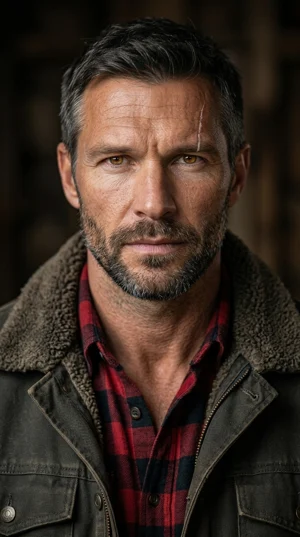
“What happened to your eyebrow?” There was a thin white line through the left one. It hadn’t been there when I was nineteen.
“Salvage job. I was thirty-one. A cable let go.”
“You could have lost the eye.”
“I didn’t.”
He turned his face up to me. Up close, in that gold light, his eyes were dark again, brown and ordinary and absolutely not ordinary, and he was looking at me as if he wasn’t sure I’d still be there when he blinked.
I kissed him.
I’d like to say it was gentle. It started gentle. It started as the thing a grown woman does to see if a memory holds up: a press of mouths, a question, his beard rough under my palm. And then it didn’t hold up, because it was worse. Better. Because he breathed my name into my mouth the way he had on a raft in July with the lake going gold around us, and his hand came up into my hair and held my head as if it weighed a great deal, and I was nineteen and forty at the same time and neither of them had any sense. I had my fist in his open shirt. He was so warm. The cold was nowhere. The line under my collarbone went slack, because there was no distance left for it to pull across, and the heat of him was in my hands and my mouth and the backs of my knees, and if he’d stood up and carried me into my grandmother’s house I’d have let him, and that was the thing that stopped me.
I pulled back, but not far. Our foreheads were still touching. We were both breathing as if we’d run up the ridge.
“You’re twenty-one years late,” I said, “and I’m six weeks out of a marriage.”
He let go of my hair slowly, one finger at a time.
“I know,” he said.
“I’m not doing this. I’m not doing anything this week except burying my grandmother and finding out what’s at that courthouse.”
“I know.”
“Stop saying you know.”
One corner of his mouth went up and came straight back down, as if he’d remembered he was out of practice.
“Go to bed, Hazel,” he said. “I’m going home.”
“In bare feet.”
“It’s two and a half miles by the shore road. I’ve done it in worse.”
I went to bed. I lay under the slanted ceiling with Edie’s wedding ring cold on my thumb and listened to him go: the bottom step creaking, then nothing. The pull under my collarbone went with him, out of the yard and along the shore, a long slow paying-out, until it stopped somewhere across the water. At six, when the window went gray, I got up and looked across the lake. There was a light on in a window on the north shore.
When I came down at seven to make coffee, the step was empty, and so was the place where Graham’s wine had been.
The Sturgeon County courthouse is a red sandstone building from 1891, with a clock tower that’s been stopped at twenty past four for as long as I’ve been alive, and a basement that smells of radiator paint and old paper. The register of deeds is down there, at the end of a hall lined with framed photographs of county officials going back to men with mutton-chop whiskers. It’s one room with a counter and a public computer terminal, and one woman, small and gray, in a black cardigan with a crumpled tissue up her sleeve.
“You’re Edie’s granddaughter,” she said, before I’d opened my mouth. “I’m so sorry, hon. She was a sweetheart.” She sniffed. “She was in here in September. Had her fraud alert email printed out and her glasses on her nose, and she was hot.”
My hand stopped on the counter. “A fraud alert.”
“County service. You sign up, and if anything gets recorded with your name on it, we email you. Most people never get one.” She came around the counter and woke up the terminal for me with a jab of one finger. “Grantor-grantee index. Type your name. Your grandma’s lawyer set her up.”
I typed my name.
There were three results. The first was Edie’s 2014 deed, the one Bowen had told me about, with my name as the remainder beneficiary. The second was dated Friday, September 18, and the document type was MORTGAGE. The third was dated Friday, October 2: ASSIGNMENT OF MORTGAGE.
I asked the register for printed copies. She brought them to me warm from the machine, nine pages and two, and went back behind the counter and pretended to be busy so I could read in peace.
THIS MORTGAGE is made on September 10, by HAZEL HALLORAN and GRAHAM PELL, Mortgagors, to SAGUARO BRIDGE LENDING LLC, an Arizona limited liability company, Mortgagee.
To secure a note of one million two hundred thousand dollars.
On the Halloran parcel, by its full legal description, all nine hundred acres, together with all of Mortgagor’s right, title and interest therein, now owned or hereafter acquired.
I knew the type of lender. Every forensic accountant in Phoenix does: a strip-mall shop in Scottsdale that makes short, expensive loans to people the banks won’t touch, twelve or fourteen percent, secured by real estate, no questions as long as the paper looks right. I read it once fast for the shape, once slow for the words, and a third time for what was missing. A power of sale. An acceleration clause. A covenant that the mortgagors were lawfully seized of the property, which on September 10 neither of us had been, because on September 10 my grandmother was alive and keeping her ledgers in square capitals at a desk four miles from here.
Now owned or hereafter acquired. It was written to wait for her to die.
I turned to the last page.
There was Graham’s signature, the one I’d watched him practice on a napkin when he founded his first company, all speed and a big looping G. And beside it, on the line marked Hazel Halloran, there was mine.
It was very good. Somebody had worked hard on it. The slant was right, and the long tail on the final n, and the loop of the lls that I never quite close. But I’ve signed my name perhaps forty thousand times in my life, and I’ve never once started the H with a blunt dot where the pen sat down and thought about it before it moved. And there was a tremor in the crossbar: the faint wobble of a hand going slowly so it wouldn’t make a mistake.
The two pages from October were shorter. For value received, SAGUARO BRIDGE LENDING LLC hereby assigns, transfers and sets over to BLACK SPRUCE LAND & TIMBER LLC, a Michigan limited liability company, all of its right, title and interest in the mortgage described below.
Somebody up here had bought my forged loan. Twelve days after it was recorded. Three weeks before Edie died.
And at the bottom of that page, in small print, was the line the State of Michigan makes everybody put on every document they record: Drafted by M. Rautio, 410 Shaft Street, Hematite, Michigan. I didn’t know anybody in Hematite. I didn’t know anybody named Rautio. I barely registered either of them, because I’d turned back to the mortgage and its notary block.
State of Arizona, County of Maricopa. Acknowledged before me on September 10 by Hazel Halloran and Graham Pell. The address under it was on Scottsdale Road, and I knew it, because it was Fennec’s office. A rubber stamp, crisp and square, with the state seal. A commission number. And a name signed in round, careful handwriting with a little heart for the dot over the i.
Jolie Wilde.
The woman Graham had moved into my house.
What did you think?