Carys came at nine on Thursday with two pairs of snowshoes over her shoulder, the old-fashioned bearpaw kind with rawhide lacing, and dropped one pair at my feet on the porch.
“These were Edie’s,” she said. “She’d want you to break them.”
“I’ve never been on snowshoes in my life.”
“Then you’ll fall over a lot and I’ll laugh.” She was already buckling hers. “Bowen says you get to see it in daylight. He says you’ve earned that much, since you saw the rest of it without permission.”
“Is he coming?”
“No.” She straightened up and looked at me, and her face was kind and amused and a little bit sorry. “He says it should be a woman who takes you. Since it always was.”
I fell over four times. Carys laughed every time, a big honking laugh that bounced off the hemlocks, and then hauled me up by the back of Edie’s barn coat. By the time we reached the top of the ridge I was soaked to the knees, my cut palm was throbbing inside my glove, and I was laughing too, because I’d been frightened for a week and my body had decided it had had enough.
In daylight, the hollow was just a hollow.
That was the strangest part. Old cedars, enormous ones, their trunks twisted like wrung laundry, standing in a bowl of granite with the snow lying blue in their shadows. Chickadees. The smell of cedar and cold. If you didn’t know, you’d think it was the prettiest spot on the ridge, and you’d take a photo, and you’d go home.
Under the biggest cedar, the roots made a dark arch over a hollow in the rock, big enough for a person to crawl into on her hands and knees. The granite around its mouth was scored with marks. Long parallel scratches, some fresh and pale, some so old they’d gone soft and green with lichen.
“The den,” Carys said. “In April. Four or five litters a spring, some years. Nobody lives in it the rest of the year. It’s more like a church.” She pointed with her pole. “And that’s the stone.”
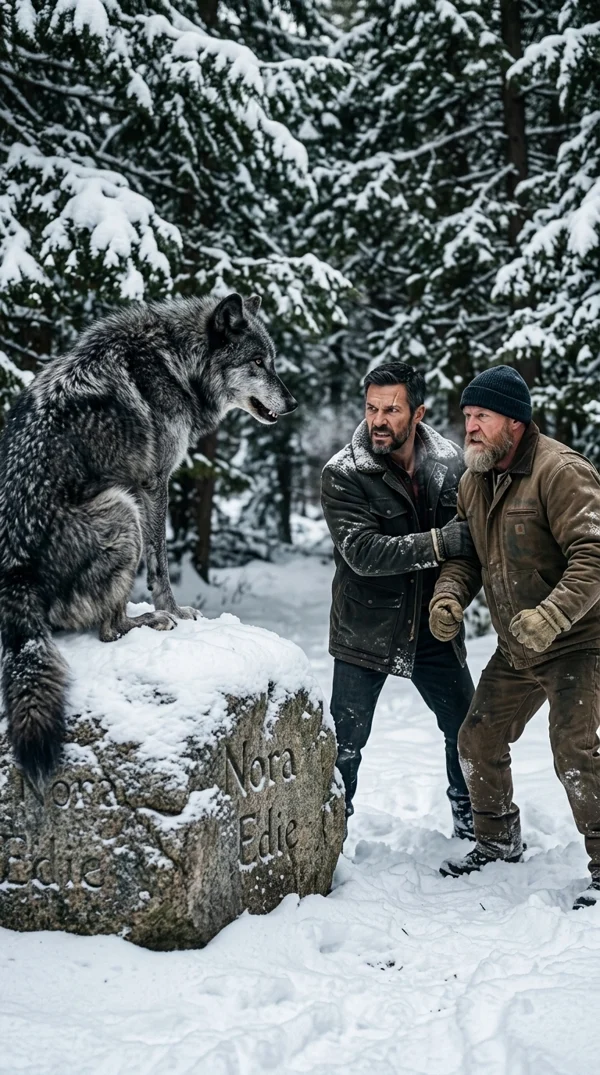
It sat at the edge of the hollow where the ground fell away toward the big lake: a boulder of gray granite about waist-high, rounded on top as if it had been sat on for a very long time. Somebody had brushed the snow off it. Carved into the flat face toward the lake, in letters an inch tall, cut deep with a chisel, were two lines.
N.H. 1919
E.I.H. 1961
I took off my glove and touched Edie’s initials. The stone was so cold it burned.
“Edith Ione,” I said. “She hated the Ione.”
“She told everybody it stood for I Owe Nobody Explanations.” Carys came and stood beside me. “Okay. You’ve been lied to by everybody you’ve met for a week, me included. Ask.”
“Nora. The three families. What did they actually agree?”
“Her name on the title, so no wolf could ever sell the den. Their backs on her roof and her woodpile, forever.”
“And the stone.”
“A Keeper brings her heir up here before she dies. The pack sees her. Only then can anybody tell her what we are.”
“That’s insane.”
“It’s a rule made by scared men in 1919 who’d seen what happened to wolves that got talked about. It’s caused more grief than anything else on this lake.” She kicked snow off her bearpaw. “Bowen broke it on your porch on Sunday. Raimo’s going to make him pay for that.”
“Edie never brought me.”
“No. She didn’t.”
“Why?”
Carys looked at the stone. “That’s Bowen’s to tell, too. I’m sorry.”
I put my glove back on. My hand was shaking, and it wasn’t the cold.
“And the other thing,” I said. “Whatever he thinks I am.”
She let out a long breath that hung in the air between us.
“A wolf’s bond wakes once,” she said. “Usually in our twenties. For one person.”
“And then what? You’re stuck?”
“It doesn’t decide anything. Plenty of us marry somebody else and are happy enough. It’s just there, like a compass that only points one way.” She glanced at me sideways. “Bowen’s woke the July you were nineteen. He came home from your grandma’s dock the first day he met you and dropped a whole tray of coffee mugs in my mother’s kitchen and didn’t know why.”
I stared at the lichen on the stone.
“In a human, it doesn’t do anything,” Carys went on. “That’s the sad part. That’s why there are so many stories about wolves who loved humans and nothing came of it. The human never feels a thing.” She paused. “Usually. Marit says it happened once. To Nora.” She looked at me sideways. “Nora played up here as a girl, before there was any agreement. Marit thinks that’s why. Edie never let you near this ridge, did she? Not once in twelve summers. Ask Marit what she thinks about that.”
“And Luna,” I said. “I heard someone say it at the supper. Under their breath.”
“The Alpha’s mate. Chosen by both of them, and the pack accepts her. She’s made up here, at the stone, in the coldest month. It’s beautiful, actually. You walk up the ridge alone in the dark, and…” She stopped. “Never mind. The point is, Copper Lake’s never had a human Luna, and the elders would rather eat their own boots.”
“I’m not anybody’s Luna,” I said. “I’m not anybody’s anything. I’m here to bury my grandmother and get my name off a mortgage.”
“Sure,” said Carys.
And then I knew where he was.
I was standing on top of the ridge with my wet knees and my aching hand, looking out toward the big lake, and the line under my collarbone drew tight and swung, the way a rod tip swings when something takes the bait, and settled. East. Four miles east, down by the water, at the yard, moving around inside the big steel barn. I could have pointed to him.
I turned my head and looked east before I could stop myself.

 100 to start reading with.
What did you think?