I lasted until nine.
Bowen had gone down off the ridge with Toivo at two, after they’d walked the whole length of the hollow and Toivo had crouched over the old man’s boot prints for a long time without saying anything. He’d told me there’d be men up there all night. He’d told me to lock the door. He hadn’t touched me again, and I hadn’t asked him to, and I’d spent the afternoon and evening in my grandmother’s house with every light on, cleaning things that were already clean and not opening the ledger on her desk, and listening to the old man’s voice say look where it got her over and over, in the tick of the stove, in the click of the ice at the shore.
At nine I put on Edie’s coat and got in the rental and drove.
The county road ran east to the end of the lake and crossed the outlet creek on a one-lane bridge, and then a two-track turned off it along the north shore, through birch and balsam, unplowed except for one set of wide tire tracks. I followed them. I didn’t let myself think about why. Something drew in with every quarter mile, and I followed that too.
The house sat on a rise above the water, where the trees opened up. It was built of logs, big ones, notched at the corners, with a steep roof and a stone chimney and a long porch facing south across the lake. There was a workshop behind it with sawdust drifted against the door, and down on the shore a little cedar building with its own stovepipe, steaming gently in the cold. One window was lit. Smoke went straight up from the chimney into a sky full of stars.
He opened the door before I’d turned the engine off.
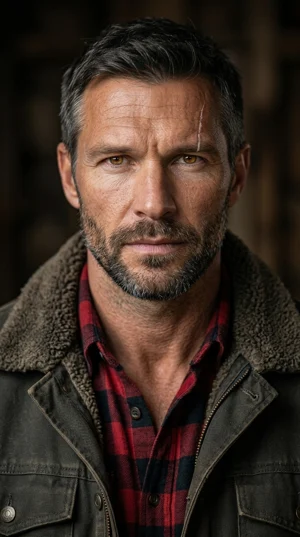
He stood in it with the light behind him, in a gray T-shirt and jeans, barefoot, and didn’t say anything. He didn’t ask why I’d come. He stood aside, and I went up his steps and past him into the warmth, and he shut the door on the cold.
He’d built all of it. I could tell. The long table was a single slab of something pale and old, with the saw marks planed out by hand. The shelves held marine engineering manuals, a run of Edie-era Reader’s Digest condensed books he must have bought by the box at a church sale, and nautical charts rolled into tubes. There was a woodstove the size of a small car, ticking, and a rag rug, and a couch that had seen things, and on the windowsill an old jar full of beach agates sorted by color.
And the window. The big one, on the south wall, looking out over the black lake.
Straight across the water, small and gold and perfectly framed in the middle of the glass, was my grandmother’s porch light.
I stood in front of it with my coat still on.
“How long,” I said, “have you been able to see her light from here?”
“Since I built the house.”
“When did you build the house?”
He didn’t answer for a while. “Two thousand six.”
The year after. He’d come back to this lake the year after I left it, and built a house on the far shore of it with a window exactly here. For twenty years he’d sat in this room and looked at Edie’s porch light, and every one of those nights I’d been in Phoenix, two thousand miles away, not thinking about him at all. That’s not true. I’d been not thinking about him very carefully.
I turned around.
“The old man,” I said. “Who was he?”
“Hematite.” Bowen stood by the stove with his arms folded. “The Hematite pack, from down on the Marquette Range. They lost their den twenty-some years ago. They’ve been looking ever since.”
“And what he said about Edie.”
He didn’t move at all. Something came up behind his face and stayed there.
“She was eighty-eight with a bad heart,” he said, very quietly. “I found her in her chair by the stove. She had her afghan on her knees. I don’t know what he meant.” His voice dropped. “I’ll find out.”
I believed him. That frightened me, how much I believed him.
“Why did you leave?” I said.
“My father.”
“That’s not an answer. That’s a name.”
He looked at the floor. Then back up at me.
“You know about the stone now,” he said. “Carys told you.”
I did know. I’d been putting it together all week, as I put a scheme together from the corners of other people’s paperwork: a column here, a date there, a rule nobody had thought to hide because nobody thought anyone would look. No one tells a human who hasn’t been stood at the stone.
“Because Edie never brought me up there,” I said slowly, “you weren’t allowed to tell me what you were. And you couldn’t keep me without telling me. So your father told you to let me go.”
He nodded, once.
“That’s most of it,” he said.
“And the rest?”
He opened his mouth, and I knew, I knew, what was coming. I crossed the room in four steps and put my hand flat over his mouth.
“If you say not tonight,” I said, “or tomorrow, or ask me later, I swear to God, Bowen Rhys, I’ll walk out that door and I’ll drive to the airport and I’ll never come back.”
His mouth moved under my palm without making words. He’d closed his eyes.
I took my hand away. I left it on his chest instead. His heart was going hard and slow under the T-shirt, and the line drew so tight it sang, and I stood there in his house with my coat still on and understood that I had not driven around this lake for answers.
“I didn’t come here for this,” I said.
“I know.”
“I want it anyway.” My voice wasn’t steady and I didn’t try to make it steady. “Tonight. Not because of anything. Not because I’ve forgiven you, or because I understand, because I don’t, either one. Not as an answer to anything. I just want you. Is that all right?”

 100 to start reading with.
What did you think?