She sat on the very edge of the second bed with her knees together and the book on her lap, and I made her a cup of the motel’s terrible coffee in the little machine, because it was something to do and because you give a frightened witness something warm to hold.
She didn’t drink it. She held it.
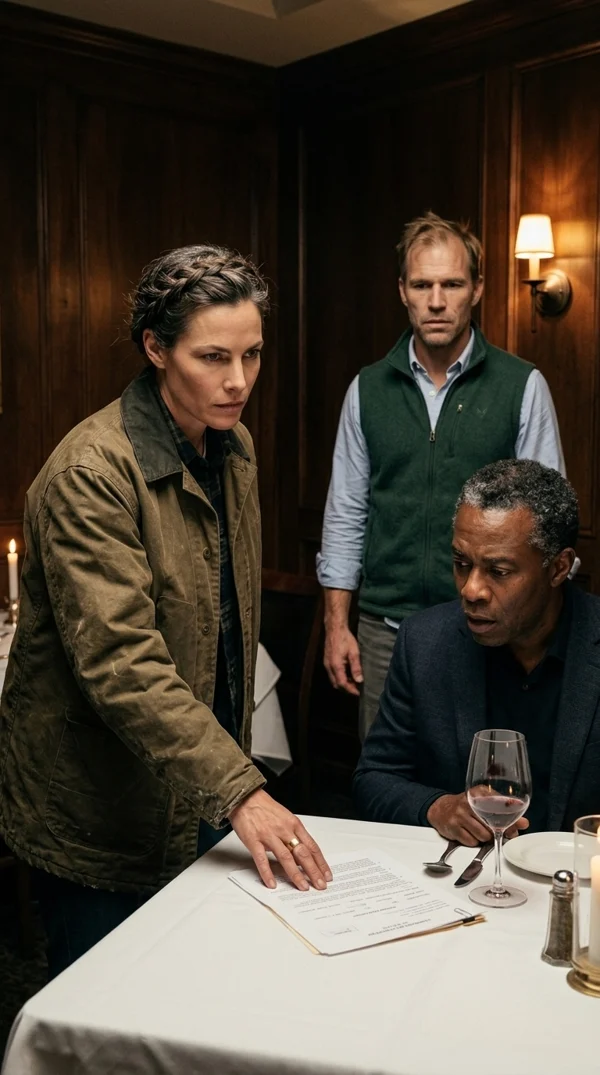
“I took the class last year,” she said. “The notary class. Graham said it’d save us money on investor paperwork if somebody in-house could do it. It’s a Saturday. They tell you the rules.” She looked at the coffee. “The first rule is the person has to be in front of you.”
“I know.”
“I know you know.” Her chin went. She got it back. “He came into the office at ten-thirty that morning with the papers already signed. He said you’d signed them at home at seven before you drove to Tucson, because you were testifying and couldn’t come in. He said you’d want it done right. I’d met you at the Christmas party. I’d met you at his birthday. I wrote personally known.” She opened the book on her knees and turned it toward me with both hands. “And he signed the journal for you. In the signer column. He said it was just a formality.”
It was a standard Arizona notary journal, the kind you buy from the state’s approved vendors, black cloth, numbered pages, columns ruled in blue: date, time, kind of act, name of signer, how identified, signature of signer, fee. Jolie’s handwriting ran down the left side of every page, round and careful, with the little hearts over the is.
Sept. 10. 10:30 a.m. Mortgage. Graham Pell. AZ DL. Signature: G. Pell.
Sept. 10. 10:30 a.m. Mortgage. Hazel Halloran. Personally known. Signature:
And there was my name again, in a third hand.
It was nothing like the mortgage. That one had been traced slowly by somebody with a lightbox. This one was fast and round and careless, a man’s idea of how his wife signs her name, written by a man who’d watched her do it for fourteen years and never once looked.
“He was in a hurry,” Jolie said. “He was always in a hurry.”
She looked at me then, properly, for the first time. I don’t know what she’d expected. Somebody taller, maybe. Somebody colder.
“He said you were cold,” she said. “When he moved me in. He said you counted things. The grocery receipts. The mileage on the car. He said living with you was like being audited.” Her mouth twisted. “Then I found out he hadn’t paid the electric bill since August, and I started counting things too.”
I didn’t say anything. There wasn’t anything to say that wouldn’t have been cruel to one of us.
“Am I going to prison?” she asked.
I could have lied to her. Graham would have. It would have been easy, and kind, and it would have cost her everything later.
“I don’t know,” I said. “I know it goes better for people who tell the truth first, before anyone makes them. I know the detective who’s been calling you is fair. And I know you came here on your own at eleven at night with the book under your arm, and that counts for something with everybody I’ve ever testified in front of.”
She nodded slowly. She drank the terrible coffee at last, all of it, and made a face.
I photographed every page with a ruler beside it. I wrote down the journal’s number and the dates of the first and last entries. Then I called Pietila, at what was seven in the morning in Michigan, and she picked up on the first ring and listened, and I heard her say Okay very quietly, like somebody whose long-awaited package had finally come.
“Don’t let her give it to you,” Pietila said. “Have her keep it. I’ll send a courier with an evidence bag and a form this afternoon. And Hazel? Ask her if there’s anything else.”
There was something else.
Jolie took out her phone. “He shares his messages to the family iPad,” she said. “Our iPad. He forgot. Last week he told me to delete a thread on it, so I screenshotted it first.” She swallowed. “He keeps saying I’ll be fine. I don’t believe him anymore.”
She sent me fourteen screenshots. My phone chimed fourteen times in the quiet room, like a slot machine paying out.
“I didn’t read them all,” she said. “I couldn’t.”
Saguaro Bridge Lending was in a strip mall on Scottsdale Road between a nail salon and a mattress store with a GOING OUT OF BUSINESS banner that, according to Yolanda, had been up since 2019. Dean Merkel came out from behind a partition in a golf shirt and a tan and saw Yolanda’s boots before he saw my face, and his smile went stiff around the edges.
He was a lot less relaxed in person. Lenders often are, when the forensic accountant on the phone turns out to be the borrower.
“I’ve told the Michigan detective everything,” he said, which I doubted. “Clean loan. We do our diligence.”
“You didn’t call me to confirm my signature,” I said. “On a million-two loan secured by land I didn’t own yet.”
He looked at Yolanda. Yolanda looked at her nails.
“Your husband brought it in notarized,” he said. “That’s what the notary’s for.”
“And the title? A title commitment would have shown my grandmother as the owner.”
He looked at the partition behind him as if somebody might come out from behind it and help. “He showed me the deed. You’re on it, after her. He said she was eighty-eight and you’d have it by spring, and he’d pay us off in ninety days out of his next round.” He shrugged, and it didn’t come off. “We skipped the title policy. Saved him eleven grand.”

 100 to start reading with.

What did you think?