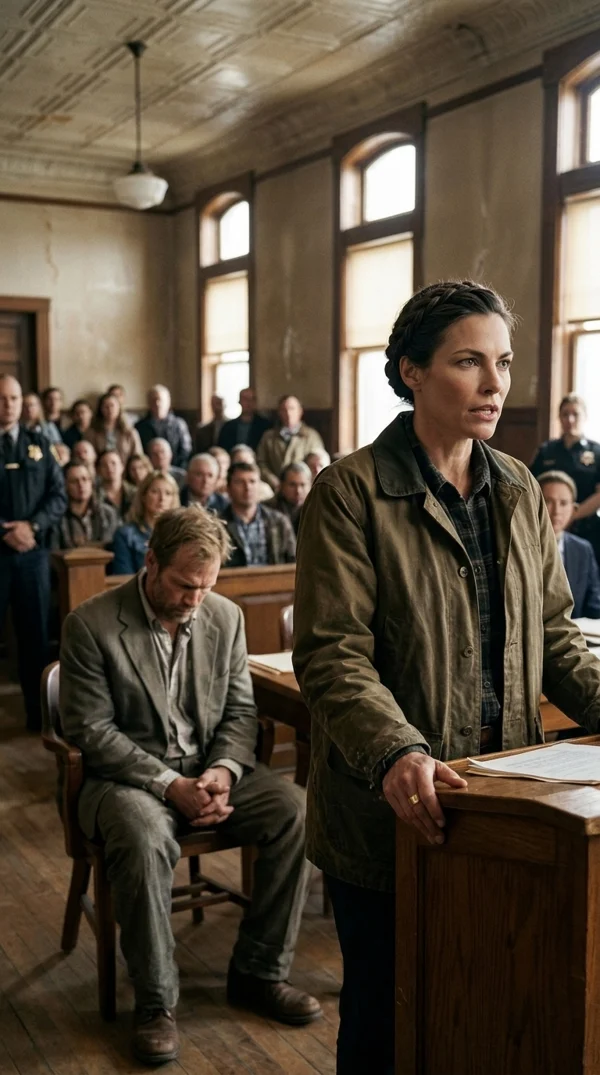
Lakeshore Title had the third floor of a red sandstone building on Front Street, and the closing room was glass on two sides. One side looked into the hall. The other looked down the hill to the harbor, white and still, and the old ore dock standing out into it on its concrete legs, a quarter of a mile of dark iron that hadn’t loaded a ship since before I was born.
I got there at twenty to ten, with Arne, and the room was empty except for the title officer setting out pens.
“Ingrid Hautala,” she said, and shook my hand. She was fifty or so, in a gray suit, with half-moon glasses and the calm of a woman who’d closed four thousand sales and seen every kind of person cry at the table. “Arne says you’ll want the corner.”
“If I may.”
“Sit where you like. It’s your land until noon.”
I took the corner chair, against the window, with every face in the room in front of me and the door to the hall in sight. It’s where I always sit. The man across from you shouldn’t have the light behind him, and he shouldn’t have the door.
Ida came at a quarter to. Jonas walked her to the door of the closing room and no farther, and she came in on her stick, hung the man’s black coat on the rack, and sat down beside me in the gray cardigan with the cameo at her throat. She set a canvas shopping bag on the floor by her feet. The black ledger was in it.
“Ma’am,” Ingrid said, and looked at her list.
“Ida Koski. Trustee of the Hematite Ore Trust.” Ida folded her big hands on the table. “I believe I’m a party.”
Ingrid looked at her over the glasses for a second. Then she wrote the name down. “So you are,” she said.
Through the glass wall I could see the reception area by the elevator. Yolanda was in one of the chairs in her cowboy boots, with a paper cup of coffee, reading her phone and not reading it. She’d flown in the night before and told me when she landed. Beside her, under a framed print of a lighthouse, four old people from Hematite sat in a row in their good winter coats with their hats on their knees. Jonas stood with them.
Bowen came at ten to.
He came down the hall in a clean flannel shirt and his canvas coat, nodded to Ingrid and to Arne, and to me, and stood by the door with his back to the wall. He folded his arms. He didn’t sit. He didn’t look at me again.
The line lay as slack as it had for two weeks. I didn’t need it to tell me he was there.
Strake came at ten exactly, with Rautio.
His arm was out of the sling. He carried it a little stiffly, close to his side, like a thing he’d been told to be careful of and had decided not to be. The stitches were gone from his jaw. He wore a charcoal suit and a white shirt and no tie, and he came in smiling, and he shook Ingrid’s hand and said good morning to Arne by name.
Then he saw Ida.
He stopped with one hand on the back of his chair. It was a very small stop. I’ve spent my working life watching people come through doors.
“Auntie Ida,” he said. “I didn’t know you were coming down.”
“No,” said Ida. “You didn’t.”
He sat. Rautio sat beside him and opened a briefcase. At five past, Graham came in with his bond lawyer, a heavy man with a cold, and took the chair farthest from Strake, with his hands in his lap. He didn’t look at me. He looked at the ore dock.
Ingrid ran the closing as she must have run four thousand others. The seller’s deed. The lease back to the Copper Lake pack. Black Spruce’s discharge of the mortgage, prepared by Mr. Rautio. Mr. Pell’s release from the note, which Black Spruce would sign when the discharge was recorded. The settlement statement. Each in its own stack, with a yellow flag where the signatures went.
“And the buyer’s funds,” she said, and looked at her screen. “We received a wire at nine fifty-two this morning. Nine hundred thousand even.” She read it off. “From the Hematite Ore Trust, account ending four-four-one, at the Iron Range Savings Bank in Ishpeming. For credit of Red Hill Holdings.”
“That’s right,” said Strake.
I hadn’t said anything yet. I’d been sitting in the corner with my hands folded on the purchase agreement, closed.
“Mr. Strake,” I said. “Before I sign anything. Can you tell me about the money?”
He turned to me with that pleasant face. “What would you like to know?”
“Whatever you think I should.”
It was a soft question. It’s always a soft question. A hard one tells the man what you’re afraid of, and then he knows what to hide.
And he was proud of it. I could see that. He’d been waiting twenty-eight years for somebody to ask.
“It’s my people’s money,” he said. “Every dollar of it. When my father sold the hill in 1998, the mine paid the pack for it, and the pack put it in trust, so it would last. It’s paid for nursing school and roofs and funerals for twenty-eight years. It’s paid for hip replacements.” His voice was warm. “And now it’s paying for a den. Which is what it was always meant to do. The hill went into a pit. This money is the hill. I’m only turning it back into ground.”
I didn’t say anything.
The silence sat on the table. Ingrid capped her pen. Rautio moved a paper an inch. Out in the harbor nothing moved at all.
“I made a promise when I was nineteen,” Strake said, into it. “To the elders. On the rim of that pit. That I’d get us another one.” He smiled a little. “Some men’s promises take longer than others.”
“The trust has two trustees,” I said.
“It does.”
“And both of them authorized this?”
“Both,” said Strake.
Ingrid didn’t look at me. Arne had called her a week before, and she’d have asked anyway.
“Then I’ll need the trust’s authorization for the file,” she said. “The signed instruction from the trustees. It’s ordinary, Mr. Strake. When the money comes from a trust, I keep the trust’s paper with the deed. Otherwise I can’t insure the sale.”
“Of course.”
Rautio found it in the briefcase and passed it across. One page, on the trust’s letterhead, with a red seal at the top. The undersigned trustees hereby authorize the transfer of $900,000.00 to Lakeshore Title Company for the purchase of real property in Halloran Township. Two lines at the bottom. Two signatures.
Ingrid read it. She turned it over to make sure there was nothing on the back. Then she looked at the bottom of the page, and at the second name, and then she looked up, slowly, at the old woman sitting beside me.
She didn’t say anything. She slid the page down the table to Ida.
Ida put on her reading glasses and read the whole page at her own pace, as she’d read the July one in the back room of the Miners’ Hall. Nobody hurried her. Strake sat with his good hand flat on the table and watched her read, and his face didn’t change, and I watched his hand.
Ida took her glasses off.
“That’s my name,” she said. “That’s not my hand.”
Rautio closed his eyes.
“Auntie Ida,” said Strake, very gently. “You’re eighty years old. You signed it at the house, in December, at the kitchen table. You don’t remember.”
“I remember everything,” said Ida Koski. She lifted the black ledger out of the canvas bag and opened it on the table. “I have met with Conrad Strake as a trustee of the Ore Trust two times last year. On the ninth of March, for the Johnson girl’s nursing school, and on the second of May, for a roof. We wrote it here and both signed. I have not met with him since.” She turned the book so Ingrid could see the page. “Nothing in June. Nothing in July. Nothing in December. I didn’t sign this, and I didn’t sign the one in July for two million three hundred thousand, and a woman in Arizona with a microscope has said so in writing.” She put her finger on the forged signature. “I start my I with a hook. I have since I was six. Whoever did this started it with a dot.”

 100 to start reading with.

What did you think?