The lantern hung on a nail inside the woodshed door, where it had hung my whole life, above the tub where the pack left its clothes. I’d walked past it a thousand times. A kerosene lantern with a wire bail and a tin base gone brown with age and a glass chimney with a chip out of the rim. When I took it down on Saturday afternoon and turned it over, somebody had scratched two letters into the bottom of the tin with the point of a nail.
N.H.
I cleaned the chimney at Edie’s sink with newspaper, as she’d taught me when I was seven and the power went out in an ice storm. I trimmed the wick with her sewing scissors. I filled it from the red can in the mudroom, and spilled some, and the kitchen smelled of kerosene all evening, which is the smell of every winter of my childhood, and I sat at her table and let it.
Carys came at six to do my hair. She’d insisted.
“Nobody does anything to your hair on the ridge,” I said. “It’s ten below. I’ll have a hat on.”
“You’ll have a hat on until you get to the stone,” said Carys, “and then you’ll take it off, because you’re going to want to, and I’m not having my brother’s Luna look like she was dragged up there by a snowmobile.” She stood behind Edie’s chair with a comb in her teeth and a fistful of bobby pins and worked my hair into a braid that went around my head and pinned it, and when she was done she put her hands on my shoulders and looked at me in the dark window over the sink.
“Ida’s hair,” I said.
“Ida showed me. On Wednesday. In the clinic parking lot.” Carys’s face went pink. “Jonas drove her down. For her blood pressure. Supposedly.”
“Supposedly.”
“Shut up,” said Carys, and hugged me from behind, hard, with her chin on the top of my braid. “Shut up, shut up. I’m so happy I could throw up.”
At eleven I went out the mudroom door alone, with the lantern.
There was no moon. The Wolf Moon was a week gone and the half that was left of it wouldn’t rise until after midnight, and the dark between the house and the ridge was as complete as the dark in November, when I’d gone up that path in terror with Edie’s flashlight switched off in my pocket. I didn’t have a flashlight tonight. I had Nora’s lantern, and a small round room of gold light that moved with me, and outside it, nothing.
I wore Edie’s barn coat and her bearpaws and her ring on my thumb. I wore the hat Carys had said I’d take off.
At the bottom of the path, where it leaves the yard and goes into the hemlocks, there was a wolf.
He was sitting at the edge of the light with his tail around his feet. A big old wolf, rangy and grizzled, almost white at the muzzle, with a torn ear that had healed ragged a long time ago. He didn’t get up when I came. He considered me, and the lantern, and then he turned his head and looked past me up the path into the dark, as if to say it was a long way and I’d better get on.
I’d never seen Raimo Saari as a wolf. I’d have known him anyway.
I walked past him into the trees. I didn’t look back. Marit had told me not to; nobody looks back on the path. And when I’d gone a dozen steps, I heard him behind me. He hadn’t moved from his place at the foot of the path. He’d lifted his head, and given one long note into the dark, old and cracked and steady, and held it until it ran out.
That was how it was done. Marit hadn’t told me that part. Nobody follows the Luna up. Each wolf who’ll have her keeps its place, and sings her past it, and the song stays on the ridge behind her where she can hear it all the way up.
The path climbed. The hemlocks closed overhead. At the first bend, where the path turns along the face of the slope and you can see the lake through the trees in daylight, there was another one. Small and white, sitting very upright in the snow, with eyes the lantern turned to silver. I’d have known her too. I walked past her, and behind me, lighter and higher than Raimo’s, Marit’s voice went up and joined his.
After that I didn’t count. I couldn’t have.
They were along the whole path. One at every bend, and then two, and then three and four, sitting in the snow at the rim of the lantern’s light under the hemlocks, and each one of them, as I came level with it, lifted its head and sang. A small red wolf, pleased with herself, who touched her nose to the back of my knee before she did it. A huge dark one I’d have known for Toivo from across the lake, with a voice like a foghorn. Kaisa, long-legged, who’d asked me in November if I was going to be their Luna, and whom I’d told I was going to learn to keep the ridge, and that was all. A pair of yearlings who started too early and had to start again. Wolves I’d sat with in the Finnish Hall and stood beside on the courthouse steps and never once seen in their other shape, and I knew them all anyway, by the way they looked at me before they lifted their heads.
None of them moved from its place. The song did. It came up the ridge behind me bend by bend, like the lights of a harbor coming on one by one behind a boat going out, until the whole dark slope below me was singing and I was walking at the top edge of it, alone, with a lantern.
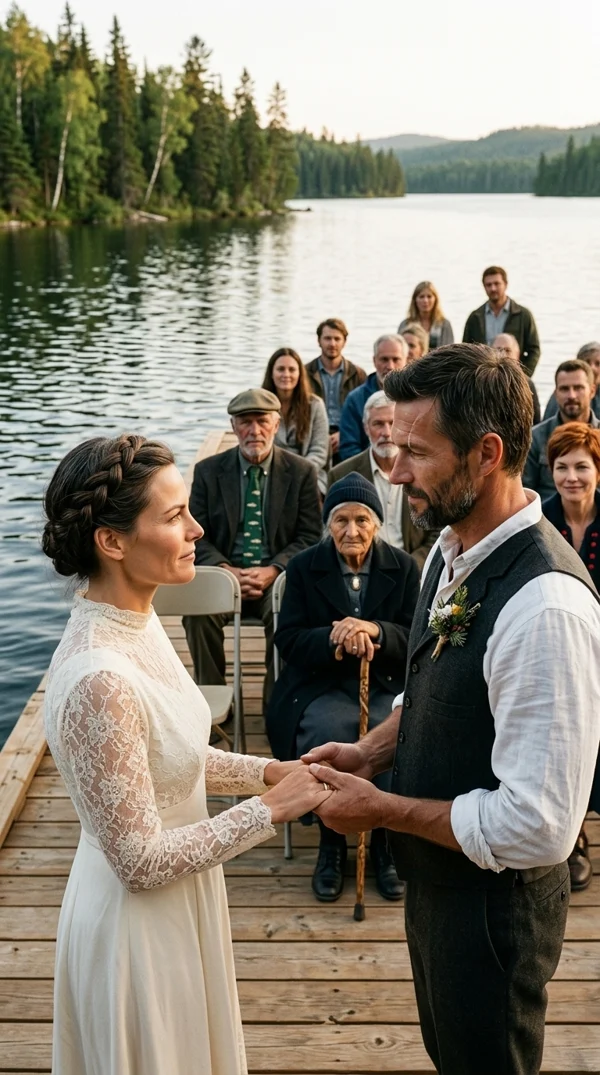
The hollow opened in front of me at the top of the path, with the great cedars standing around it in the starlight and their arms full of snow, and the den under the biggest one, black and quiet. And at the stone, in the middle of all that white, a man was standing with his hands at his sides.

 100 to start reading with.
What did you think?