Houses in the Water, chapter 3 of The Beast That Wouldn't Kneel
The old road ended in a kitchen.
Iona did not recognize it at first. She saw a low wall, nettles and a rectangle of water where the river had pushed into the bank. Then her boot found a threshold. Beyond it lay a hearth, its stones black beneath nine years of silt.
She stopped with one foot inside the doorway.
Dain nearly walked into her. “What is it?”
She pointed.
He lowered the keg. The wood knocked against the threshold with a hollow, domestic sound.
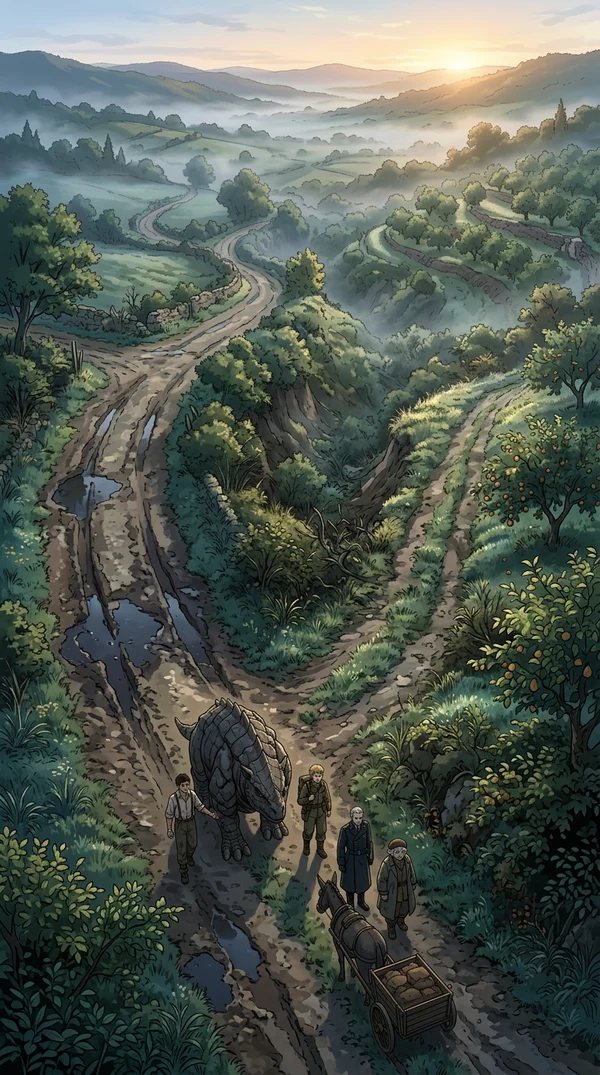
Across the flooded floor, Seventeen put its mouth into the river. The water around its jaw cleared, clouded and cleared again. It drank for a long time. When it raised its head, a strand of weed hung from the scar on its lip.
Iona stepped over the wall.
“Don’t go far,” Dain said.
The room was smaller than the one in the memory. Or perhaps it only seemed smaller because she occupied her own body. There had been a windowsill. A woman. Water climbing. She tried to place the window against the remaining walls, and immediately found herself choosing the wall that best suited what she wanted.
She stopped doing it.
A little ridge of mud ran along the hearth. She scraped it with the toe of her boot and uncovered a tile, green beneath the brown. One corner was missing. On the glazed surface someone had painted a fish so round it looked like a potato with fins.
She picked it up.
“This wasn’t a crossing,” she said.
Dain stood outside the doorway. He had taken the itinerary out again.
“Could have been a toll keeper’s house.”
She looked beyond him. Low walls ran between the alders. Another threshold faced theirs across the strip of old road. Further along, the ground rose in a regular line under the grass.
“A large toll keeper.”
“People leave places.”
“Then someone wrote that there were no houses, when they meant there were empty houses.”
He folded the paper along its existing crease. “We came for a ford.”
She put the tile in her pocket.
They found the crossing downstream, where the river divided around an island of gravel and willow. The nearer channel was shallow enough to show individual stones. The further one moved faster. On the opposite bank an old ramp climbed toward pasture.
Iona cut a straight branch and waded in.
The cold reached through her boots at once. She tested each step with the branch. Pebbles rolled beneath her heels. Halfway across, the water rose above her knees and pushed hard against the outside of her leg.
Behind her, Dain unbuckled his sword belt.
“Stay there,” she called.
“You need a rope.”
She knew it. She had known it before entering, but asking him for one would have meant admitting she needed anything from the man who held her irons.
She came back.
He tied the lead rope around her waist without comment. His knot was a competent one. She retied it anyway, then wished she hadn’t when he stepped back and let her.
This time she reached the gravel island. It was scarcely wide enough for the beast to turn on. The far channel was deceptive: beneath the smooth surface, the branch met nothing until she pushed it almost to the crook of her arm.
She moved upstream. There, a line of old paving crossed the bed. Two stones remained level; the third tipped when she tested it. A dark space opened beneath its edge.
She stood looking down until Dain tugged the rope.
“Well?”
“I don’t know yet.”
It took them an hour to find a line she trusted. They carried stones into a gap, testing the footing after each armful. Dain worked in his stockings, trousers rolled above the knee. He had a hole in one heel. When Iona offered to take the next load, he shook his head and bent for another stone.
On the bank, Seventeen ate the willow leaves they had cut. Its jaws moved steadily. The wound had stopped bleeding.
By the time the channel was ready, the afternoon had shortened. Shadows lay across the near bank. Iona checked the sacks on the harness, then untied them. Barley that got wet would weigh more than she could lift, and they had little enough to begin with.
“We’ll take the food first,” she said.
Dain looked at the animal. “Will it stay?”
“It might.”
He waited for a better answer.
She lifted one end of the first sack.
They carried the grain across between them, the rope fixed to an alder behind and paid out toward the gravel bar. On the return journey Dain slipped. His left foot went down between two stones. Iona caught his sleeve, and for a moment both of them leaned against the current, neither balanced enough to move.
“Don’t pull,” he said.
She held him where he was while he worked his foot free. The stocking stayed in the gap. They watched its grey toe flutter underwater.
“That’ll come out of your wages,” she said.
He gave a single surprised laugh. Then the cold caught him and he began to shiver.
Seventeen would not enter the ford.
It approached to the edge, put one forefoot into the water, and withdrew. Iona crossed to the island. It watched her go, its eye following the branch in her hand.
She laid the branch down.
“Nothing to do with you,” she said.
The animal stepped sideways. Behind it lay the drowned kitchen, a shallow pool shining where a floor should have been. It turned toward that pool rather than the crossing.
Dain came up beside Iona.
“The food’s over there.”
“It can see.”
“Then why—”
She raised a hand. Seventeen was lowering itself, slowly, folding its hind legs first. The wounded shoulder made it pause. Its mouth hung open. A little clicking noise came from deep behind the jaw.
Iona had heard that noise in the pen.
She went back to the bank and crouched several paces away. The animal did not look at her. Its eye stayed fixed on the flooded room.
She could make another crossing attempt. Tighten the strap. Put the rope on. Dain still had the bit and the fork. The broken pin could be replaced with a nail; she had seen worse repairs hold for years.
Her bandaged hand lay open on her knee.
She closed it and stood.
“Fetch the grain back.”
Dain’s face hardened. “We just carried it over.”
“Half a sack. We’ll rest here.”
“We cannot spend the night because an animal is looking at a puddle.”
“Look at its shoulder.”
“I’m looking at the sun.”
They stood facing each other while water dripped from his bare heel. She could have told him about the woman in the window. The words rose as far as her mouth. She saw herself saying them, saw him taking out his injury form and recording a handler who had begun seeing things.
“Two hours,” she said.
“One.”
She nodded.
He went for the grain.
While the beast rested, Iona followed the old street. She kept within sight of Dain. He had hung his remaining stocking on a branch and was rubbing his feet beneath his coat.
There were five doorways before the road disappeared under the river. In one, a pear tree had grown through a roof beam. In another, the remains of a stair led three steps above the mud and stopped. Iona climbed them. From the top she could see the arrangement of the settlement: houses facing the water, a wider building by the ramp, gardens running back toward the orchard slope.
Someone had cleared this place from a map without clearing it from the ground.
At the wider building, she found a post leaning into the reeds. Its upper face had been hacked away. Below the cuts, protected by the earth, a strip of incised letters remained.
She knelt and dug with Bess’s knife.
LETH DISTRICT. WATER TOLL VII.
Beneath that, a date. The year before the flood.
She worked the knife around the post until she found the next line. There were numbers, a measure of river frontage and a tax rate. The lettering was too deep to carry away; she had nothing to write on except the transport order, which Dain held.
“Pell,” she called.
He arrived carrying his boot. “You have ten minutes.”
She showed him the inscription.
He crouched reluctantly, then put the boot down. He wiped the date with his thumb.
“That’s a rate post.”
“For houses?”
“For occupied frontage. Warehouses, houses, a landing.”
“Not an abandoned crossing.”
He said nothing.
She took the green tile out of her pocket and set it on the post. Beside the measured figures, the fish looked absurdly cheerful.
“I saw this place,” she said.
“You’ve been here?”
“In the yard. When it touched my hand.”
He looked at her hand, then at the animal by the water.
She told him about the apron and the window. She left out nothing she could remember, though halfway through she began to wish she had left out all of it. Dain did not interrupt. At the end he picked up his boot.
“Did you hit your head when you fell?”
“No.”
“Had you eaten?”
She looked away.
He reached into his pocket and offered her the last piece of bread from noon. She nearly knocked it out of his hand.
Then her stomach cramped. She took it.
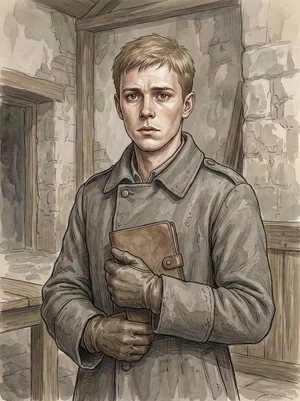
Dain pulled a narrow notebook from the pack containing the fork. He turned past columns of expenses and copied the inscription, using his thumb to measure the spaces between the figures. When he finished, he showed it to her.
“This I can put my name to,” he said.
By evening Seventeen crossed. It went while they were carrying the second sack, stepping into the river without warning. Water surged around their knees. Iona stumbled onto the gravel bar and stayed there while the animal passed, giving it the whole narrow line they had found.
On the far bank it shook itself. Mud spattered Dain’s clean copy of the inscription.
He held the book open until the drops dried.
Iona looked back across the water at the post. From here she could see what she had been too close to notice. The cuts across its upper face were all the same depth and ran at the same angle, as regular as the teeth of a comb. Floods did not do that, and neither did rot. Someone had stood where she had knelt, with a chisel and an afternoon, and taken off the top of the post, where a rate post carried the date of its last assessment.
They had missed the lower date only because the earth had already covered it.
What did you think?