The Animal's Road, chapter 5 of The Beast That Wouldn't Kneel
They had left the water behind.
Iona realized it when she reached for the keg and found only the sack of barley. She stood with her hand half raised. Dain saw her looking and looked back down the slope.
“No,” she said.
“I wasn’t going to.”
Neither believed the other.
The drainage road ran between an old retaining wall and fields gone to seed. Water moved in a narrow ditch beneath the wall, too shallow for Seventeen to drink without pressing its injured shoulder against the stones. Iona tried cupping it in her hands. By the time she reached the animal’s mouth, most of it had run through her fingers.
Dain took a tin mess bowl from his pack.
She accepted it without thanking him. It took many journeys between ditch and beast to give it a little water. By the end, her back ached where the stone had hit her and Seventeen was nosing the empty bowl with impatient clicks.
“That’s all for now.”
It pushed the bowl against her chest. She filled it again.
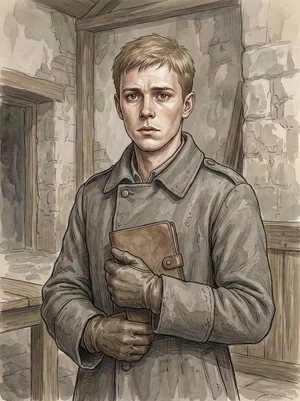
While she worked, Dain spread his pack on the grass. The command case and wrapped bit lay beside his notebook, a spare shirt, a little packet of salt and the original transport papers. He counted the grain they had saved. The sack was less than half full; its seam had split during the climb.
He sewed the seam with a needle from his pay packet.
“They don’t charge for those?” Iona asked.
“They charge for everything.”
He pulled the thread through with his teeth. His lip opened again and marked the barley sack with a little spot of blood.
She looked away before he caught her watching.
At a fork in the road they found a boundary stone bearing a white stripe. Someone had painted it over an older imperial mark. Dain put his palm on the top, then turned toward the western hills.
“Whitebank’s down that valley.”
“How far?”
“A day’s road. More like this.”
“A town?”
“Treaty city. My culvert maps stopped at the boundary. Their surveyor made me wait while he measured our ditch.”
She studied the white stripe. It had been renewed recently. The old carving showed through where the paint had run thin.
“Will they take us?”
“They hear petitions.”
“That wasn’t what I asked.”
“It’s what I know.”
The sound of a horse reached them along the retaining wall.
They moved into the field, crouching below a bank of dead thistles. Seventeen remained on the road. Iona beckoned, then hated herself for expecting a human gesture to explain a mounted pursuit.
The animal turned toward a stand of hazel and began pushing through it.
They followed.
From the other side of the bushes Iona saw two riders pass along the road. One wore the close-buttoned coat. He rode slowly, bent forward, looking for tracks. The other carried a horn. Both stopped at the place where Seventeen had stood drinking.
There was no hiding those footprints.
Iona drew Bess’s knife. The chipped handle had become slippery in her palm. Dain touched her wrist and pointed downhill.
Seventeen had found a deer path under the hazel. It was enlarging it as it went. Stems broke against the plates, leaving bright scratches. The riders would hear that soon enough.
They hurried after the beast until the field dropped away and the sound of hooves disappeared. At the bottom of the slope, a stream crossed the path. Seventeen stepped into it and stopped. Water ran around its feet.
Iona waited on the bank. Dain knelt to drink, then filled his bowl and handed it to her. She drank too quickly and coughed half of it back.
“We could leave it here,” he said.
She lowered the bowl.
“They want the animal. We can’t hide it.”
“They want me at Eight.”
“You can run faster without it.”
She looked at the stream running clear around the plates. The thought had already occurred to her. She resented him for putting it where she had to look at it.
“You could run faster without either of us.”
He sat back on his heels. His boots were patched in three places; one stocking was gone. Somewhere in his pack were ten coins, perhaps fewer now. He touched the place inside his shirt where he had put the order.
“I could say you took the papers.”
“You could.”
“And my coat.”
“A desperate woman.”
He almost smiled. Then the expression went away.
“Where would you go?” he asked.
She knew the answer so well she nearly gave it. There was a room above a cooper’s yard in the northern town where her sister lived. Before her conviction, she had asked the landlord about it twice. It had a little stove and a window facing away from the yard. The landlord would not promise to keep it, but he had said she could write when she had her discharge.
She had never written.
“North,” she said.
“Work?”
“Something that doesn’t need a bell.”
He turned the bowl between his hands. “I wanted a place on a lock crew. River locks. They hire men who can keep a level.”
“Why didn’t you take it?”
“They wanted me at spring opening. The corps kept extending my service to finish the closure accounts.”
She looked at his careful little sewing stitches in the barley sack. “You should have gone.”
“They kept my last quarter’s pay.”
“You should have gone anyway.”
He set the bowl down. She heard her own advice as he must have heard it: a woman who had stayed for years explaining how easily he could have left. She reached for the bowl, then drew her hand back.
“I kept thinking there would be a better time,” she said.
“Was there?”
Across the stream, Seventeen tore a strip of bark from a fallen branch. It held the wood down with one foot while it worried the loose edge, intent on a problem that had nothing to do with them.
“I don’t know,” she said. “I stopped looking for one.”
Dain nodded once, not agreement so much as recognition. He poured the last of the water from the bowl where the roots of a young tree reached into the bank.
“I put the iron on you.”
She rinsed the bowl. “You did.”
The stream was too cold to stand in for long. Seventeen climbed out and turned upstream. Dain packed his things. Neither said which road they had chosen, but when they reached the next white-marked stone, they went toward it together.
The quickest path to Whitebank crossed a ridge through the remains of a military signal station. They found its tower in the late afternoon: a squat square of stone, roofless, with a rusted crosspiece still bolted above its entrance. Below the crosspiece hung three narrow bells.
Seventeen stopped at the foot of the hill.
The path beyond the station was broad and dry. Iona could see it curving into open pasture on the western side. A walk of ten minutes would put the ridge between them and the men behind.
She climbed halfway and waited.
The beast backed away.
She came down, walked past its head and tried the approach from the other side. The animal turned with her but would not advance. Its left forefoot trembled. The shoulder pad had worked loose again; she could see the red edge beneath the leather.
“We can go around the tower,” Dain said.
“The path’s on a shelf. There’s nowhere to go around.”
“Below the hill, then.”
She looked into the ravine. Trees crowded its sides. Water gleamed far beneath them. It might take two hours to find a crossing, and the sun had already reached the ridge.
“Come on,” she said to Seventeen.
It stood looking past her.
She fastened the lead to the yoke and pulled.
The animal’s head moved an inch. The wounded shoulder came forward beneath the harness. She pulled again, turning her body the way she had taught younger handlers to do, using the incline and the animal’s own discomfort.
It made the clicking noise.
Dain said her name.
She kept the rope tight for another moment. Long enough to feel what she was doing. Then she let it fall.
Seventeen backed until the lead dragged free of her fingers.
“I know,” she said, though neither Dain nor the animal had asked whether she knew.
She went to the shoulder. The beast swung its head toward her, too fast. She stopped out of reach and waited until its eye opened fully.
Taking off the yoke would mean losing the only place to sling the grain. It meant no chest ring for a lead. It meant that if the animal wandered while they slept, she would have nothing to catch but its skin, and that skin covered an animal built to pull gates from their hinges.
She put Bess’s knife on the ground where she could reach it.
The first fastening opened easily. The second had swollen around a wooden peg. She worked the peg loose with the knife tip, pausing whenever Seventeen shifted. Dain came to hold the weight of the loosened frame.
“This side?” he asked.
“Under the bow. Keep your fingers out of the joint.”
Together they lowered the front half. The rear straps still held. Seventeen moved forward, dragging them two stumbling steps before Iona got the last buckle undone.
The yoke fell on its side.
Under it, the beast’s skin was grey and ridged where pressure had kept the air away. Old sores marked the places earlier straps had lain. Iona picked a small stone from one crease. It had been there long enough for the skin to grow around its edge.
She put the stone in her pocket beside the green tile.
Dain lifted the barley sack to his shoulder. Iona cut away a sound length of harness rope and rolled it. The frame they had removed was worth more than all the food they had left. They left it beside the path.
Seventeen lowered its head to smell it.
“We have to move,” Dain said.
She knew.
They took the ravine path. For several minutes the beast did not follow. Iona could hear only their own feet on loose stone. She nearly turned back at every bend.
Then a hazel branch snapped above them. Dust trickled down the slope. Seventeen appeared between the trees, coming on its own line, its head moving freely without the yoke.
It passed them and stopped at a muddy hollow where the stream widened. It began rolling its uninjured side against the wet bank.
“You could have told us,” Dain said to it.
Iona sat down on a stone. She found she was shaking. She pressed both hands between her knees until the shaking stopped.
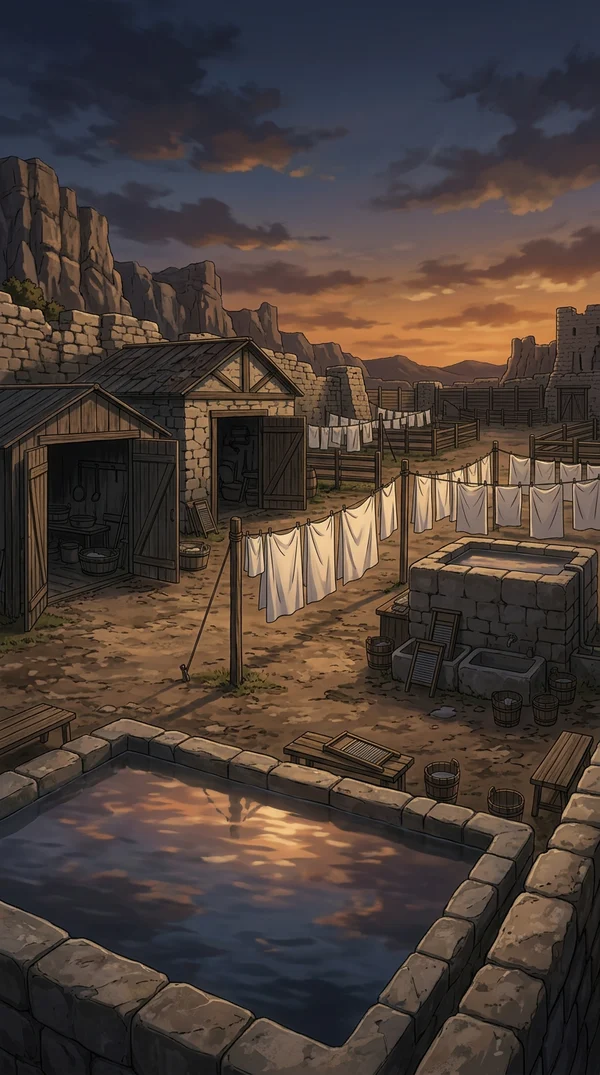
They followed the stream west until dark. When it passed under a paved track, they found the remains of a wash yard. A wheel turned slowly beside a long, low building. Sheets hung from a line, pale enough to catch the last light.
Someone had mended the roof with two different colors of tile.
Iona stopped before the open gate.
There was a gutter across the entrance, worn smooth where many boots had passed. Beside it stood a trough with a stiff brush chained to its rim.
“Water and a roof,” Dain said.
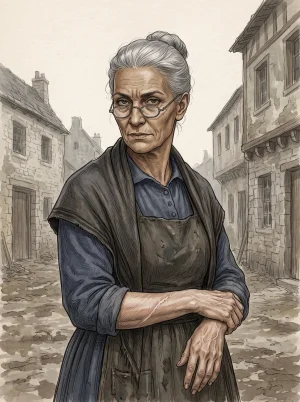
She could smell the bitter soap before she saw the woman in the doorway.
“Go around,” Iona said.
But Seventeen had already put its mouth into the trough, and the woman had already lifted the lamp to see who had come.
What did you think?