Leva walked faster than either of them expected.
She carried her lamp in one hand and a walking stick in the other. At each junction she stopped just long enough to inspect the drainage, then chose a path. Once Dain offered to take the lamp. She shook her head without breaking stride.
Seventeen followed the smell of the river below them. Sometimes that took it onto Leva’s path. Sometimes it took it through a fence, leaving Iona to make what repairs she could with a stone and a length of old cord. By midmorning she had given up apologizing to empty fields.
At a hill overlooking a broad bend, Leva stopped.
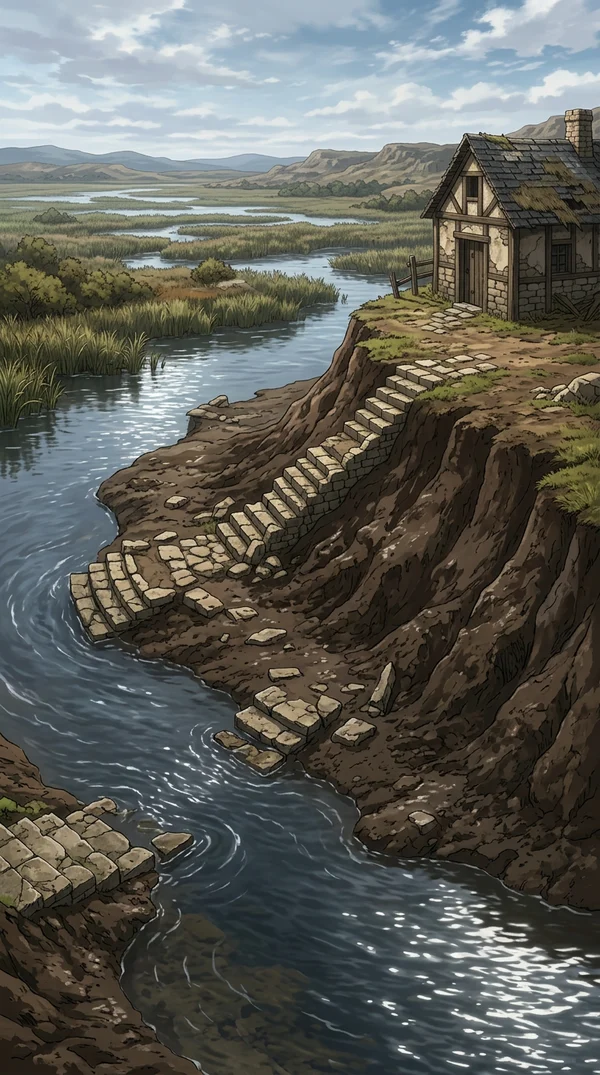
The toll house stood on a spit of raised ground beside a stone bridge. Its roof had collapsed at the river end. The bridge itself remained intact, narrow and high, with a parapet wide enough for a man to sit on. On the far side, the road climbed toward a white tower.
“Whitebank?” Dain asked.
“One of their boundary posts. The city is beyond.”
Iona counted the bridge’s arches. The central one was tall, its supports washed clear to the bedrock. Seventeen could cross it if the approach was wide enough. She caught herself planning the ropes and stopped.
Leva pointed to the toll house’s landward door.
“That’s where the scales were.”
The door had fallen inward. Dain lifted it enough for Leva to pass. Inside, a rusted scale beam hung from the ceiling, its pans missing. Rainwater stood in hollows between the floorboards. A bird flew out through the broken roof as they entered, scattering dust over Dain’s shoulders.
Iona remained by the entrance, watching the road.
“Which floor?” she asked.
Leva tapped with her stick. The boards gave back different sounds: solid by the wall, hollow toward the middle, a wet crunch beneath the collapsed roof.
“They had a stone well for the duplicates. The floor was built over it.”
“A well full of paper?”
“A dry well. Sealed jars. It’s what the river houses used before anyone had enough iron for chests.”
Dain knelt by a board and slid his knife into the join. His blade bent.
“Don’t break it,” Iona said.
He looked at hers.
She left the doorway and helped him lift the board with a fallen piece of the scale frame. Beneath it was empty space and a beam furred with white decay. No jars. No stone well.
Leva tapped further toward the river.
“It was under the place they stood to settle accounts.”
“You said the scales were here.”
“The scales were here. The man who took your money stood where you couldn’t reach him.”
She moved along the wall, feeling for a change in the plaster. At the far end, beneath fallen slates, they found the base of a narrow counter.
Iona looked at the sagging boards beyond it.
“One person.”
Dain began unbuckling his pack.
“I’ll do it,” she said.
“I weigh less.”
That was true. The shape of the argument bothered her; it left her nothing useful to say.
He put the pack beside the entrance. The order stayed inside his shirt. Iona gave him the sound harness rope. He tied it around his waist, using the same knot he had made for her at the ford, and she left it alone.
He crossed on hands and knees, spreading his weight. Each board made a little noise as he reached it. At the counter he cleared the slates one at a time and passed them back along the floor.
Leva watched his hands.
“More to your left.”
He moved left.
“That’s a brick.”
“Then lift the brick.”
Under the broken brick was a square lid of dressed stone. Dain scraped mud from its edge with the back of his knife. There was an iron lifting ring, so rusted it came off in his hand.
They worked a rope beneath one corner and pulled together from the doorway. The lid rose, caught, then fell back with a sound that shook dust from the rafters.
Seventeen snorted outside.
Iona went to look. It stood on the river bank, its nose pointed toward the bridge. Nothing moved on the road. Far off, a cart creaked across the high arch and went toward the white tower.
She returned to the rope.
On the second attempt, Dain wedged a slate beneath the lid. On the third he got his arm into the opening.
“Jars,” he said.
Leva closed her eyes.
There were five. Two had broken. The first intact one held a roll so swollen with damp it had become a single brown cylinder. Dain lowered it without trying to unroll it. The second contained annual tallies for river cargo, dated fifteen years before the flood.
The third jar had a waxed cloth beneath its lid.
He passed it to Leva. She supported it against her knees while Iona cut the cloth free of the rim. The wax had hardened like a second pot. It came away in yellow fragments.
Inside were three rolls tied with black thread.
Leva lifted the first as carefully as if it were something asleep.
“Not here,” Iona said.
“We need to know.”
They spread the least damaged end on the dry side of the fallen door. Lines of names emerged beneath the curling edge. A heading marked the district. Beside each name were a frontage measurement, an assessment and a record of payment.
Iona found the year of the flood.
“Here.”
Dain crouched beside her. Leva held the roll open with the heels of her hands.

 100 to start reading with.
What did you think?