The hearing room had been built above the stables.
Through its open windows came the smell of hay and warm horses. A loose shutter knocked whenever the wind changed. Someone had put a folded piece of paper beneath one leg of the table to keep it level.
Iona sat facing a woman in a dark wool dress. The woman had a travel bag beside her chair and dust on the hem of her skirt. Edris introduced her as Adjudicator Senn, then placed the register on the table between them.
Orren took the chair nearest the door.
He had put his sword in the rack downstairs, as Holn required. Without it, and without the siege insignia, he looked like a man attending to an inconvenient delivery. Iona found herself watching his hands for the fork before remembering he had left that below as well.
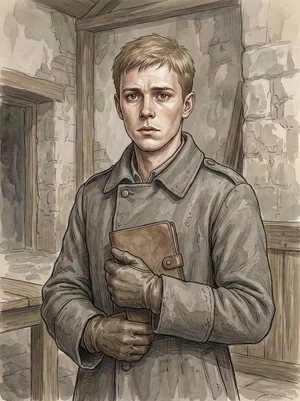
Leva sat beside her. Dain had been brought up in a carrying chair, his leg resting on a stool. The surgeon had allowed it on condition that he remain seated. Dain held a cup of water and kept forgetting to drink.
Senn read the first page of the register. She did not hurry to reassure anyone.
“This hearing concerns preservation and temporary custody,” she said at last. “I am not deciding every allegation made in these papers today. Lieutenant, what do you seek?”
“Return of a military animal and the people unlawfully retaining it.”
“The two requests are separate.”
“They concern the same escape.”
“They are separate.”
He inclined his head, conceding the word without appearing to concede anything else.
Edris laid the original transport order before Senn. The adjudicator read it through, then compared it with the revised order. She placed them side by side.
“Is this your command stamp?”
“It is.”
“Was this instruction issued under your authority?”
“Yes.”
Edris wrote both answers in the register.
Iona looked at the stamp she had seen so many times on feed requisitions. A split in its outer circle marked every impression. Until this moment she had never watched anyone ask Orren to explain one.
“Why the change of destination for the handler?” Senn asked.
“She reported an illness during departure. She subsequently abandoned the designated route and resisted the relief detail. Examination was indicated.”
“Did she report an illness to you?”
“She collapsed in the yard.”
Iona started to speak. Senn raised a finger without looking up.
“Did she report an illness to you?”
“No.”
Edris wrote that too.
When Iona’s turn came, she described the harness wound and the broken release pin. She explained why she had refused the bridge. Dain supplied the load limit from memory, then corrected himself after consulting the notebook. The correction seemed to steady him. He placed the notebook where Senn could see the figures.
Orren waited until they had finished.
“The transport suffered difficulties. That does not transfer title to the handler. An animal of that weight, released without command gear, is a danger to anyone on the road.”
Senn turned to Iona. “Is it?”
She could hear Seventeen moving in the pen below. Wood creaked under its weight.
“It can be.”
“Can you guarantee that it will not hurt someone?”
“No.”
Orren settled back a little.
“Can command gear guarantee that?” Senn asked him.
“It provides the established means of control.”
“That wasn’t my question.”
He looked at the shutter, which had begun knocking again.
“No guarantee is absolute.”
“Then we will record the risk without pretending either party can remove it.”
She called Holn to the table. He described the holding pen, the wide rear opening and the watered enclosure inside the wall. It had once held confiscated oxen during a customs dispute. Its outer fence was stone; its gates could be barred from outside. The animal could be kept away from public traffic if permission were given to move it through.
“The handler would remain responsible for practical care,” Holn said. “Under supervision.”
Orren’s hand flattened on the table.
“At whose expense?”
“That can be recovered later,” Senn said. “If there is a basis for preserving it.”
Edris untied the tarpaulin.
The roll would not lie flat at first. Its edges curled toward the damp air. Leva put two little wooden weights at its corners. She had brought them from the clerk’s booth, asking permission before she touched them.
Senn read the heading and examined the remains of the seal.
“Who opened the jar?”
They told her. She asked who had found the well, whether anyone else had entered the building, how long the papers had been out of their sight. Edris’s first account had anticipated some questions but not all. Senn added the gaps to the margin.
Iona watched the gaps accumulate.
Then the adjudicator reached the line marked Mara Fen.
“These are occupied assessments,” she said.
Orren leaned forward. “They can remain on a roll after occupation has ceased.”
“Payments are recorded into the month of the flood.”
“Arrears.”
Senn touched the payment heading. “Current quarter.”
He did not answer immediately.
She moved to the confiscation entries. Beside the old roll she laid the new destruction order. The registry references sat a hand’s width apart.
“What is LVII-4?”
“A closed military registry.”
“For what?”
“The water-control action at Leth.”
Iona felt Leva’s knee press against hers beneath the table.
“Your disposal order requires the destruction of all mineral tissues under that registry’s closure schedule,” Senn said. “Why does a former toll district determine how an animal’s remains are handled?”
“Because the animal was assigned there.”
“Then records survive concerning its service?”
“Records exist. Whether they concern the allegations being made here is another matter.”
“I agree.”
For the first time he seemed uncertain what her agreement meant.
Edris brought Leva’s tallies forward.
Leva put on her spectacles. One arm had been repaired with thread. She held them in place while she identified her handwriting and the marks entered by the house supervisor. She described the difference between a blanket issued, a bowl prepared and a person delivered. Senn asked her not to estimate totals when she had no names.

 100 to start reading with.

What did you think?