I could have called him. I had his number; he’d written it on the back of a guest check and left it under the sugar caddy Thursday without a word, where the tips go. I drove instead.
Saturday we closed at three. By six I was on the river road in my mother’s Buick with the windows down, because the air conditioner had given up somewhere around Tuesday, and the heat came in off the fields thick enough to chew. Kudzu had taken the railroad cut and the old tobacco barn and a whole stand of pines along the ditch, smoothed them all over into green shapes like furniture under sheets. The sky to the west had gone the color of a bruise. Cicadas. Red dirt on the shoulders. An old man’s hand-lettered sign on a card table: PEACHES $5 BAG. I stopped and bought a bag, because my mother would have, and because I wanted something in my hands when I got there.
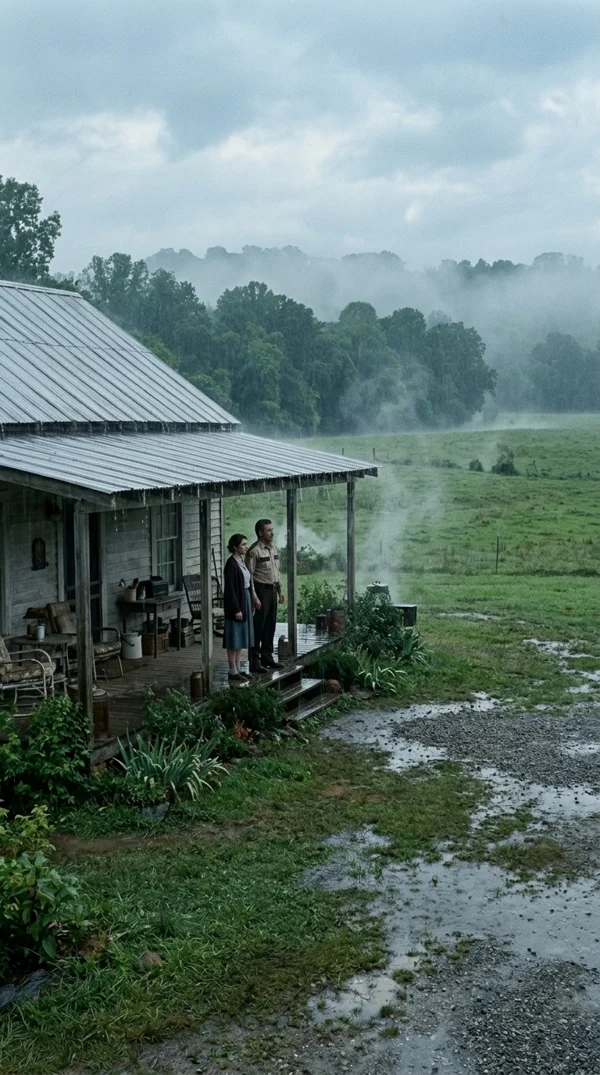
His granddaddy’s place sat back from the road at the end of a gravel drive between two pecan trees: white clapboard gone soft gray, a tin roof, a deep porch that ran the whole front, and a field going down behind it to a line of dark trees where the river was. An old bluetick hound got up off the porch boards when I pulled in and came down the steps to inspect me, slow, like an usher.
“That’s Deacon,” Beau said from the porch. “He doesn’t bite. He just judges.”
He’d been fixing the screen door. He had a screwdriver in one hand and a hinge in the other and no shirt on, and I’d like to report that I was a grown woman about it. I was not. He was forty-four years old and it showed, and it showed well. The shoulders I’d seen grown into at the funeral, the chest gone broad and dusted gray, a long pale scar down his ribs on the left side that hadn’t been there when I was twenty-two and had known every inch of him by heart.
He saw me look. He put the screwdriver down and went inside, and came back buttoning a shirt, which was worse.
“You didn’t call,” he said.
“I brought peaches.”
“I see that.”
I came up the steps and held out the ticket instead of the bag.
He took it the way he’d taken the check from my fingers in the diner, carefully, like it could go off. He held it to the last of the light and read the purple print along the bottom, and I watched him do the arithmetic. I watched him finish it, this time.
He didn’t say anything. He sat down on the top step with the stub in his hand. Deacon came and leaned against his leg.
“Wednesday,” he said finally.
“Twelve-fourteen. Cash.”
“I was asleep at twelve-fourteen. I’d been at your mama’s counter till three.” He turned the ticket over, as if the back would tell him something. “Mama’s never stood in a line at a bus station in her life.”
“Then who did?”
“I can find out.” He looked up at me. “Will you stay for supper? I’m not asking anything else.”
The storm came across the fields while I was slicing tomatoes. I watched it come through the kitchen window over the sink, a gray wall walking toward the house with the trees bending ahead of it, and then it hit the tin roof all at once like somebody had poured a truckload of gravel, and the lights went out.
“That’ll be the co-op line,” he said in the dark. “It goes every time.”
He lit a hurricane lantern and set it on the table. We ate tomato sandwiches standing at the counter, on white bread with Duke’s and salt and pepper, the juice running down our wrists, because that’s the only way to eat a tomato sandwich in July and anybody who uses a plate is from Ohio. We ate peaches over the sink. The rain was so loud we had to lean close to hear each other, and I talked, because I always talk, about Corinne and the ninety thousand and the ledger and Calvin’s okra oil, and he listened with the lantern on one side of his face and the dark on the other.
Then I stopped talking.
He was wiping his hands on a dish towel. He stopped, too.
“I believe you,” I said.
He set the towel down very slowly.
“Not because of the ticket,” I said. “The ticket proves she’s a liar. It doesn’t prove anything about you.” I’d been working out how to say this since Wednesday night, and now it came out wrong and right at the same time. “It’s because you stopped. Thursday. You were an inch away and you stopped, because I hadn’t decided. A man who’d write that letter wouldn’t have stopped.”
The rain hammered. The lantern flame stood up straight in its glass.
“So I’ve decided,” I said.
He came across the kitchen. He didn’t hurry. He stopped in front of me and braced one hand on the counter beside my hip, not touching me, and looked down at me, and I could see in the lantern light exactly what it was costing him to go slow.
“Say it plain, Dell,” he said. “I’m not guessing about you twice.”
“I want you.” My voice came out low and rough and not at all like a woman who runs four restaurants. “I’ve wanted you since you took that check out of my hand. I want you to take me upstairs.”
He closed his eyes for one second. Then he picked me up.
I hadn’t been carried anywhere since I was a child, and I am not a small woman, and he took the stairs like I was a sack of feed and the house was on fire, and I laughed against his neck, helpless, and then I wasn’t laughing.

 100 to start reading with.
What did you think?