Corinne Lattimore slid the last page across her desk at 8:37 in the morning and said, “Sign here, and here, and initial there,” and I signed my name nine times in blue ink, Adele M. Tolliver, in a hand that didn’t shake, and she picked up her phone.
“Send it,” she said to somebody. Then, to me: “Go.”
I went.
Darnell Hicks was waiting at the curb in a county cruiser with the engine running. I’d met him properly exactly twice. He was tall and narrow and had a breakfast biscuit in one hand, which he ate standing up, always, as if sitting down to food was a weakness he’d decided against.
“Sheriff said I happened to be going your way,” he said.
“Did he.”
“I’m going your way.” He finished the biscuit. “Try to keep up, ma’am.”
He drove up the state road with his lights on and no siren, and I followed him in my mother’s Buick with the windows down and the hot wind roaring and the speedometer needle shivering at eighty, past the peach stands and the pecan orchards and the kudzu rolling over everything like green surf, and I didn’t think about anything at all except the clock on the dash. 9:02. 9:20. The water tower. The Bellamy County line. 9:41, and the courthouse clock over the trees.
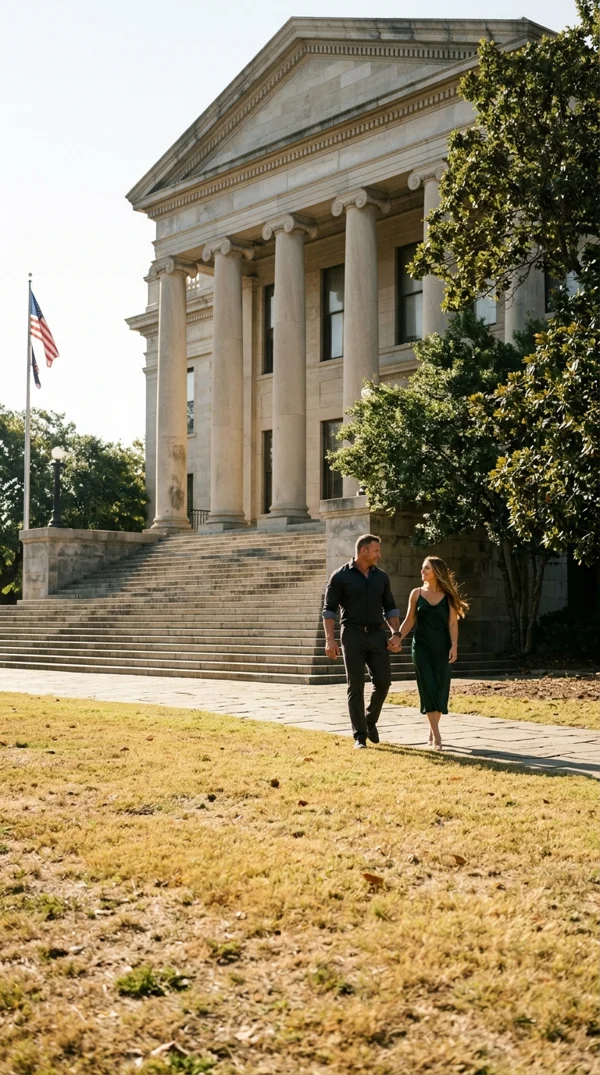
I’d never seen so many people on the square.
They were on the lawn and the sidewalks and the courthouse steps, under the oaks, in the heat, fanning themselves with church bulletins and copies of the Ledger: the old men from the counter in their feed caps, the Methodist men, the road crew in orange, half of First Baptist, the women from Lorraine’s circle in a tight group by the war memorial in hats. Calvin in his apron, which he’d come straight from the flat-top in. Dontrell beside him. Opal Dukes on a folding chair in the shade with her Bible in her lap and a little straw hat, sitting as straight as a pew back. And Luanne, everywhere at once, readers on, phone in her hand, looking like a woman who had personally called every one of them, which she had.
“I may have mentioned it to a few people,” she said when I came up the walk.
At the top of the steps, in front of the big doors, stood Tate Gatlin in a seersucker suit with a folder of notices, and beside him, in pale blue linen and pearls and a hat with a brim as wide as a cake stand, Lorraine Whitcomb. Beau was at the foot of the steps in uniform, his hat on, his thumbs in his belt, looking at nothing, keeping the peace.
He saw me. He didn’t move. But he looked at me the way he’d looked at me over his mother’s check the day of the funeral, and I knew he’d been counting the minutes, too.
The courthouse clock began to strike ten.
Gatlin opened his folder. He cleared his throat and read in the flat sing-song lawyers have used on those steps for a hundred years. “Under and by virtue of the power of sale contained in a Security Deed given by Marjorie A. Tolliver to Whitcomb Farmers Bank—”
“Mr. Gatlin,” I said, from the bottom step. “You’ll want to check with your client.”
He stopped. He looked down at me over his folder.
“The loan’s paid,” I said. “In full. At your updated figure, including the insurance my mother already paid in March, which I’ll be wanting back by Friday.”
The crowd made a sound like wind going through a field.
Gatlin’s face did a small, careful thing. He took out his phone. But before he could dial, the door of the bank across the square opened and a young man in a polo shirt came out at a run, across the street, through the crowd, up the walk, with a sheet of paper in his hand. I knew his face. I’d seen it on a hall table on Church Street, grinning, with his grandmother’s eyes.
“Mr. Gatlin,” said Wesley Dukes, out of breath, holding up the paper. “Payoff came in at 9:11. It’s received. All of it.”
Gatlin read it top to bottom, and then just the bottom line, again. Then he closed his folder, and cleared his throat again, and said to the square in the same flat voice, “The sale of the property known as Margie’s is withdrawn.”
I didn’t hear what happened next because Luanne screamed. Then everybody was making noise at once, the road crew whooping, Calvin with both arms in the air like a man at a revival, the old men from the counter clapping slow and hard, and somebody on the lawn started to sing, God help us, Leaning on the Everlasting Arms, off-key, and it was Calvin, and then it was thirty people.
On the top step, Lorraine Whitcomb smiled.
She waited for the singing to die down. She was good at waiting. Then she spoke to the crowd, not loud. She didn’t have to be loud. Fifty years in that town had taught everybody on that lawn to go quiet when Lorraine Whitcomb opened her mouth.
“Well. Congratulations, Adele,” she said. “Y’all enjoy your diner while you’ve got it. She’ll sell by Christmas.” She looked out over the crowd, kind, sorry, a woman telling hard truths for everybody’s good. “That girl takes money. She always has. She took five thousand dollars of mine to leave my son at the altar, and she hasn’t been home once in nineteen years until there was something in it for her. You all remember.”
They remembered. I saw it go through the circle ladies by the memorial, and through the Baptists, and through some of the old men, a little settling, a nod. The half that matters.
I climbed the steps. I stopped two below her, so I was looking up, and I took my mother’s envelope out of my purse.
“I’m going to read you something,” I said. “I could say it in my sleep, but I want you to hear it in the right order.”
I unfolded the yellow legal page, the eight pieces my mother had taped back together on the back, and I held it up so the people on the steps could see the brown tape, and I read it out loud on the courthouse steps in a voice that carried all the way to the bank.
“Dell, I’ve thought hard about it all night and I can’t do it. Mama’s right that we’d both be sorry. You deserve better than a man who’d sneak off without telling his family, and I owe my family a wife who knows how to be a Whitcomb. Take the money. Make a life. Don’t call. Beau.”
I let them sit with it. A wife who knows how to be a Whitcomb. I watched three of the circle ladies hear it, because they’d been at the rehearsal dinner thirteen years ago, and they’d heard it there first.

 100 to start reading with.
What did you think?