Six, chapter 3 of The Captain Broke My Heart
Four o’clock on the track, the Wednesday re-test, and fourteen people on the bleachers for it, because there is nothing else to do in Harlow County at four.
I ran 57.4, better than the twenty-fourth and worse than fifty-five. On the sixth rep my left calf seized, and I ran the last thirty yards badly, on a leg with no push in it, while the bleachers watched me limp it in like something with a thorn in its paw. Verna called the number at the line, and I stood with my hands on my knees and the taste of blood at the back of my throat. Vada wrote it in the book and turned the book over.
“One’s held,” Vada said, which I already knew from Bream. “Held means you dress. Do it again in October and hold it, and we’re done.”
“Vada, come on—”
“Don’t. It’s a number, Larch. Go take a shower.”
Just a number. Sure. Just a number with my whole fucking season hanging off it like a skate off a lace. Fourteen people on the bleachers, and two of them were the golf team.
Ike Pankow opens the Barn at 5:40. The board by the door has the temperature on it in whiteboard marker, and Ike writes the number before he says anything to anybody. On the Thursday he wrote a four and an eight, then turned his head to me.
“Forty-eight. Outside. It’ll be on the panes.”
The panes are the windows in the cold end. They were fogged along the bottom and running at the corners, and the ice under the lights was white-blue and cut up from the night before, and the place smelled like the inside of a freezer somebody had once kept fish in. The building was so cold the compressor sounded warm.
Forty dollars a shift at the rental counter, five shifts a week, six to ten in the morning, and whatever evenings Ike was short. He had taken me on the Tuesday, after the card, with two questions: could I count money, and could I keep my mouth shut about the temperature?
Skate rental is a wall of numbered racks, a form on a clipboard and a boot drier that smells like a wet dog died in it. In August it is nine pairs a night, mostly children. They take a four, go out, and come back with the laces cut through and one of them crying.
At six Ike hands you the key to the rental and goes and gets the machine. The Zamboni is a 1984, the only one. He lays the ice whole in ten minutes, in exactly the same pattern every night of his life. When he comes off, there is a forty-minute hole before the figure skaters at seven.
“Go on, then.” He shut the door of the machine. “Before it sets.”
The first length is the best thing there is, and what makes it is the quiet. New ice, unmarked, the steel cutting in. The lights are down at the cold end so half the rink is dark. There is nothing in the building but the compressor and the boards and a man in a boiler room with a percolator.
I did four lengths with the cold in my teeth and then worked. The kill is a set of angles and a set of edges. The edges you cannot teach. What you can work is the turns and the stops and the starts, and there is no better place for it than a sheet with nobody on it. Ten hard starts from a standstill off the goal line. Ten stops on the outside edge with the snow going up. Backwards crossovers in the circle until my thighs burned like hell, then the other circle, then the other way.
Under all of it I was really practicing one thing: the turn out of the corner. You come up the wall with your shoulder to it and your head up. The puck is behind you, and you put it up the wall on the backhand without looking at it. It goes a hundred and ninety feet, the icing wave is off, and the clock runs.
The wall clear is the only legal pass in hockey that nobody claps for.
At twenty to seven I got the rental open and the lights up. Ike came out of the boiler room with two cups of coffee, put one carefully in my hands, and stood at the glass with his, eyes on the ice. “Left foot’s better.”
“Left foot’s the ankle.”
“It was the ankle Tuesday. Now it’s the left foot.” He drank. “You’ll want it the other way round. They’ll be reading you off the right.”
“They read the tape, Ike. Not the foot.”
“They read the foot. There’s a boy down in Ridgeway reads the foot and he’s had two hundred goals off it.” He set the cup down on the ledge. “Get the right one under you and stop showing the left.”
Ike has been at Amberley Rink since 1986. He has seen every player who has ever played here, and he has never once been a coach and does not want to be. Every so often he puts a thing down in front of you like a plate and simply walks off, and you stand there holding it for the rest of the day, trying to work out whether it was dinner or a test.
The figure skaters came at seven with their mothers and their bags and the noise, and by the time the ice was cut up the counter was moving. Small boot, small boot, a five, the boot drier. A boy of about eight tried to pay with a dollar forty in coins, and I took it and put it in the cash box.
At ten I shut the counter and went up the hill to a lab. At ten past four I was back behind it, squaring the morning’s cash box, when the team came in for the 4:15 and the corridor filled.
Vada came in with Onnie Mace and went past the counter with her gear bag on her shoulder and didn’t glance at me. Onnie did, briefly, and Onnie’s face said nothing personal, which is what it always says. Hildy Vance came in behind them and stopped dead. “How much?”
“Forty dollars to you.”
“That’s fucking robbery!” She paid it.
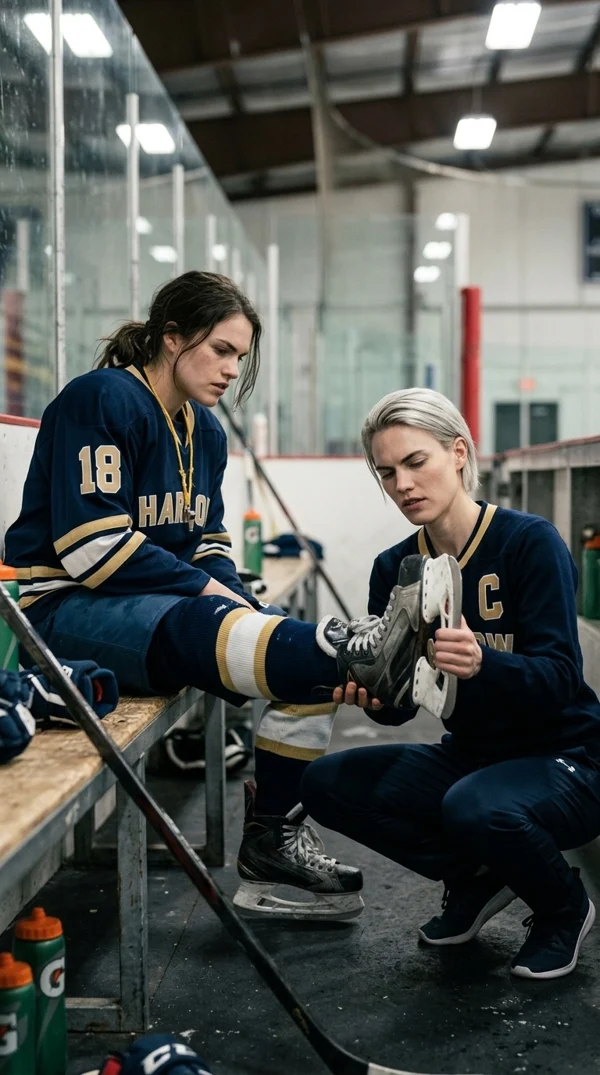
That was the pattern of the week. My name was back on the tape, and every morning Vada read the card as it stood, and the card still had her black line through me. So the room had a shape, and I was outside it by an inch. I dressed and skated with them, and nobody passed to me for the first four minutes.
At the end of the session Shea put us on the half-sheet for 2-on-2: me with Ren and Franny against Vada and Onnie and Rennet. First shift, Vada came down the right and I stepped up. She chipped it past my ear, Onnie had a breakaway, and Onnie scored. Shit. The next shift was better, and the one after was better again. On the last one Vada took the puck off Franny on the wall, and I got in front of her at the blue line and didn’t go for the hit. I just bodied her out of the lane. The puck went dead and the whistle went, and she held my eyes and said nothing, her breath smoking through her cage.
In the room after, while everybody was unlacing, Shea called it across. “Larch! Forty feet of it. You’re stepping up too early on the good ones and letting them chip.”
“They chip because I show the hit.”
“Then don’t show it.”
“Then they walk it in.”
“Then they walk it in.” Shea pulled the board round, and that was the end of the conversation. Nine seconds, in front of the room, and it was my entire problem. Vada unlaced with a smile on her lips, aimed at the tape on her stick.
I got out of my gear, fetched the changer from the mop closet and worked the evening counter. When Ike came past with the machine, I stopped him. “Can I have the room?”
He finished the ice and went. I put the changer down and stood in the boiler room door.
It has a bench, a percolator, a two-burner camp stove and pipes on the wall. Over the bench hangs a sheet of pegboard with a screwdriver for every size and a row of the disc blades the machine needs. The rest is hooks with nothing on them. Ike was in the chair with his cup on his knee.
“Why forty feet?”
“Because it’s under the line.” He didn’t raise his eyes. “You can hit a body at forty feet and win the puck forty percent. You won’t beat a chip till the chips are all on the tape.”
“So everybody’s on the tape.”
Everybody who was any good was on the tape, according to Ike, and then it was what was on the tape that was the trick. He turned his cup slowly. The girl chipped because she knew I’d step. “Give her a step, then don’t take it. She’ll chip one out in front of the bench and it’ll go wrong, and her coach will do the talking for you.” He drank. “You’ll be going round her by Christmas and she won’t know how.”
I sat on the end of the bench and leaned back slowly against the warm pipes, and the heat came through my shirt onto my skin.
“Can I ask you something that’s not about the foot?”
“Ask.”
“What’s the kill for?”
He put the cup down deliberately on the floor by his boot. The percolator ticked quietly as it cooled. “Which kill.”
“The penalty kill. I’ve been doing it since I was ten, and it’s the only thing about hockey I’m better at than everybody I’ve ever met.”
“Better at the kill. Or better at the kill.”
What did that even mean? Was he really asking me? I had to think about it, and he let me. The second one, maybe. I knew the angles. “It’s a walloping, Ike. Everybody on the kill gets walloped and nobody sees it, and the goalie gets the credit.” I fixed my eyes on the pipes, because it was easier than his face. I’d done it because I was nobody, and then it turned out I loved it, and what was the reward for loving it? If I got good enough, nobody would want me on the kill at all. They’d want me on the power play. “The kill is what you do so somebody else can score.”
He let that sit. Then he started on Debbie Pankow. She had killed penalties in this building forty-one years ago, in a helmet with no cage, and her nose broke twice, both times by the same woman. She’d sanded the blade on her stick and used to clear it on the backhand off the wall, the length of the ice. He picked the cup up. “Deb’s the second Pankow on that pegboard. She lost a finger to the saw up at the co-op in 1991, and it’s still the only thing anybody says about her.”
“That’s what I mean.”
“No. It’s the other way. Nobody in this town can tell you one thing about a woman on the power play, because there wasn’t one worth watching. There’s a picture of her on the wall of the co-op, and thirty people can name that finger.” He drank and made a face, and put the cup down again. “Deb was nobody, and she was good at it, and she was the most-watched thing in this barn for four winters. That’s what the kill is for.”
My eyes stung, which was stupid. It was just the percolator, obviously.
The compressor went on. “All right. Get that ice. Seven’s the baby class.”
I did the ice for the babies and ran the counter another hour with my hands going and the changer singing in the cash box. At a quarter past eight I got the mop and did the once-over by the benches and under the rail where the dip is. Ike did up the board carefully with the temperature. Then he wrote underneath it, his back to me, and capped the marker.
“Everything in this building’s in there. Temperature to the names. Forty years.” He went out past me. “So it wants to be worth writing down.”
What had he written? I waited until the outside door had shut behind him before I went and read it.
Larch, 6-7, ice.
What did you think?