The scaphoid’s the little one at the base of the thumb, and it’s the worst bone in the body to break. There’s one artery to it, and it comes in at the far end. If it goes wrong, the near end dies and the bone never joins.
I got that from Verna in February, in the training room, with the X-ray up on the screen. Then she gave me the other thing, quietly, with her eyes on mine. She was not going to be the one to tell Prue.
Six weeks off the ice, she reckoned, and it was February. I argued anyway, which was stupid. “It’ll be six weeks, and it’s a wrist. It’s not a knee.”
“It’s a wrist and you’re a defenseman and you block.” She turned the screen off. “And you’ve got a father with a store that can’t carry the four of you forever. A wrist that doesn’t work in February doesn’t work in August either.”
The injection was on the eighth of October. Sixteen weeks, she gave it. Then it would start to go, and it would go in two weeks, and after that it was a question of how many blocks and what on.
I didn’t tell anybody. Why would I? I just don’t. And in October there was a card and a shuttle and a first-year with a line through her name, and my wrist was the least interesting thing in the building. It stayed that way for a month. Honestly, I liked it that way.
I block with my face now. The face is the one part of you nobody has ever had to be careful about.
A puck to the visor is a noise and a scuff and, once, a stitch. A puck to the wrist is a week. It’s a bad trade, and I make it anyway. What else am I supposed to do, stand there?
The store’s last Saturday was the twelfth. I got off the bus from Vane Falls at eight and was behind the counter by ten. I still smelled of her hotel soap. Her breathing was still counted somewhere in the back of my head, and the skin of my ribs still had her fingers on it. I worked the floor and my father did the register. At four he put the cash bag in the safe, and the safe was going with the fittings on the Monday.
The shelving unit was still flat in its carton by the stepladder. I didn’t look at it. I couldn’t stop looking at it. Cardboard. It was just cardboard, a flat box of steel shelving with the fittings in a bag, and my face still went hot every time it came into the corner of my eye, because I knew exactly how it creaked.
My father had a hand truck by then. He didn’t really need it, and he used it anyway for two boxes of shelf brackets out to his truck. On the second box the tailgate was stiff. He put his weight into it and got it, and then he stood a while with one hand flat on the truck’s side.
I asked was he all right. “Tailgate.” He barely got it out.
It was not the tailgate. He’s fifty-one. He has lifted shelf brackets for thirty-two years, and his shoulder has been going since the spring. He won’t have it seen to, because a shoulder is a thing you get seen to when there’s money.
The chain’s man came promptly at five for the keys. My father put them in his hand, and the man turned them over and admired the place, politely, like a guest. My father let him. “It’s kept itself.” Which is not true, and is the most he’ll ever say.
After, in the truck, my father kept both hands on the wheel. There was a job at the lumber yard in Ridgeway from the fourth of January, he informed the windshield. A counter. Seven fifty an hour. I did the sum before I could stop myself. “That’s fifty cents down on the store.”
“It’s a job.” He put the wipers on, and the wipers did not need to be on. “They want a second body on the dock. Saturdays, and the Monday mornings you’ve got no class. I told them you.”
So that was the yard. From January it was both of us. The Vane Falls letter was in the door pocket of the truck, against my knee, where it had been since the first of December. I could feel the corner of the envelope through my jeans the whole way home, every pothole between the store and the house pushing it into my knee like it wanted an answer. Did he know it was there? He knew. He’s my father.
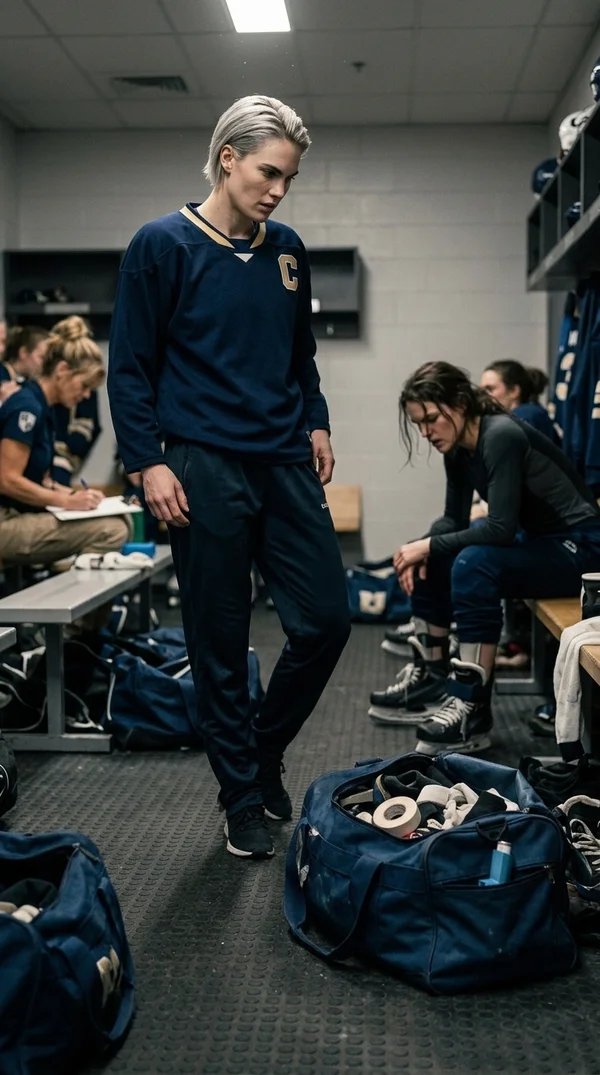
The change room before the Ridgeway game, on the eighteenth. Verna shot the wrist at four-thirty, and neither of us opened our mouths. We both knew it was number three, and number three in ten weeks. The label on the vial read sixteen weeks. The vial was only a suggestion.
I wrapped it myself, badly, clumsily, one-handed. Vada came past and stopped, and her eyes went straight to it. “Give it here.”
She did it standing up, in nine seconds, a proper figure-eight with the thumb out, and tore the tape with her teeth. “You’ll have that off before the third period.”
“I’ll have it on till the bus.” I probably wouldn’t, and from the way her eyebrow went up, she knew it.

 100 to start reading with.
What did you think?