Frances’s email came on Monday morning at 7:14, with no message, just a subject line in capitals: CALL ME BEFORE YOU READ THIS. And then, underneath, an attachment.
I read it first. Of course I did.
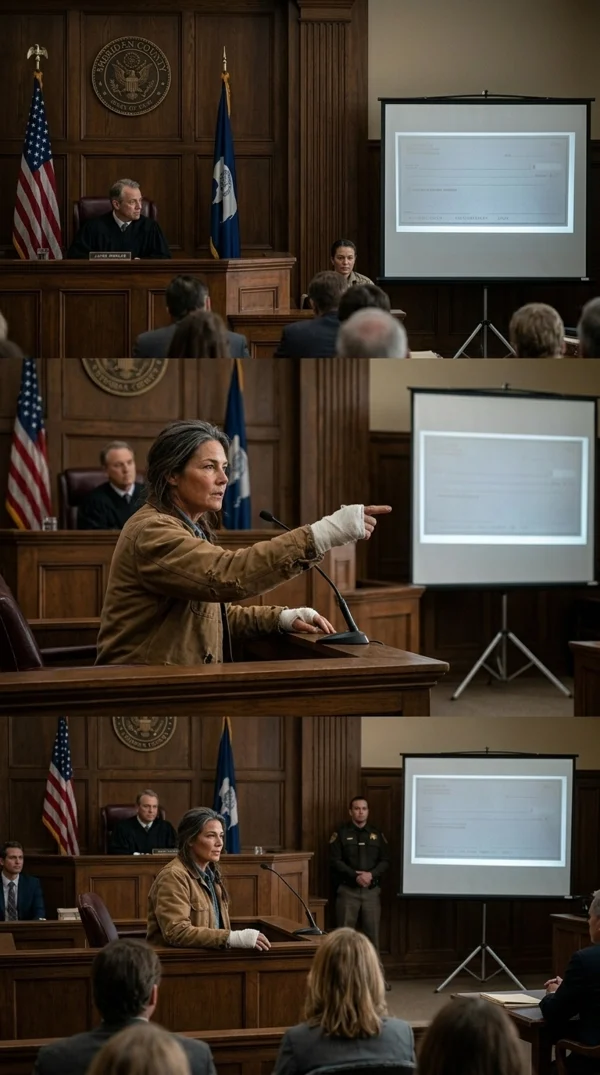
It was a court filing. Grant’s lawyer, a man named Weller from Billings who I’d never met, had filed a response to my petition and attached an exhibit. Exhibit C. Ratification and Confirmation of Power of Attorney and Sale. Two pages of dense type saying that I, Josephine A. Kessler, being of sound mind, did hereby confirm and approve the power of attorney granted to Grant T. Fallon and all actions taken under it, including but not limited to the listing and sale at auction of the property known as Seven-Bar.
And at the bottom of the second page, my signature.
Not traced. I saw that in half a second. Fast and downhill and a little hard at the end, the way I sign when I’m tired and somebody’s waiting. No skip in the K. My own hand.
I put my phone down on Marnie’s kitchen table very carefully, the way I’d put my coffee down on the rail at the sale barn.
Then I called Frances.
“I told you to call me first,” she said.
“I know.”
“Is it yours?”
“Yes.”
Silence. I could hear her gum. I could hear her radiator. And under both of them I could hear three weeks of work coming apart, the long soft slump of a stack of bales going over.
“Josephine,” she said, and her voice was gentle, which was worse than anything. “If you signed that, then it doesn’t matter what he traced. It doesn’t matter about the vet or the light box. A ratification means you knew about the power of attorney and approved it after the fact. Weller’s going to stand up in front of Judge Ringler on Friday and say you’re a confused, angry woman who’s changed her mind, and he’s going to hold that up, and the judge is going to look at it.” She stopped. “Do you remember signing it?”
I closed my eyes.
Except I had, hadn’t I. I’d signed everything.
“No,” I said. “Yes. I don’t know. Frances, he’d put things in front of me. At the table. At night, after chores. Sign here, honey, it’s the bank. I’d sign it. I didn’t read them. I never once read them.”
“I know you didn’t, dear.”
“I’ve got to go,” I said, and hung up on her, which I had never done to anyone in my life.
I sat there at Marnie’s kitchen table with my hands flat on the oilcloth and the phone face down in front of me, and for about ten minutes I was the woman at the back of the sale barn again. Boots stuck in the sawdust. Sixteen years coming up my throat.
Then I turned the phone back over and did what I should have done at that kitchen table every single time.
I read it.
Slowly. Every word. The way I’d read the divorce petition in Frances’s office. The way you go over a sick calf, all the way down, looking for the thing that’s wrong. I read the title and the recitals and the whereases and the paragraph numbers. I read the date at the top: August 14. I read it like it was the brand book.
I read the bottom of the page.
At the foot of the second page, under my signature, in tiny gray print so small I had to spread it with two fingers on the screen, there was a line I’d never have seen in a hundred years at a kitchen table after chores:
RGSB Form 22-B (Rev. 3/19) Page 4 of 4
Page four of four.
On a document that was two pages long.
I knew that form. I’d been signing it every August for eleven years. Red Grade State Bank, Form 22-B: the renewal for the Seven-Bar operating line. Four pages, with the signature on the last. Grant brought it home every year, and every year I signed the last page at the kitchen table without turning back to the first.
He’d taken it off. He’d taken the last page off the loan renewal I signed in August, the one with my real signature on it, and stapled it to the bottom of a page of lies he’d typed himself, and he’d been counting on the fact that I had never in my married life read the small print at the bottom of anything.
He was right. Until this morning, he was right.
My copy of the August renewal was in the office at Seven-Bar, in the file drawer of Gran’s rolltop, under Bank. Three pages now, if I was right. Missing the last one.
I was out Marnie’s door before I’d finished thinking it.
I smelled the smoke from the cattle guard.
It was a gray morning, windless, the kind where smoke goes straight up and hangs. It was coming from behind the barn, where the burn barrel stood, a fifty-five-gallon drum with holes punched in the sides that we’d used for trash and dead branches for as long as I’d been alive. A column of it, pale and greasy, going up into the low sky.
Paper smoke. You can tell. It’s thinner than wood and it smells like a schoolroom.
Grant’s truck was in the yard. I didn’t stop at the house. I drove straight across the yard and around the barn and got out with the truck still running and Mule already over the seat and out the door behind me.
He was standing at the barrel with a cardboard box at his feet, feeding it.
The file drawers from Gran’s rolltop. I knew the folders. Bank. Taxes. Brand. Vet. He was dropping them in a handful at a time and watching them go. On the ground beside the box, waiting their turn, were the last of my day books, the old ones from the mudroom I hadn’t had room for in the feed sack, and on top of them, green cloth gone black at the corners, the thing Wade had told him to bring back by the Friday before last:

 100 to start reading with.

What did you think?