The West End, chapter 4 of The Drowned Likeness
Lavinia recovered the way some women recover from a fall in a shop, by deciding it had not happened.
“I came to see were you settled,” she said, and put on her glasses and looked down the row again, briskly this time, as if they were invoices. “And I see you’ve met the family. August, you let her bring them up here.”
“It’s dry up here.”
“It is that.” She looked at the sheeted easel and the clean jars, and her mouth went tight and then loosened. “Well. You need feeding, honey, and I need a drink, and the tide’s out for another hour. Come down to the Ridge. August won’t come.”
“No,” August said.
He did not look at his aunt when he said it, and she did not look at him, and Maren, standing between them in the gold light with her own face six times at her back, felt the kind of silence she had grown up inside: a silence two people had kept so long it had furniture in it.
They walked the boardwalk at low water, the boards dry and bleached and ticking in the last of the heat. Lavinia went slowly. Twice she stopped with a hand on the rail and looked out at the marsh as if admiring it.
“My knees,” she said. “I told you.”
“You came up anyway.”
“I did.” She started walking again. “I hadn’t been in that house since Anne’s funeral. Seventeen years. I’d forgotten what the hall smells like.” She did not say what it smelled like.
She didn’t take Maren straight to the store. She took her west through the lanes of the Ridge, past crab pots stacked in yards and plastic flamingos and, in one window, a hand-lettered sign that said PRAY FOR HESPER, and out the far side of the village to where the high ground ran down into marsh and stopped.
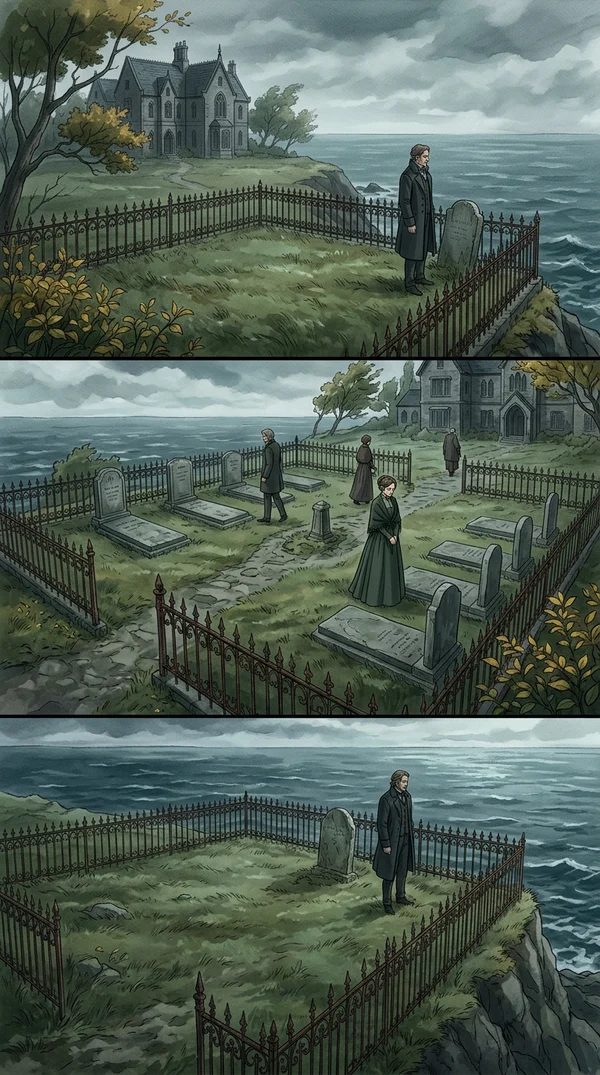
The West End had been a street once. A straight line of fenceposts walked out into the reeds and then into open water, their tops gray and furred with barnacle. Square outlines of brick foundations lay under an inch of water. A heron stood on the stump of a chimney. And there was a graveyard. It had been on a little rise. Now the rise was an island a few yards across, and the headstones leaned out over the water like mourners straining to see a boat, and some had already gone in. She could read one. PRUITT. The rest of the name was under the Sound.
“We used to be eight hundred,” Lavinia said. “When I was a girl. That was the school, where the pilings are. That was my mother’s people’s house.” She pointed at an outline in the water exactly like all the others. “Every year the Sound takes a little more. You build the bulkhead, the Sound goes around it. You raise the road, the Sound comes up under the road. It’s not storms, mostly. It’s just the water deciding.”
“It’s the land sinking,” Maren said. “And the sea rising. The whole bay.”
“I know what it is, honey. I’ve read the same articles you have.” Lavinia looked at the graves. “I’m telling you what it looks like from here.”
On the way back she stopped at the church, white clapboard with a short square steeple and a sign that said SEPT 27 HOMECOMING ALL WELCOME. Inside it smelled of floor wax and damp hymnals. Lavinia walked her down the aisle to the second pew and pointed at the wall.
Someone had painted a neat blue line along the plaster at the height of Maren’s hip and lettered beside it: 1933. A few inches above it, a second line. ISABEL 2003.
“That’s where the water stood,” Lavinia said. “In this church. Both times.” She laid her palm flat above the higher line. “And not a drop up at the house. Old people used to say it when I was small. As long as Sounding stands dry, Hesper stands.” She took her hand away. “I used to think it was just a thing people said.”
“And now?”
Lavinia gave her a warm and tired smile, and did not answer.
Supper was crab cakes at Lavinia’s kitchen table behind the store, with tomatoes from someone’s garden and a bourbon poured without asking. Halfway through, the screen door banged and Wash came in with a mail sack, took a crab cake off the platter with his fingers, and sat.
“Eighth,” he said to nobody. “Moon’s at perigee. You’ll have a tide that week like you’ve not seen. Weather service says a low might come up the coast with it.”
“Thank you, Wash.”
“Just saying.”
“You’re always just saying.” Lavinia passed him a plate. “He’s been predicting the end of this island since Carter.”
“Island’s been obliging,” Wash said.
Maren waited until he had gone back out, and Lavinia had poured them both another inch.
“Mrs. Calder. The portraits have my face.”
“I saw.”
“Did you know they would?”
Lavinia turned her glass on the oilcloth. “I knew they’d have somebody’s.” She said it gently. “They had my stepmother’s when I was a girl. Then they had my best friend’s. August’s mother. Anne.” She drank. “I brought Anne out here to clean the pictures. Summer of ’86. We’d been at art school together in Baltimore. She was the clever one; she went on and trained in conservation, same as you. I thought it’d be a nice summer job for her.” A small laugh, with nothing in it. “She married my brother the next year.”
“And she drowned.”
“In the Gut. The channel past the harbor mouth. Flat calm, middle of an August afternoon, taking August across to the mainland. He was sixteen. He was in the boat.” Lavinia set the glass down. “He hasn’t crossed since. Not once. Seventeen years.”
Outside, a golf cart went by with its headlight on, and a woman called someone’s name, and was answered.
“Why do the faces change?” Maren said.
“Oh, honey.” Lavinia leaned back. “The house wants looking after. It shows you who’s going to do it. That’s what they said on the Ridge when my grandmother came, and she was a painter too. I always thought they were being poetical.” From among the folded receipts in her cardigan pocket she brought out a key on a loop of red string. “The Calder papers are in the back room at the church. Two hundred years of them. If you want to know who they all were, the women in the pictures, it’s all there.” She put the key in Maren’s palm and closed Maren’s fingers over it, warm. “You’d be the first in a long time who asked.”
It was full dark and the tide was in when she reached the head of the boardwalk, and the boardwalk was gone.
There was only water, black and faintly moving, running out across the marsh in a long glinting sheet, the rail posts standing up out of it like the fenceposts of the West End. And halfway along, a light.
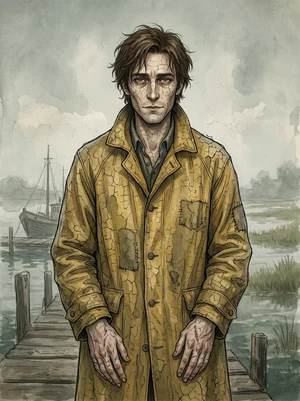
He was standing in the water to his knees with an old hurricane lamp, the glass sooted on one side. He had come out to wait for her. She did not know how long he had been there, and the not knowing put an ache under her ribs she had no name for.
“Soft boards at the middle,” August said. “Walk where I walk.”
She pulled off Lavinia’s boots and rolled her jeans and walked where he walked. The water was warmer than the air. Things moved against her ankles that she decided were grass. At the soft place the board dropped under her heel and he turned without a word and caught her elbow and held it until she had her feet. Then he let go. He was good at letting go. She was starting to dislike it.
“She told you about the faces,” he said after a while.
“She said the house shows you who’s going to look after it.”
He said nothing. The lamp swung and his shadow went out across the water and came back.
At the house the water stood two steps up the front stair. They climbed out onto dry stone and stood dripping in the lamplight. He set the lamp on the step. She was pushing her wet hair off her forehead, and he reached out, slowly, like a man reaching for a thing on a high shelf, and moved a strand of it off her eyebrow with one finger.
His finger stayed. It rested on the scar.
“That came last,” he said quietly.
She did not move. She could feel his breath on her mouth. She could feel the whole length of the gap between them, a few inches of warm air in a cold night, and how easy it would be to close it, and what he would do. She wanted to know what he would do. She wanted it the way she wanted to see under a varnish: urgently, and with her whole attention, and against her better judgment. His eyes went to her mouth. Her lips parted before she told them to.
And she understood, with the same cold clarity she had felt at the test window, where he was looking. Not at her. At a scar he had watched arrive on six paintings. He was checking it against his notes.
She stepped back.
“You’re not looking at me,” she said. “You’re looking at them.”
He dropped his hand. In the lamplight his face was utterly still.
“I don’t know how to tell the difference,” he said.
It was the most honest thing anyone had said to her in years, and it was not what she wanted. She picked up her boots and went inside and did not let herself look back to see if he was still standing on the step. She knew he was.
The kitchen was dark. She wanted water, a glass of her own water, cold, and went to the row of jugs by the range.
They were in the sink. All six of hers, caps off, upside down, empty. Even the one she had left in the gallery beside the swabs. Someone had carried it down and poured it out with the others and stood it in the sink to drain.
She turned on the tap and held her fingers under it and touched them to her mouth, and tasted the marsh.
What did you think?