The wind went around to the northeast at four in the afternoon, and by five Wash’s voice was coming out of the radio in the kitchen telling every boat on Hesper to double its lines.
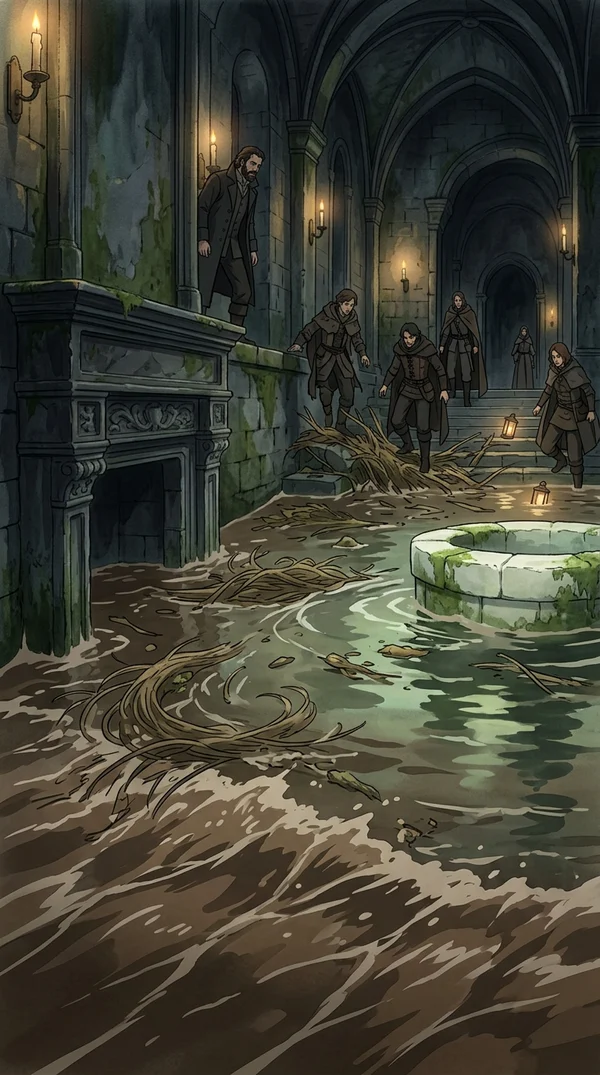
It was not the big one. That was still out at sea, a smear on the weather maps August pulled up on a phone with one bar of signal, a low that might or might not come up the coast with the king tide on Thursday. This was only the first blow of the fall, the kind the island got three or four times between September and Christmas. But it came on top of a spring tide, and on top of whatever Maren had done to the house that morning with a bowl of rainwater and two dozen swabs, and by dark the Water Room was full to the plaster garlands and the bay was coming in under the cellar door.
“The ledgers,” August said, and went down.
She went after him. The cellar stair was a black well with water standing on the third step and rising, and he was on the second step with the headlamp on, lifting the cloth-bound books off their shelf by the armful. She took them from him as he passed them up. Forty-one of them, soft as felt, heavier than they looked, and two hundred years of water written in them in a dozen hands. They carried them up to the attic in two crates and set them on the long table beside Joan’s notebook, and by the time they went back for the last armful the brass plate on the wall had gone under.
The main block held. It stood on its hummock with the bay washing around it in the dark, and the water came up the front stair one step at a time, and at the top step it stopped, and stayed there, and lapped, as though considering.
At nine the power went.
They were in the attic because it was the driest place and the warmest, and because the paintings were there. The rain came down on the north glass so hard that it sounded like gravel. August had brought up blankets, a camping lantern, a box of crackers, two tins of peaches and a bottle of whiskey he had found in his mother’s cupboard among the solvents, with a label in her hand that said NOT FOR CLEANING. They ate the peaches out of the tins with the same fork, passing it.
He had come up the attic stair with the blankets and knocked on the open door frame, and waited, and when she said “Come in,” he came in. Neither of them mentioned it. It sat between them on the blanket anyway, warm as the lantern.
Five of her watched them from the wall. And Harriet, with her own plain face now, looking slightly to one side, with better things to look at.
“You stopped,” he said. “After her.”
“I wanted to see what the house did. Before I did it five more times.” She held out her hand for the fork. “And I don’t know what I’m doing. I want to know what’s under the Lantern before I take everyone else off the wall and leave her up there alone.”
He gave her the fork and was quiet for a while. The wind found a loose pane somewhere and played it like a reed.
“I didn’t tell you all of it,” he said. “The boat.”
She waited.
“When she went over I went in after her. It was clear, that water, the sun was going straight down into it. I got hold of her wrist.” He was looking at his own hand, turning it over, as though the wrist might still be in it. “Something was pulling her down. Not a current. There’s no current in the Gut at slack. It was just pulling, steady, like a weight on a line, and it was pulling me down too, and she knew. She looked at me. Down there. She looked right at me and she took my fingers off her wrist. One at a time.” He closed his hand. “Then Wash had me by the collar.”
Maren put the tin down.
“I used to think she let go because she was angry. That I’d made her try to leave and it killed her. I thought that for years.” His voice stayed level, the ledger voice. “I don’t think it any more. But I haven’t been off the island since. I go down to the dock and I look at the Gut and I can’t.”
She did not say she was sorry. She had been told she was sorry for things her whole life and it had never once made anything lighter. Instead she told him about the bag.
“My mother left when I was four,” she said. “She put me on the front step of my grandmother’s rowhouse in Highlandtown with a duffel bag, and said wait here, and went to get cigarettes. I sat on the bag. I sat on it until it was dark. I didn’t cry, because I’d decided if I was very good and very quiet she’d at least come back for the bag.” She took the whiskey from him and drank and gave it back. “My grandmother cleaned offices at night. She used to take me with her when I was small and sit me in a corner with a coloring book and tell me, you be so quiet they forget you’re there, and you can stay. And I was. And they did.”
“So you went into a job where nobody sees your work.”
“If anyone sees my work I’ve done it wrong.” She heard how it sounded. “I sign my reports with my initials. I don’t own a picture of myself. I’ve been in a lot of rooms, August, and nobody has ever looked at me for more than about a minute, and that was fine. That was the arrangement.” She looked down the row of paintings. “And then I came here.”
He did not say anything. The camping lantern hissed.
“Here’s what I can’t get past,” she said. “This house wants me to stay. It’s wanted it since I was seventeen. And I sit up here with you and I want to stay. I want it so much I can taste it.” She made herself look at him. “So how do I know any of it is mine? How do I know it’s not the house wanting it for me?”

 100 to start reading with.

What did you think?