Lavinia had been in the attic in the night. She had stood among the stripped portraits a few feet from where Maren lay dreaming, lifted the pot off the table, and gone down again without waking her.
Maren sat on the cot with that for a minute. Then she got up and went looking for rain.
It came at four in the afternoon. All day the storm had been wind and spray, the bay running brown and furious past the windows, the house shuddering in the gusts, and no rain at all, as if the weather were holding it back on purpose. Then the light went green and the first band came across the marsh like a wall, and she was on the second-floor landing with a hacksaw from August’s toolbox, sawing through the old iron downpipe where it ran past the window, and when it parted the water came out of the cut end in a solid rope. She filled a plastic bucket. She filled both of August’s old jugs. She tasted it off her wrist: tin and roof-moss and sky. Sweet.
High water was at nineteen minutes to ten. The turn of the tide. Lay it on yourself, with your own hand, at the turn of the tide.
From the end of the hall, under the door to the cellar stair, a thin yellow light was showing.
At nine she went down.
She had a jug of rainwater on a strap over her shoulder, the headlamp, and the boat hook, which she found floating against the inside of the door when she opened it, because the last dry step was not dry any more and had not been for hours. The stair went down into black water at the third step. She went down it. The water was cold and moving, pushing up the stairwell and sucking back in slow surges as the storm drove the bay against the outside of the house, and at the bottom of the stair it was at her chest, and the floor of the Water Room was not where it had been. The floor was soft. Somewhere under her boots the boards had broken and were lifting and settling with the water, like the deck of a boat.
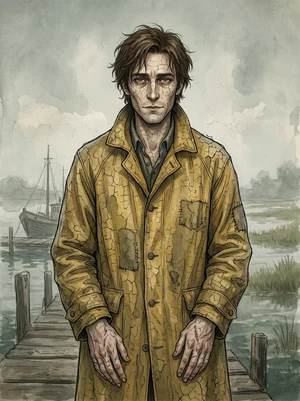
The room was full of noise. Wind in the boarded windows. Water slapping the plaster. The long groaning of the north wall. And in the middle of it, calm, a camping lantern on the thwart of the Calder skiff, tied to the iron ring by the mantel, and Lavinia sitting beside it in her yellow slicker with the enamel pot in her lap.
Above her the Lantern hung on its wall, bright and clean, with the water lapping at the bottom of its frame, exactly at the line.
“I knew you’d come,” Lavinia said. She did not raise her voice. In the noise of the room Maren should not have been able to hear her, and she heard every word. “I’ve been sitting here two hours deciding whether I could make it be my hand. It can’t. I tried. I put the brush to her before you came down and it just slid off, like trying to paint on glass.” She lifted the brush off the lid of the pot. It shone. “It has to be you.”
“It doesn’t have to be anyone.”
“There are eleven children on that Ridge, Maren.”
“And there’s a line on the church wall. Two of them.” Maren waded toward the mantel. The water pushed her back a step for every two. “Your village has flooded every time it was going to flood, Lavinia. It’ll flood tonight. And it’ll still be there in the morning, and so will you. You can go and look.”
She unslung the jug. She had the cap off.
Lavinia moved faster than a woman of sixty-six should have been able to move in a skiff. She came across the thwart and her hand closed on the jug’s handle, and they had it between them for a second, and the skiff heeled and shipped water over its gunwale and Lavinia’s weight went the wrong way, and the jug went out of both their hands. It went into the black water with a flat sound. It did not float. Sweet water poured into salt, and was gone.
Lavinia caught herself on the ring. She was breathing hard. She did not let go of the brush.
“I’m sorry,” she said. “I’m sorry, honey. I am.”
Maren stood in the water to her chest with nothing in her hands.
Lavinia’s lantern was swinging on the thwart, and its light went out across the water and came back, and the water in front of Maren steadied between two surges and lay still for a moment, black and glossy, and she looked down into it.
Her face looked back up at her.
She was holding a lantern.
Maren’s hands were at her sides. In the water, her reflection held a tin lantern up beside its face, pierced all over with small holes, and the light came out of the holes in small soft stars that lay across the surface and did not move when the water moved. Her reflection’s face was her own face. It was not her own expression. It was the expression from the painting on the wall, patient and glad, the face of someone who had waited a long time and did not mean to show you how long.
“Mind the step,” it said, in the flat kind voice, with Maren’s mouth.
She heard herself make a sound.
“You’d be kept,” the reflection said. “Do you know what that is? For a woman like us?” It tilted the lantern so that the light fell across Maren’s chest, warm, through the cold water. “Every day of your life, someone looking. He’d look at you every day. Every morning at six on that stair you’d write the number down together. You’d have her studio and the north light, and your work on these walls, and your face on them, your own, forever. Nobody would ever again forget you were in the room.” The voice softened. “You sat on a bag on a step until it was dark. I know. I lay in this water some hours, too, and nobody came. Let me keep you. I’ll never put you down.”
It was the truest thing anyone had ever offered her, and it was offered by the only one in the house who knew exactly what it was worth.
Lavinia was beside her. She had got out of the skiff, into the water to her chest, holding the ring with one hand and the brush with the other, and she took Maren’s right hand in hers under the water and brought it up and pressed the brush into the palm. The handle was warm from her grip. The bristles were heavy with varnish, gold and salt-smelling, and a drop of it ran down over Maren’s knuckles.
“Close your hand,” Lavinia said, gently, as to a child. “Just close it, honey. I’ll do the rest.”

 100 to start reading with.
What did you think?