Everyone Who Said No, chapter 2 of The Last Real Fall
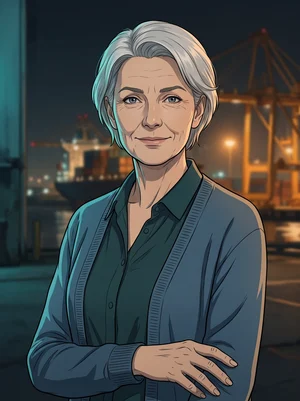
Ingrid Lindqvist’s house sat on the hill above the port in San Pedro, and from her back step you could watch the cranes unload ships the size of neighborhoods. The cranes were automated now. They moved all day with the patient, stupid grace of things that would never be tired, and Ingrid said they reminded her of night shift.
“Nobody looks at them,” she said. “Same as nurses.”
She was sixty-six and wore her gray hair in a knot with a pencil through it. She had poured Tess a coffee and stood at the counter with her arms folded, looking at the lemon tree in the yard, so overloaded the branches touched the ground.
“Danae says it’s a long shot,” Ingrid said.
“Danae’s right.”
“She says if anyone breaks the law to get evidence she can’t know about it in advance.” Ingrid turned and looked at Tess over her glasses. “So I’m not asking you anything. I’m making coffee. Do you want more coffee?”
“Yes, please.”
“Good.”
The doorbell rang. Ingrid went to answer it, and Tess heard Mars before she saw her, because Mars talked the way she drove, with the throttle already open.
“I’m here to say no in person, Mrs L, because I love you, and because Tess is going to try to talk me into it, and I want her to see my face when I say it. Lupe, shoes. Lupe. Shoes.”
Mars came into the kitchen in her Valet Royale polo with a foil-wrapped burrito in one hand, the keys to Dolores, her old Crown Victoria, in the other, and her daughter attached to her leg. Lupe was seven, wore a Nightjar backpack Tess would have to pretend not to notice, and had already spotted the lemon tree.
“Can I pick them?”
“The ones on the ground,” said Ingrid. “Take a bag.”
Lupe went out. Mars pointed the burrito at Tess.
“No,” she said.
“I haven’t said anything.”
“You sent a picture at midnight, Tess. To the group. With his name still in it. That’s a flare. That’s somebody on a raft shooting a flare.” Mars bit the end off the burrito. “I have a kid. I have a custody agreement with a man who thinks a turn signal is a suggestion. One arrest, one, and his lawyer is in front of a judge with a printout of my face. I park cars now. Nobody dies parking cars.”
“Okay.”
“Don’t okay me. I hate when you okay me.”
“I’m not going to talk you into anything.”
“Good.” Mars sat down at Ingrid’s table. “What’s the plan?”
Through the window, Lupe was crouched under the tree filling a canvas bag with windfall lemons, her mother’s tablet in her other hand. Tess could hear the music from here. The rising strings. The wind across the cable.
“Is she watching it?” Tess said.
Mars turned around in her chair. “Lupe, what are you watching?”
“The bridge one!” Lupe held up the tablet. “Mama, look. Look. That’s Tío Bo’s tap.”
The kitchen was very quiet.
“She’s seen him do it a hundred times,” Mars said, not to anybody. “Every birthday. He’d stand on the arm of the couch, tap tap, fall backwards onto the cushions. She thinks it’s how you say goodbye.”
“He’s in the movie,” Lupe called. “Did they get him to do it before?”
Mars got up. She went out the back door and across the yard, and she knelt beside her daughter under the lemon tree and watched the trailer over her shoulder with her hand on the back of Lupe’s neck. She watched it twice. Then she said something Tess couldn’t hear, and Lupe said “Okay” and went back to the lemons, and Mars stood up and stayed facing the port for a long time.
When she came back in, she ate the rest of the burrito in four bites, balled the foil, and threw it into Ingrid’s sink from across the kitchen.
“I need to be home by midnight on any night we do this,” she said. “My sister keeps Lupe till midnight. After that she turns into a pumpkin. That’s my condition.”
“Okay.”
“I told you not to okay me.”
Jonah came over the back fence at eleven, because he could, and because, he said, it was better content.
He dropped from the top rail into a forward roll on Ingrid’s grass and came up with his helmet camera blinking and his arms out. He was twenty-six and built like a coat hanger, all shoulders, his hair dyed silver for a fashion campaign and grown out black at the roots.
“Caption,” he said. “Local freerunner arrives fashionably, regrets the cactus.”
There was a cactus by the fence. Ingrid took him by the wrist without a word, sat him on the back step and removed the spine from his palm with tweezers from her apron pocket.
“Camera off,” Tess said.
“It’s off. Mostly. Now it’s off.” He tapped it. “I saw it at the gym. Somebody put it on the big screen. Everybody went crazy for the fall. I was like, guys, guys, I knew that dude, he taught me to roll, that’s his thing, and this kid next to me goes, ‘No, that’s Dax’s thing.’” He stopped smiling. “I almost hit him. I didn’t. I did a backflip instead, which was weird, but I had to do something with it.”
“Good,” said Ingrid, and gave him back his hand.
Then she went into the house and came back with a cardboard box.
It was a moving box, taped and retaped, with LARK PICTURES / PERSONAL EFFECTS / LINDQVIST B. on a printed label and, under that, in Ingrid’s capitals, BO’S WORK THINGS. She lifted the flaps and stepped away, as if it were someone else’s business.
“They sent it in March,” she said. “I don’t know what any of it is. You take what’s useful.”
Tess knelt. She knew all of it.
The gloves first, goatskin, the right thumb mended with dental floss because Bo said floss outlasted thread. Three rolls of tape, white, black, the expensive stretchy tan. A water bottle with a sticker of a cartoon walrus. And the chest harness he wore under wardrobe on wire days, his own, not the production’s, the webbing gone soft and gray with years of sweat. Her hands went over it the way they would have gone over her own, checking. The buckles. The stitching at the D-ring. The left shoulder strap, where he wore the sheath.
The sheath was empty.
She turned it over. It was a molded plastic sheath for a hook knife, the kind with a curved blade guarded inside a loop so you could cut a line or a seatbelt without cutting yourself. The release clip was closed. Nothing inside.
“Where’s his knife?” she said.
Ingrid looked at the harness. “They said a lot of things went in the tank.”
“Stunt people don’t lose the knife,” Jonah said. He had come to stand behind Tess. His voice had gone small and serious, the way it did when he forgot to be on camera. “He told me that my first week. You lose your keys, you lose your phone, you lose your mind. You don’t lose your knife. It was yellow. He did the handle in yellow tape so he could find it in the dark.”
“Clip’s closed,” Tess said. “If it fell out in the water, the clip would be open. You have to open the clip to draw it.”
Nobody said anything for a while. Below them a crane lifted a red container off a ship and swung it, slowly, through the air, and set it down without a sound.
Gus arrived at noon with a sack of oranges from a stand on Gaffey Street, because he did not believe in arriving anywhere empty-handed, and because, Tess suspected, he had driven around for an hour first.
He put the oranges on Ingrid’s counter. Ingrid looked at them and then at her own tree.
“I know,” Gus said. “I panicked.”
He kissed her cheek, shook Jonah’s hand, squeezed Mars’s shoulder. He did not look at Tess, and he did not look at the cardboard box, which she had brought inside and put on the table with the harness on top.
Mars, who never left a silence alone in her life, said, “Gus. Real question. The decelerators that day. Was there anything wrong with them?”
“I checked that brake three times,” Gus said.
He said it to the oranges, fast and worn smooth, a thing he had said to himself at three in the morning for eight months.
Mars looked at Tess. Tess looked at Gus’s hands, which had found an orange and were turning it, around and around, a thumb pressing the peel.
“Okay,” Mars said.
“Somebody has to keep you idiots from dying stupid,” Gus said. “That’s all I’m here for. I’m not here because I think it’s a good idea. I’m here because you’re going to do it anyway and you’ll rig it with shoelaces. Jonah, is that a cactus spine?”
“Ingrid got it.”
“She’s a good woman.” He put the orange down. “Who else is coming?”
Tess knew who else. She had known since the third bubble last night, the one that had appeared and disappeared and appeared again and finally sent nothing at all.
A car pulled up outside.
Electric, heavy, silent except for the tires. Jonah pulled the front curtain aside with one finger.
“Oh,” he said. “Oh, no.”
A black Lark Pictures sedan, a silver lark with its wings up on the rear door. The passenger crossed Ingrid’s tiny front yard with his hands in his jacket pockets and rang the bell.
Ingrid went to let him in. Nobody else moved.
Rafe Iwasaki came into the kitchen and stopped just inside the door, the way you stop at the edge of a cold pool. He was thirty-eight and stood like a man who had spent his working life being set on fire and walking calmly away from it: shoulders loose, weight even, nothing wasted. The burn scar ran from his left wrist over the back of his hand to the knuckles, pale and shiny. His wrists were taped. Figure-eight, thumb free. The way Bo had taught all of them.
Tess noticed that before she noticed anything else, and was angry that she had.
“You came in a Lark car,” she said.
“They pick me up on session days. I had a session at eight.” He looked at the box on the table, the harness. His face did not change. His hands came out of his pockets and then did not seem to know where to go. “I didn’t want to be late.”
“Session,” said Mars.
“I’m a reference performer.” He said it to all of them, flatly, as if reading it off a badge. “Since March. I licensed my motion to Lark. When the Dax feather does a fire gag, a burn, a car hit, it’s built on mine. I go in twice a month, they put me in a suit, I walk, I fall down, I get up.”
Jonah said, “Dude.”
“Yeah.”
“Dude.”
Tess got up from the table without deciding to and walked past Rafe into the back yard, and heard him follow her.
Under the tree, she turned around.
“You sold him,” she said.
“I sold me.”
“He’s in that trailer. They fed them his last fall. And you went in the next month and put on a suit and let them have you, too. While Ingrid was getting letters saying her son made an error.”
Rafe stood with the lemon branches brushing his shoulders. Somewhere behind him in the house, Lupe was explaining to Gus that the oranges were not as good as the lemons.
“Yes,” Rafe said.
“That’s it? Yes?”
“You want me to explain, or you want me to stand here?”
“I want you to have said no.”
“Everybody said no, Tess.” He looked past her at the port, at the cranes moving their boxes through the bright air. “Everybody said no. Then everybody’s rent came due. I’m not going to tell you mine was the noble version.” Something in his jaw worked. “Ingrid knows. Ask her if you want.”
“I’m asking you.”
He didn’t answer that. Instead he took a breath, the way he did before a full burn, when the safety team was standing by with the blankets and he had about four seconds of air left in the suit.
“Here’s the only thing I came to say,” he said, loud enough for the kitchen. Mars and Jonah were in the doorway. Gus was behind them. Ingrid was at the window with her arms folded. “Lark’s security reads you by your walk. Usher. It’s got all of us from the capture stages. You five are flagged. You set one foot on that lot and every camera on every lamppost lights up red.”
“We know,” Tess said.
“You don’t know this.” He looked at her. “It reads me as Dax Holloway. My walk is his walk now, in the system. That’s what reference means. Every door on that lot that opens for Dax opens for me.”



What did you think?