Lunch with Vivian Strand, chapter 5 of The Last Real Fall
Vivian Strand had taken the booth at the back of the Bluebird that faced the door, which was exactly the booth Tess would have taken, and she had already ordered.
“Pie,” she said, as Tess slid in opposite. “Peach. They do it with a lattice. I ordered you the same because you’d only have ordered a salad to make a point.”
“I don’t like peach.”
“You love peach. You ate four slices at the wrap party for Highwire and then threw up in the parking lot of the Sportsmen’s Lodge.” Vivian smiled. “I hired you, Tess. I know what you like.”
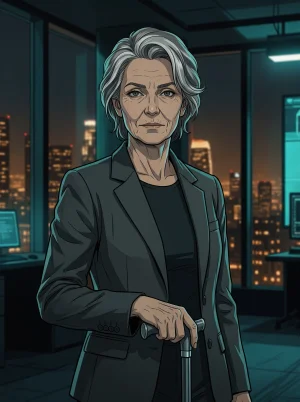
She was sixty-one and looked like a blade somebody had wrapped in linen: silver hair cropped close, reading glasses pushed up into it, a small enamel lark on her lapel. She sat very straight. She had to; three bones in her lower back had been fused since a fall in 2009 that ended her career and, people said, started her real one. A black cane with a steel tip hung on the edge of the table.
Twenty years ago Vivian Strand had been the best high-fall woman in the business. Tess had once had a poster of her taped inside a locker at stunt school: Vivian going backwards off a dam in Nevada, arms out, perfectly flat, a hundred and twelve feet.
The pie came. The waitress put down two forks and two coffees and left.
“Tell Rosario,” Vivian said, “that the little boy’s father wrote to us. He’d like to thank her. I have to decide whether to give him her name.” She picked up her fork. “I’m inclined to. It was a good save. Three strides from a standing start, low, scooped him under the arms without changing her line. I watched it six times. She was always the best driver I ever hired, and she should have been a runner.”
“She was taking a tour.”
“In her cousin’s wife’s shoes.”
Tess picked up her fork too, because it was something to do with her hand.
“I’m not going to pretend I don’t know what you’re doing,” Vivian said. “I’m too old and my back hurts. I’m going to ask you to stop, and I’m going to tell you why, and then I’m going to let you pay for lunch.”
“You could have called.”
“You’d have hung up. You can’t hang up on pie.” She ate a bite. “Do you know how many funerals I’ve been to? For work?”
Tess didn’t answer.
“Nineteen. I keep a list. Names, dates, the gag. Car rollover in ’97. A full burn in 2004 when the suit seam went. A boy on a ratchet in 2011, twenty-two years old, the line was rated, the line was fine, the anchor wasn’t.” She said the words as if setting down a tray, one cup at a time. “After the ninth one I stopped going to the cemetery and started going to the board. Thirty years I went to meetings. Pads, airbags, rated rigging, safety officers on every set. And people kept dying, Tess, because you can make the gear perfect and the human being on the end of it is still a sack of water and bone moving at forty miles an hour toward the ground.”
“So you replaced us.”
“So I stopped needing you to fall.” Vivian put her fork down. “Since February, nobody on my lot has broken a bone for a picture. Not one. In the old days, in eight months, I’d have had four. Four real people. Kids with mortgages and husbands and a knee that’ll never bend again. You want to hate me, hate me. But don’t sit there and tell me it isn’t working.”
The coffee machine hissed behind the counter. Someone laughed at the next booth.
“You used his footage,” Tess said. “In the trailer. The feather taps its buckle. Twice. You told the arbitrator the A-camera was corrupted.”
“I told the arbitrator what the archive told me.”
“That’s not an answer.”
“It’s the one I gave under oath.” Vivian looked at her steadily over the pie. “I’m going to offer you two things. You’ll say no to both and then you’ll think about them in the car. One: a reference license. Like Rafe’s. You’d fall once a month, into a foam pit, in a capture suit. Low falls. Thirty feet, never more. They’d pay you more than you made in your best year, and you’d never have to stand on a deck again and wonder.”
“No.”
“Two.” Vivian reached into her jacket and laid five cream envelopes on the table, fanned like a hand of cards. Each had a name on it in fountain pen. OCAMPO. FERREIRA. VELA. PAK. IWASAKI. “Premiere passes. Row F. Come and see it. All of you. See what he made possible, on a forty-foot screen, with three thousand people cheering. And then let it go.”
Tess didn’t touch them.
“He made it possible,” she said. “That’s what you think.”
“I think he’d have hated it. I think he’d have stood at the back with his arms folded and complained about the physics. And I think in ten years nobody will remember there was ever a time when people did this with their bodies, and that will be a good thing, Tess. That will be the best thing I ever did.”
She picked up her cane and set its tip on the floor, and then she paused, half risen, looking down.
“I’ve read your medical file,” she said. “I’m sorry. I had to. Retrograde amnesia, four seconds. You don’t remember the end of the fall.” Her voice changed, became almost gentle. “Be grateful for that. I remember every second of mine. I remember the sound my back made. It was very small. It sounded like a pencil.” She stood all the way up. “Leave it in the ground, Tess. Whatever’s down there, leave it.”
Tess paid for the pie, which neither of them had finished. When she looked up from the card machine, Vivian was gone, and the five envelopes were still on the table. She thought about leaving them there. She put them in her jacket instead and hated herself all the way to the car.
That evening, at the top of Gus’s tower, she found out that she couldn’t do it.
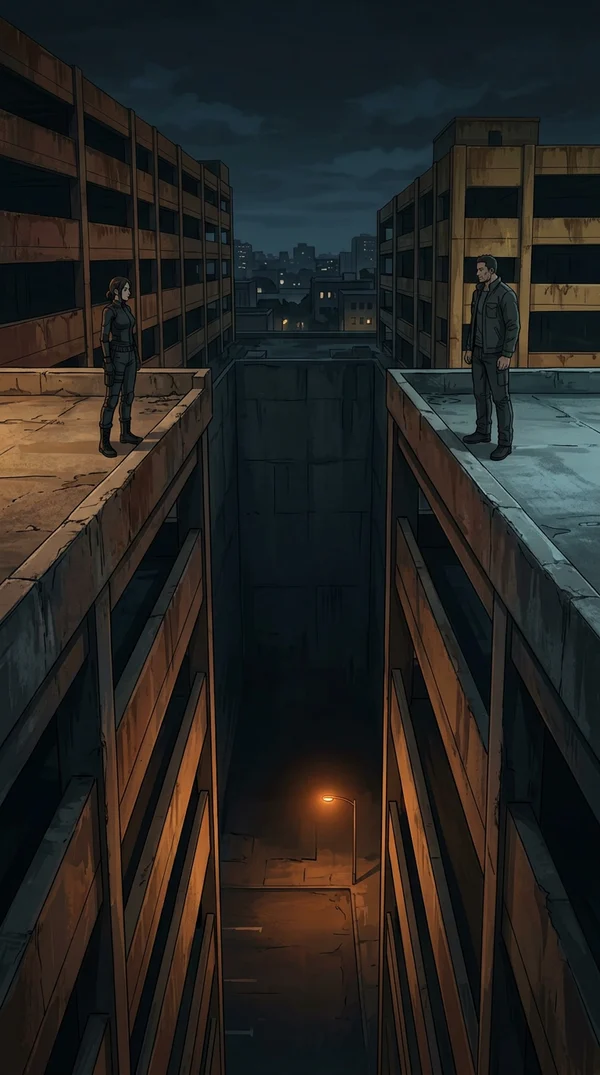
It was sixty-five feet. The roof of the training tower was a square of cracked concrete with a low parapet and a steel arm bolted out over the edge, and from it hung the decelerator, Gus’s best, a drum in a yellow housing with its line wound around it like thread on a spool. It let you fall almost free and then caught you, gently, a yard above the gravel. It was what she had been on in February.
“If anybody opens that machine-room door while you’re halfway down the shaft,” Gus had said at the bottom, “you don’t abseil. You drop. So you drop here first.”
She had clipped in. She had checked the carabiner, and the gate, and the harness, and the line. She had put her heels on the edge.
Her body would not go.
It wasn’t fear exactly. It was like reaching for a step in the dark and finding no step. She told her knees to bend and they did not bend. Her hands were holding the davit arm on either side and she could not open them. Below her, the gravel yard was the size of a playing card and Gus was a dot with glasses.
“Tess?” Gus, on the radio. “Talk to me.”
“Give me a minute.”
“You’ve had four.”
Behind her, a boot scuffed on concrete. Rafe had climbed up with her, to spot the top, and he had stayed back by the stairhead the whole time without saying anything, which she had been grateful for and which she now resented, because it meant he had watched.
“Don’t,” she said.
“I’m not doing anything.”
“You’re about to say something wise.”
“I’m about to say something boring.” He didn’t come closer. “You want it?”
She didn’t answer. He took that for a yes.
“Fire’s honest,” he said. “That’s why I like it. It’s hot, it hurts, it tells you exactly how bad it is, and if you listen, you live. Height’s not honest. Height lies to you. Every time you stand on an edge it tells you you’re going to die. Every time. And how many times has it been right?”
“Once,” Tess said.
He was quiet.
“Once,” she said again. “It was right once.”
“Not about you.”
The wind came across the yard and moved the line against her harness. Down at the bottom, Gus had stopped saying anything into the radio.
“Tell me your three things,” Rafe said.
They all had them. The checks you said out loud on the deck so your mouth would do them if your mind went blank. Bo had made the crew learn each other’s, years ago, so anybody could prompt anybody.
“Chin,” she said. “Back. Arms.”
“Chin.”
“Tucked.”
“Back.”
“Flat.”
“Arms.”
“Wide.” Her fingers had come off the davit. She didn’t remember opening them. Rafe had moved, while they talked, so he was standing a step to her left, the side where Bo always stood, and she felt it the way you feel a draft. “Not there,” she said.
He moved to her right without a word.
“Three,” Tess said. “Two.”
She didn’t say the last word. She didn’t need it. She went.
The yard came up at her, the gravel, the stacked pads, the rust-red face of the tower streaming upward past her shoulder. The drum sang above her, a high whirring note, and for a terrible second the falling was simply falling, nothing between her and the ground but a thread. Then the brake took her. It took her with a long thin squeal of metal on metal, like a tram on a curve, and the world slowed and slowed, and she was hanging three feet above the gravel with her arms out, turning very gently, and she was alive.
She unclipped, dropped, landed. Her legs held her.
Up on the roof Rafe was a silhouette against the evening. He raised one hand. She raised one back.
Then she saw Gus.
He was sitting on a sandbag beside the base of the tower. He was holding his glasses in his lap. His face had gone the color of the concrete.
“Gus?”
“That squeal,” he said.
“It’s the brake. It always squeals.”
“Not like that. Not that one.” He put his glasses on, then took them off again. “It squealed like that in February. Right before. I heard it through the radio. Then the line went slack.”
Tess knelt beside him on the gravel.
“Vivian came to me two days after,” he said. “In the hospital parking lot. She said the investigators had taken the decelerators apart. My decelerators. The brake pads on his unit were glazed. It slipped. She said the report would have named me, the rig, the rigger, and the insurer would have come after me and the union would have come after me and the DA might have. She said she’d kept my name out of it. She said it was the last thing she could do for me.” He looked at his hands. “That’s why it says performer error. Because the other thing it could say is me.”
“Gus.”
“I checked that brake three times,” he said. “Three times, Tess. And it still slipped. That’s what’s on that camera. My brake.”
“It wasn’t your brake.” The words came out of her before she had decided to let them. “It was me. They moved my mark. I went long. I overshot it and put my line through his. I’ve known since February.”
Gus stared at her.
“You don’t know that,” he said.
“Neither do you.”
They sat on the gravel together. Eight months, and each of them had been sure it was theirs, and neither had said so out loud until now. Above them the decelerator line swung in the wind, emptied, the yellow drum ticking softly as it cooled.
“I’ll still rig it,” Gus said at last. “I’ll rig it, and I’ll get you in, and I’ll get you out. Whatever’s on that mag.” He pushed himself up off the sandbag with one hand on her shoulder, the way he used to push himself off the edge of a bag. “And then we’ll both know whose it was.”
What did you think?