He sat outside my door all night.
I know because I lay on the other side of it with the key turned and the striped blanket up to my chin, and I could feel him there, a warmth on the far side of the old pine, about where the mark was. He didn’t knock. He didn’t speak. Every so often I heard the floor creak as he shifted his weight, a big man on a hard floor, and around four in the morning I got up and opened the door, and he was sitting with his back against the opposite wall and his forearms on his knees, wide awake, looking at me.
“Go to bed,” I said.
“No.”
“That’s not a term.”
“It isn’t in the terms,” he agreed, “that I have to sleep.”
I closed the door again. I didn’t lock it. I lay awake for a long time thinking about that.
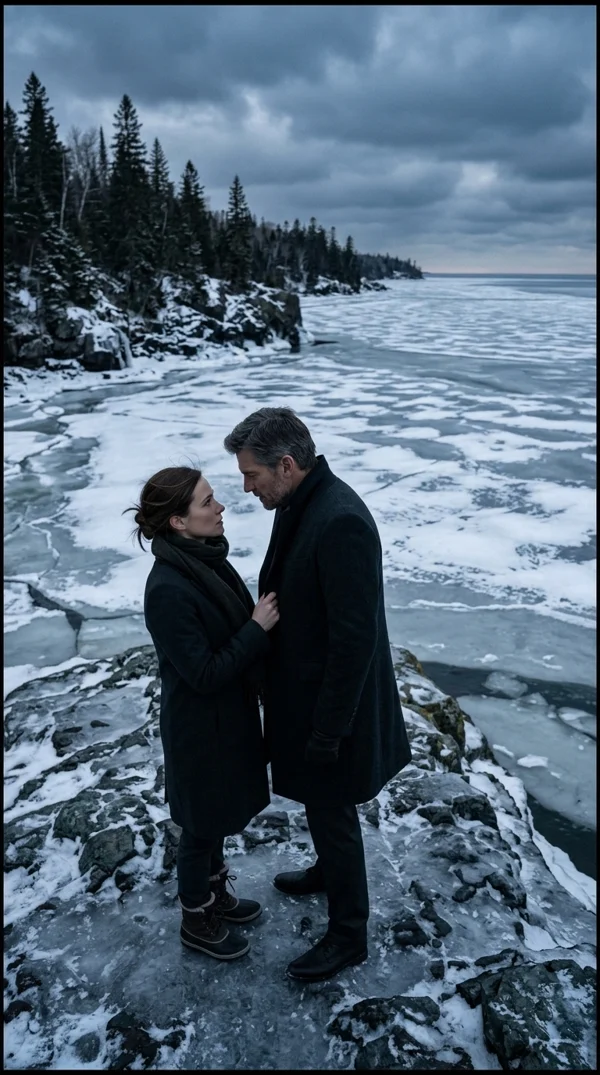
The storm came in off the lake on Thursday morning, a northeaster, the kind the people up here name and remember. It started as a gray wall on the horizon at breakfast, and by ten the wall was on us. Solveig had gone into Grand Marais at first light with Margaux for groceries and her prescriptions, and at ten-thirty she called on the landline to say the highway was closed and they were staying at her daughter’s, and that if the king let the pipes freeze she would skin him.
At eleven the power went.
The house didn’t go dark so much as go gray. Snow hit the windows sideways, so thick I couldn’t see the rail on the terrace six feet away, and the lake was a sound and nothing else, a huge continuous roar under the wind, the ice on the rocks groaning and cracking like the whole point was being pried loose. Lindgren put on a snowsuit and went out to check the generator and the perimeter, and Lucan built up the fire in the great hearth until the heat came off it in a wall, and then he went down the long hall and came back carrying my suitcase.
“That room has one wall on the lake,” he said. “You’ll freeze in it. There’s a room off this one.”
“With a lock on my side?”
He stopped. Then he went and got a screwdriver.
I watched him take the lock out of my door and put it into the door of the small room off the great hall. It took him twenty minutes. He did it with great care and no comment, kneeling on the floor in his gray sweater with the screws held between his lips, while the storm screamed at the house. When he was done he turned the key twice to show me it worked, and handed it to me, and went and sat in the chair by the fire.
I was going to have to do something about him. I didn’t know what.
We ate soup at the hearth at two in the afternoon, in the gray dark, with candles on the stones because Lindgren said the generator was for the pipes and the freezer and not for “ambience.” Then Lindgren went to sleep in the boot room in his snowsuit like a bear that had found a good cave, and it was just the two of us and the fire and the noise.
I told him about Brandon.
I hadn’t meant to. It came out the way things come out in a long session, after lunch, when everybody’s tired and the room’s warm and the defenses go down with the blood sugar. I told him about the three years. The briefs I’d written at my kitchen table after mediating all day, the ones that went out with Brandon’s name on them and won. The time a partner had stopped me in the hall to say Brandon had a real gift for statutory argument, and I’d said thank you before I could stop myself, and he’d looked at me oddly. How Brandon had said it, in my bed, in the dark: that the partnership committee looked at the whole picture, and a mediator wasn’t, you know, a lawyer lawyer, and it would look like he’d been carried. How he’d brought the Ziploc bag over the next night. Not even the next week. The next night. He’d already put my toothbrush in it. He’d already sealed it.
“And then they had cake,” I said. “And I clapped. That’s the part I can’t get past. I stood there in the all-hands with a paper plate and I clapped, because if I didn’t clap everyone would know.”
Lucan didn’t say anything for a while. He was looking at the fire. His jaw had gone hard and his hands had closed hard on the arms of the chair, and I had the distinct impression that if Brandon Galloway had walked into the room at that moment he would not have walked out of it.
“He’s a fool,” he said finally.
“He’s a partner.”
“He’s a fool who’s a partner.” He turned his head and looked at me. “He had you in his bed for two years and he looked at you and saw a typist.”
I laughed. I didn’t want to. It came out cracked down the middle and I put my hand over my mouth.
“I thought,” Lucan said, quieter, “for a long time, that being alone was what I was owed. For Josette. For the eight after her. I told myself it was a fair sentence.” He looked at his hands. “It isn’t fair that you were made to clap. That’s the only thing I know for certain this afternoon.”
The fire popped. The storm threw a fistful of ice at the window.
I got up out of my chair. I crossed the hearth to his. I stood in front of him with the firelight behind me, and he looked up at me and didn’t move, didn’t reach for me. His hands stayed on the arms of the chair. He waited.
“I want you,” I said. “I want to be very clear, because I’m a mediator and I believe in clear terms. I want you tonight. This afternoon. Now.” I took a breath. “This isn’t my answer.”
“I know.”
“It’s not the bond. It’s not the knowing. It’s just me.”
“I know.” His voice had gone low and rough. “I’m not asking you for the answer tonight. I’m not asking you for anything you don’t want to give.”
“Then ask me for this.”

 100 to start reading with.
What did you think?