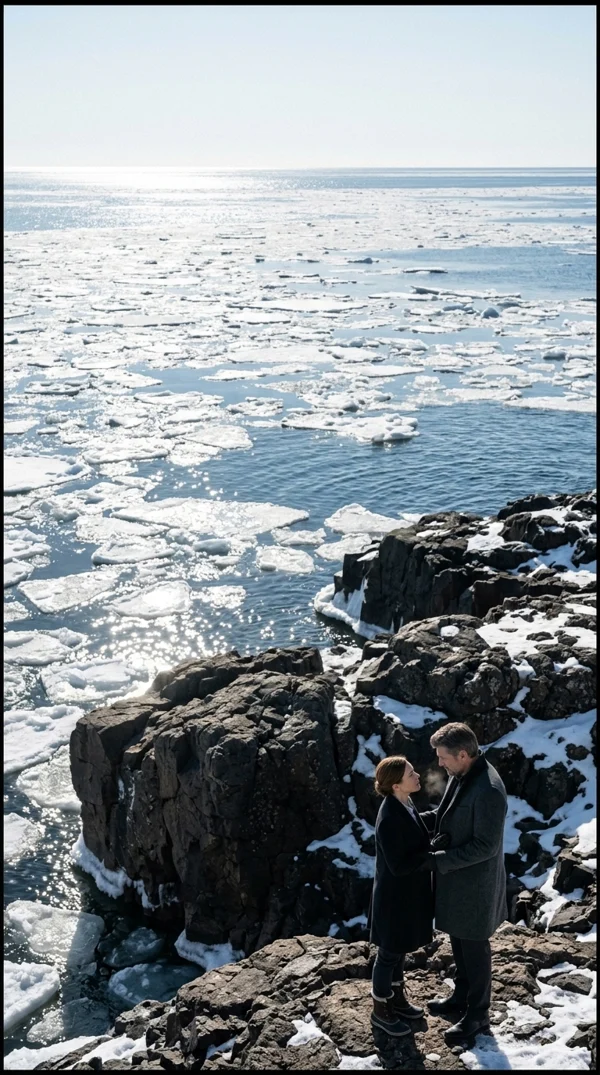
The moon came up out of the lake at a quarter past five, enormous and orange, and laid a road across the open water all the way to the rocks below Skarvik.
By six the drive was full of cars. Pickups with Pepin plates, Subarus, a church van from Red Wing, a Lexus with a Falls pack bumper sticker I didn’t understand and didn’t ask about. They parked in the spruce and walked down to the house in the blue dark in twos and threes, people in Carhartts and good wool coats, whole families, talking low. Some of them didn’t walk. Some of them came down through the trees on four feet and lay down along the terrace wall in the snow with their heads on their paws, watching the door, and nobody remarked on it at all.
We’d driven up that morning, Lucan at the wheel and me beside him with Dessa’s printouts on my knees. I’d slept through the tunnels with my hand on his leg, and woken at Skarvik to Solveig in the doorway saying it was about time.
Two hundred and six. Solveig counted.
They’d moved the long table to the hearth end of the great room. I sat at the middle of it with the treaty file and the blue binder and my legal pad squared in front of me, and my arm bandaged under my sleeve. Margaux on my left, Torvald on my right. Edith Corbin and Bastien Duval at the ends, like bookends that disliked each other. The room in front of us was packed to the walls and up the stairs, and it smelled of wet wool and woodsmoke and cold air and that warm wild undertone I didn’t pretend not to notice anymore.
Lucan stood behind my chair.
He’d asked me where. I’d told him. He hadn’t spoken since. I could feel him back there like the fire.
“This is a hearing,” I said, and the room went quiet the way a lake goes quiet when the wind drops. “I’m Avery Sutter. I’m the mediator. On Monday, Margaux Duval and Torvald Corbin signed an agreement dissolving the treaty marriage of 1826, with two schedules dividing the dower lands. Tonight, at the moon, the king is asked to seal it. Before he does, anybody with a right to speak can speak.” I put my hand on the binder. “I’ll start with Schedule C.”
“No,” Adrian said. “You won’t.”
He was standing at the front of the crowd by the stairs, in a dark suit, and beside him, in his navy partner’s suit, holding a folder like a shield, was Brandon. Brandon was looking at the wolves along the walls. I don’t think he’d blinked since he walked in.
Adrian came forward and laid a sheet of paper in front of me. Then he turned to the room and spoke to them, not to me, in that warm, sorrowful voice.
“I’m sorry to do this here,” he said. “My uncle withdrew his decree last night. That’s his right. But you all deserve to know who’s running this hearing. Ms. Sutter is not neutral. She has been living in this house as the king’s lover since Tuesday. She has no business mediating anything he’s party to.” A murmur went through the room. “And there’s worse.” He touched the paper on the table. “These are the articles of a company called Cormorant Land, which has spent three years buying your dower lands for ten dollars a parcel. Falls riverfront. Pepin bluffs. North Shore timber. You can read the organizer’s name.”
He read it to them anyway.
“Avery J. Sutter.”
The room turned.
I felt it go. I’ve felt rooms go before. Never like that. Two hundred wolves, and every one of them shifted at once, a creak of boots and floorboards, a breath drawn in, and along the terrace wall outside, through the windows, I saw heads come up off paws. Bastien Duval’s lip lifted off his teeth. Edith Corbin’s pearls went perfectly still on her chest.
“A human,” someone said from the stairs. An old man’s voice, cracked. “Of course it’s the human.”
Behind me, Lucan didn’t move. The heat at my back went up like a stove door opening.
I didn’t turn around. I’d told him not to speak, and he wasn’t speaking, and I loved him for it so badly it was hard to breathe.
I picked up my pen.
“Mr. Marrok’s raised two objections,” I said, in my ordinary voice, the one for the moment a room starts to turn. “Conflict, and fraud. I’ll take them in order.”
I turned to Margaux.
“Ms. Duval. I’m disclosing to you, formally, in front of these witnesses, that since Friday I’ve had a personal relationship with the king, who is a party to this agreement. Under the ethics I practice by, a mediator with a conflict has to disclose it, and then the parties decide whether they want her to go on. If either of you says no, I’ll get up and go.” I slid the legal pad across. “Do you want me to go on?”
Margaux looked at me, and then at the man behind me, then took a pen from her coat and wrote on a fresh page, in a big, angry hand, I’ve known since Friday. Keep going. M. Duval, and signed it.
“He walked into the room and looked at you,” she said to me, for everyone. “We all saw it. If that’s a conflict, it’s the only honest thing that’s happened in this treaty in two hundred years.”
I turned to Torvald. He was already reaching for the pad.
Same, he wrote, in careful block capitals. T. Corbin.
“Thank you,” I said. I turned back to the room. “That’s the conflict. Now the fraud.”
I looked at Brandon.
“Mr. Galloway,” I said. “I’d like to speak with you in caucus, please. Three minutes. You’re entitled to have Mr. Marrok present if you want him.”
Brandon looked at Adrian. Adrian smiled at him.
“No,” Brandon said. His voice came out strange. “No, it’s fine.”
The boot room was cold and smelled of wet dog and gasoline. I shut the door. Brandon stood against the wall of hooks and parkas with his folder against his chest. His knee was going.
“Those are werewolves,” he said. “Ave. Those are actual werewolves.”
“Yes.”
“I thought they were some kind of secretive old Minnesota family. Adrian said they were private.” He laughed, a terrible high little laugh. “There’s one by the door the size of a pony.”
“Brandon. Listen to me. We have three minutes and I’m going to use them. Here’s your walk-away. If you go back out there and stand next to Adrian, then two things happen. In that room are two hundred people who can smell a lie, and you smell like one. And outside that room is the Minnesota bar, which can read a Secretary of State filing as well as I can. You typed my name as organizer of a company you formed for a client who used it to steal. That’s not boilerplate. That’s the end of your license and maybe the start of a charge.”
The color went out of him again, all at once, like it had in my kitchen.
“Or,” I said, “you go out there and tell the truth. All of it. Who instructed you, what you drafted, why you used my name. And then I’ll tell anyone who asks, the bar included, that you came forward on your own before anybody made you. I can’t save your partnership. I’m not sure I can save your license. That’s the only door I’ve got.” I opened it. “It’s the only door anybody’s got, in that room.”
He looked at me. I watched him work it out, the thing he’d missed for three years across a kitchen table: that I was the one in the room who knew what she was doing.
“I used your name,” he said, very quietly, “because you’d never look. You never checked anything of mine. You trusted me.” He swallowed. “Adrian said the organizer had to be somebody who wasn’t on the account.”
“I know,” I said. “Come on.”
He told them.
He stood at the end of the long table with his folder hanging from his hand, and his voice shook at first and then it didn’t. Adrian Marrok had come to him three years ago with a list of parcels and asked him to form a company to buy them. Adrian had said the trustee had full authority and the beneficiaries were sentimental about old land. Brandon had drafted the deeds and formed Cormorant, and he’d typed Avery J. Sutter into the organizer field because she wasn’t on the Marrok account and she never checked his work. Six months later Marrok Northern’s billings had doubled, and the partnership committee had noticed, and they’d made him partner on a Monday, with cake.

 100 to start reading with.
What did you think?