On the ninth morning the smoke comes down to the lake.
It comes over the northern ridge in the night, grey and low, and by breakfast you can taste it in the bread. The fire’s crossed the top of the hill and started down the near side, towards the farms, and from the east terrace you can see it plainly now: a long ragged line of orange, broken into pieces, eating the straw-coloured grass in little rushing bites.
Half the court is out on the terraces. Nobody’s saying much.
At noon he rides out. Alone. No guards, no grooms. Just the High Lord of Summer on a grey horse, going up the hill road at a canter, with his coat off and his gloves on.
“What’s he doing?” says Wilf.
“Putting it out,” says Dervla.
“On his own? With what?”
Dervla doesn’t answer. She’s standing at the balustrade beside me with her hands folded, and her knuckles are white.
He leaves the horse at the last farm wall and walks up the slope into the fire.
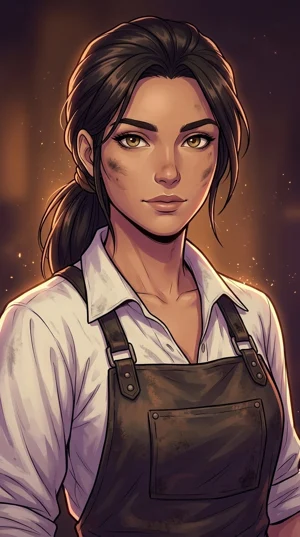
I’ve worked at a furnace every day of my life since I was nine. I know what fire does. I know how it moves, how it wants to climb, how it takes the air out of a room. I have never seen it do what it does now.
It bends to him.
The whole ragged line of it, as he walks into it, leans towards him the way grass leans in a wind. It pours. The flames nearest him go thin and long and stream into him like water running into sand, and where they’ve been there’s just black ground, smoking, and the line goes dark behind him as he walks along it. He doesn’t hurry. He walks the whole length of the burning hill, end to end, the way you’d walk a field to check a fence.
It takes all afternoon.
Nobody on the terrace goes in. Senna comes and stands at my other side and doesn’t say anything clever. Wilf sits on the steps with his chin on his knees. The sun goes over and down, and the smoke turns gold, and the line of fire on the hill gets shorter and shorter, and then there’s only the small figure at the far end, and then there’s nothing at all but black ground and a thin grey haze.
“What does it do to him?” I ask Dervla. “Taking it in like that.”
“What it always does,” she says, and goes in.
He doesn’t come back up to the house.
I know where he’ll go, because I’d go there. Stone floor. Water. Somewhere nothing can catch.
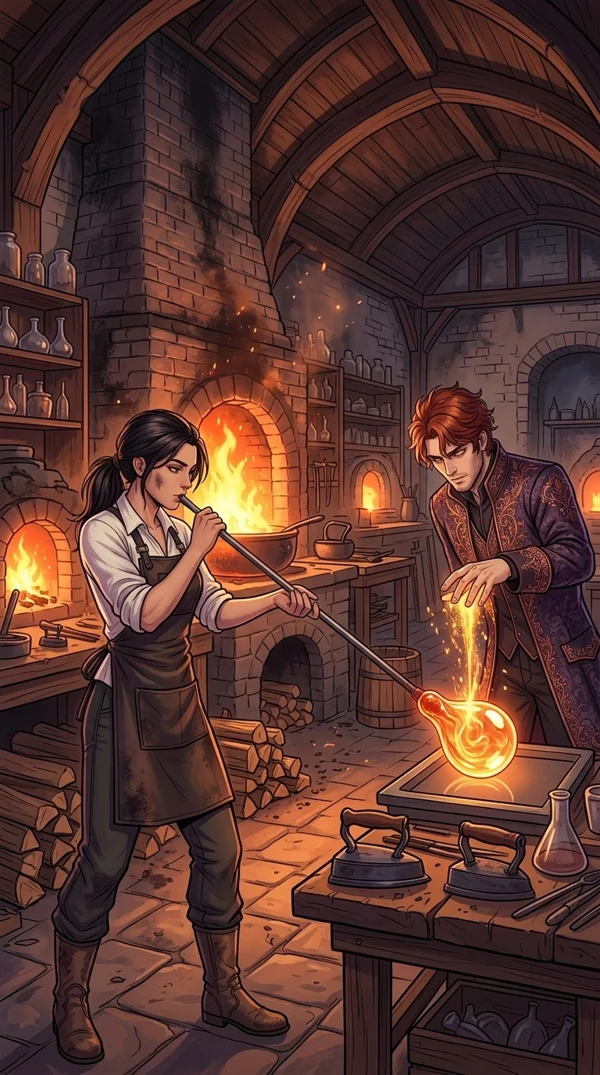
I’m in the workshop when I hear him in the passage. I’ve been in the workshop since dark, with the furnace banked and the lehr ticking, pretending to sort cullet. The door bangs open, and he comes in fast, like weather, and he doesn’t look at me. He goes straight past me to the quench tub and plunges both hands into it, gloves and all, to the elbow.
The water boils.
It comes up white and roaring, and steam rolls off it across the floor, and he stands there bent over it with his head down, shaking.
“Out,” I say. “Get them out of there. You’ll cook the leather onto your skin.”
He doesn’t move. I grab his wrist and haul his arm out of the tub, and he lets me. He’s black to the shoulders with smoke. His shirt is scorched brown down the back and through at the elbows. When I strip the wet glove off his hand, the leather comes away hot as a pan, and his hand underneath isn’t burned. It’s worse than burned. It’s glowing, very faintly, from the inside.
I get the other glove off. I sit him down on the bench and get the bin of damp sand I keep for cooling and push both his hands into it, and wet a cloth in the quench tub, which has stopped boiling, and put it on the back of his neck.
The cloth steams.
“Who did this to you?” I say.
“I did.” His voice is wrecked with smoke. “It’s my land.”
I take my shears off the hook and cut his shirt off him, down the back and along both arms, because it’s ruined and it’s holding the heat in. He sits still and lets me. His back is all flush, from his neck to his waist, like someone who’s lain too long in the sun, and the heat coming off it makes the air waver.
I put my hand flat between his shoulder blades.
He makes a sound I’ve never heard a man make.
It’s not pain. It’s the opposite of pain. His whole body goes loose under my palm all at once, like a rope cut, and he bends forward over his knees with his hands still in the sand and breathes, long and ragged.
“It stops,” he says.
“What does?”
“When you touch me.” He sounds astonished. “It’s the only time it stops.”
I’ve had two days to think since the tower roof.
I’ve thought about it at the lehr, at dawn and at noon, letting the heat down a finger’s width at a time. I’ve thought about it lying awake in the guest wing under a painted ceiling full of fat gold suns. I’ve thought about the laughing woman in the frame, and the shirt that turned to ash, and a man who walked the length of a hall and decided in the walking what I could bear.
I’ve thought about what I want. Not what’s wise. Not what’s owed. What I want.
I take my hand off his back. He lifts his head.
“This isn’t forgiveness, my lord,” I say. “I want that understood.”
He looks at me. In the furnace light his eyes have gone almost gold.
“This is mine,” I say. “You decided for me last time. This time I’m deciding for me. If you mean no, say no, and I’ll put the kettle on and that’ll be the end of it.”

 100 to start reading with.
What did you think?