Don't Turn On the Light, chapter 1 of The Neighbor's Husband
At 11:52 on a Tuesday night, my best friend’s husband was sitting on my front steps in the dark.
I didn’t know it was Mack at first. They’d sent me home eight hours early from the 911 center after a bad call, and I was so tired I had my house key out before I saw the shape on the steps. A big man, elbows on his knees, not moving.
I had my phone in my hand with 9-1 already typed before he said a word. Nineteen years on a headset will do that to you.
“Trish. It’s Mack. Don’t turn on the light.”
Mack Kearney. Steph’s Mack. He lived directly across the circle at number 2. He was a lieutenant at Station 2, and he’d taught both my boys to throw a spiral on my front lawn. He was supposed to be on shift until seven in the morning.
So was I.
“What’s wrong?” I said. “Is it Steph? Is she hurt?”
“Steph’s fine.” He held his phone out to me with the screen face down, as if he didn’t want to see it again himself. “Sit down first.”
“Mack. Tell me exactly what happened.”
That’s the first thing we say, after the address. Tell me exactly what happened. It comes out of me in a voice I don’t use for anything else, low and level, a voice like a hand on your shoulder.
He turned the phone over.
It was a photo from a trail camera, the grainy gray kind hunters strap to trees, with the date and time printed in white along the bottom. A man at a back gate in the dark, reaching over to lift the latch. He had on the plaid robe I’d bought him at Kohl’s for Father’s Day.
08/04 23:46.
“Your husband’s in my house,” Mack said.
I sat down.
I didn’t decide to. My knees did it, and the step was there. The concrete was still warm from the day. Across the circle, number 2 was dark except for one lamp upstairs, in the back bedroom, the one with the sunroom roof under its bathroom window. I knew that room. I’d helped Steph pick the paint. Agreeable Gray. We’d laughed about the name for a week.
“How many,” I said.
“Eleven, counting tonight.” He took the phone back and swiped. “Tonight it sent me one at 11:09. That’s just what the camera caught. I didn’t put it up until the nineteenth of May.”
He showed me. He held the phone low between us so the screen wouldn’t light our faces, and he swiped slowly. Rob at the gate. Rob at the gate. Rob at the gate in the rain with a golf umbrella, our golf umbrella, the one from the Lattimer Flooring sales retreat. Rob leaving at dawn, carrying his shoes. The numbers marched along the bottom of every picture.
06/02 23:41. 06/08 23:38. 06/17 23:50.
I don’t remember my own phone number half the time. I remember my schedule the way some women remember their children’s birthdays. I had worked June 2. I had worked June 8. I’d worked every single one of them, twelve hours on a console with a headset digging into the same spot behind my left ear, while my husband walked out the back in his slippers.
“Every one of these is a night I was at work,” I said.
“Every one’s a night we both were.”
“And tonight?”
“Tonight I traded with Dwayne. Steph thinks I’m at the station.” Mack’s jaw moved. “Camera sends the pictures straight to my phone. Eighty-nine dollars at the sporting-goods store. I bought it for deer.”
“What made you…”
“I came off shift in May and the seat was up.”
I looked at him.
“In our bathroom,” he said. “The toilet seat. Twenty years I’ve put that seat down, Trish. I know what my bathroom looks like in the morning. Steph said it must have been the plumber.”
“You don’t have a plumber.”
“We’ve got me.”
Something came up out of my chest that was nearly a laugh. I put my hand over my mouth to keep it in. He swiped one more time, and I stopped laughing.
07/17 23:44. Rob at the gate with a bottle in his hand. Even in the gray I knew the shape of it, the long neck, the gold label. A Napa cabernet that cost more than our first car payment. I had bought it two years ago and hidden it behind the paper towels in the basement, because Rob and I would be married twenty-five years next May and I was the kind of woman who planned a bottle of wine two years ahead.
He had carried it across the circle to her.
“Okay,” I said, in the voice. “Okay. Does Steph know you know? Has anyone else seen these? Are you safe, are you planning to do anything tonight that…”
“You’re doing it.”
“Doing what?”
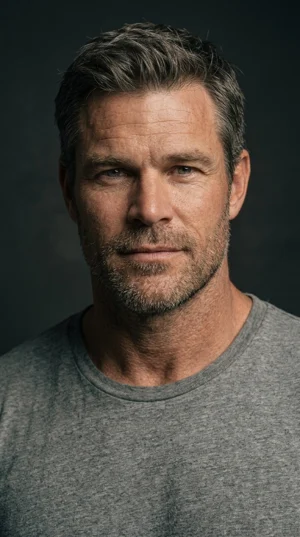
“The voice. The 911 voice.” He wasn’t looking at the phone now. He was looking at me, and he was a big man to be looked at by from that close, wide through the shoulders, gray coming in at his temples, a burn scar on his left forearm that he told kids was shaped like Lake Erie. He smelled of soap and the cut grass on my lawn. “Steph does an impression of it at parties. You know that?”
I hadn’t known that.
“You don’t have to be calm with me,” Mack said.
I didn’t know what to do with that sentence. I turned it over. There wasn’t a card for it in the protocol binder. You don’t have to be calm. Nobody had ever said it to me. Not my mother, not Rob, not my boys, not the supervisors who’d said Nowak, you’re a rock for nineteen years and given me the worst calls because I could take them.
Tonight’s worst call had been a man on Orchard Lane, sixty-one, collapsed in his kitchen. I’d talked his wife onto her knees beside him. Put the heel of your hand in the center of his chest. Push hard and fast. Count with me. I had counted out loud for her for nine minutes, one, two, three, four, until the medics came through her door and the line went to the sound of strangers working, and then somebody hung up, and I never found out. We almost never find out. We get people to the door of the worst night of their lives, and then the line goes dead, and we take the next call.
Gail had sent me home at eleven because I’d done sixty hours that week, and because she’d seen my face after Orchard Lane.
I’d driven home thinking I would make tea and sit in the dark in my own kitchen and nobody would need me for eight hours.
“I don’t know how to be anything else at midnight,” I said.
I stood up.
I’d taken off my work shoes on the top step, like always, because Rob didn’t like shoes on the carpet, and so I went down my front path in my socks. The grass of the circle was cold and wet. I could feel every blade. I wasn’t thinking about anything. I was looking at the lamp in the back bedroom of number 2 and walking toward it.
I got as far as the curb.
His hand closed around my wrist.
Not hard. He didn’t pull. He just held it, the way you’d hold the rail on a ladder, and I stopped because I’d hit the end of something. His palm was warm and rough, and I could feel his pulse in his fingers, or mine, I couldn’t tell whose. In fourteen years he had hugged me at Christmas parties and once, at my mother’s funeral, held my elbow while I went down the church steps. That was all. I had never once thought about Mack Kearney’s hands.
I thought about them then. I’m not proud of it. My husband was in his bed and I stood on the curb in my wet socks and felt where his thumb was.
“Not like this,” he said.
“Why not?”
“Because you’ll be the crazy wife on the lawn at midnight in her socks, and he’ll be the poor guy who got caught. And by Thursday this whole street will be bringing Rob a casserole.” His voice was very quiet. “I’ve had three weeks with this. Every night I’ve wanted to put my boot through my own front door. That’s what they’d love. Then I’m the angry fireman and she’s the scared wife and you’re the hysterical one. They walk away from it holding hands.”
“So what, we just sit here?”
“For now.”
Upstairs at number 2, the lamp went out.
We both looked. The window went black, and then nothing, the way a line goes quiet when the caller puts the phone down to go and look at something.
“They saw your headlights,” Mack said.
My Camry was in the driveway. Of course it was. I’d parked it where I always parked it, and the garage door opener had been broken since April, because Rob was going to fix it, because Rob was always going to fix it.
“He’ll come back the way he goes,” Mack said. “Out her back gate. Along the pond path. Over the Albaughs’ fence, behind number 4, in through your back slider. Then he’ll come out your front door looking surprised to see you.” He let go of my wrist. The air where his hand had been felt colder than the grass. “You’ve got about two minutes. Decide what you want him to see.”
I didn’t know what I wanted him to see. I knew what I wanted to do. I wanted to go in my own back door and meet him in the kitchen with the cabernet bottle in my hand. I wanted to scream until every porch light on Linnet Court came on. I wanted to take my phone out and dial the three numbers I’d answered forty thousand times and tell somebody my emergency.
I’d never once called. Not when the boys were small and Evan split his chin on the coffee table. Not when my mother died. I drove Evan to urgent care myself and I called the funeral home myself. I’m the one people call.
“What do you want, Mack?”
He thought about it. I liked him for thinking about it. Most men answer that question before you’ve finished asking it.
“I want them to be the last people on this street to know,” he said. “Like we were.”
Across the circle, the Albaughs’ motion light snapped on.
It lit up their whole side yard, white as a stage, their hostas, their recycling bins, the split-rail fence Vern Albaugh had put up himself and was so proud of. A shape came over the top rail. It was clumsy about it. It got one leg over and stuck there for a second, wobbling, and then it dropped down onto the Albaughs’ mulch and stood up in the light.
My husband of twenty-four years, in his boxer shorts and the plaid robe from Kohl’s, holding his loafers in one hand.
He looked toward our house. He couldn’t see us in the dark. He bent over, almost a crouch, and ran.
Mack stepped in close behind me, so close I could feel the heat of him at my back without him touching me at all, and put his mouth down by my ear.
“Here’s what we do,” he said. “We give them exactly what they gave us.”
What did you think?