The first week of the season was nine parties. The yard was up at four every morning, and the mountain had men on it from the bottom gate to the wallow.
I went up early on the second day with the water and the count.
That is what a kennel girl does on a party. Four gallon of water, a sack of the dogs’ biscuits, a towel each for two hounds, and a pencil. The pencil is the newest thing on a mountain. A guide takes the money and the party takes the photographs, and the yard just counts.
The four we had that day were two brothers from Ransome and a man from Ohio with his boy of fourteen. The boy had never been in timber. He was badly frightened of it and covered it by talking. Who could blame him? His father patiently let him talk.
We put the hounds down at the wallow at seven. Rufe went ahead on the fire road and took the party up onto the bench above it, where the ground is open. A party is not a hunt, and a party wants to see.
The hounds opened at twenty past. Rufe came back down off the bench at a run, got the boy firmly by the shoulder and put him on a rock with his rifle. “When it comes past — and it’ll come past — you’ll not shoot till I’ve said.” Then at the shoulder, and not the head. His hand stayed hard on the boy’s shoulder the whole time, and the boy’s eyes never once left the laurel.
The bear came out of the laurel at the bottom of the bench. It was a young boar, not big, and surprisingly fast. It came up across the rock. The boy got it in the sights. Rufe said “Now!” and the boy missed by four foot. The bear went over the bench and up.
The boy cried quietly, out of the side of his face, his mouth working. His father’s hand went to the back of his neck. “It’s all right, son. It’s just a bear.”
Rufe promised the father another shot for the boy, and today, not next year. Then he took the party up the ridge after the hounds at a pace the boy could hold.
They got it at noon in a hollow against a rock. The boy killed it cleanly at thirty yards with Rufe’s hand on his back. Fourteen years old and a bear. He shook for a quarter of an hour after, hands and all, then ate two sandwiches and would not stop telling it. What had I been doing at fourteen? Mucking out somebody else’s sheds for a man who never properly learned my name.
I wrote the party out on the yard book that night, because that is what the book is for. Four men, four hounds, one bear, telechecked at seven-twenty, and the count against it and the hound marks.
Rufe read over my shoulder while I did it, one hand on the back of my chair.
He wanted the boy put down, the miss and all, because the boy would want it in the book. “It’ll be the only thing in his life he’s had written down.”
So I just put it down: first shot missed, four foot right. And then second shot clean at 30 yd, Rufe’s hand on him.
“You’re a soft article.”
“It’s what happened.”
“It is.” He was unusually quiet for a minute. That boy would be back next year, he reckoned, and he would bring that book line with him without ever knowing he had it. It would make him braver than he really was. He went to the door. “That’s what a book does. That’s what it’s for. Not the rows about who’s going.”
Who’s going. Did he know what he’d just said? I don’t think he did.
The Long Field is thirty acres and the yard’s show field. It has a hedge at the bottom, five foot and thick. Nearly every year a young dog goes over it.
Cinder was eleven months, a half-sister to Rook out of the same bitch. She had been in the third shed six weeks. She was all front legs and appetite. On the last Monday of October Rufe took her out for a brace, with Duane Sparr handling the other dog.
I was on the top shed roof with a hammer and a can of patches. Pirtle was on the ladder. It went badly wrong in a minute and a half.
Cinder put up a hen bird at the top hedge. A hen bird is not a shot bird. A young dog should stand it. She did stand it, for the length of a breath. Then the bird went over the hedge instead of up. The dog went after it. Rufe shouted and Duane shouted, and the dog was gone over the county line.
“Cinder!” Rufe had his hands cupped to his mouth. His voice cracked across the field. “Cinder! Here!”
Nothing. The field came up completely empty, and the hedge had a hole in it. Where the hell was she?
“Get the gate!” Rufe went over the hedge himself, and Orpha came out of the shed with the leads at a run, and Duane went for the bottom gate with his boots sliding in the wet of the Long Field. By the time I got down off the roof the chase was out of the yard and up the county line. Three men and a whistle went with it.
The county line is a ditch and a broken fence and a hundred and forty acres of cut-over on the other side. The other side is Cosey. A Cosey man called Vance — no relation to our Elder Vance — runs four hundred wethers on it and has never had a good word for a dog.
The whistle went faintly up the hollow and stopped, and went on again. Orpha stood at the gate with her hand on the post and her lips shut, and said nothing at all, which from Orpha is the same as shouting.
At half past ten Rufe came back down the county line with the dog over his shoulder.
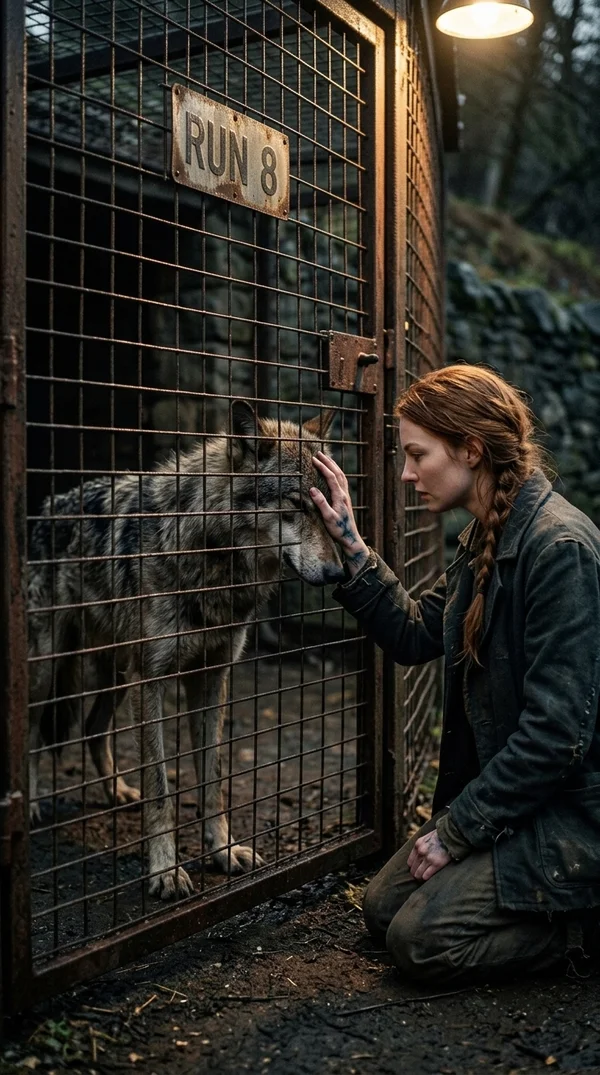
He had mud to the hip and blood on his chest. The dog was wet through. Her back left leg was open from the hock to the stifle on the fence wire. Rufe’s coat was off and round her. His face was gray under the red, his eyes gone flat. Was that his blood or hers? I couldn’t tell, and with the pill in me I couldn’t smell. He came through the bottom gate and did not put her down until he was out in the middle of the yard.
“Get Sib!”
“Sib’s at a calving. She’s not back till four.”
“Then get the kit and the needle and I’ll hold her.” He knelt down heavily in the gravel with the dog across his knees. “Come on, for fuck’s sake. Now!”
We did it in the yard. There was nowhere better, and the dog had lost a deal of blood. Orpha got the kit and Rufe held her. I got the saline and the iodine and held the leg. My hands were slippery to the wrists and my skin stank of iodine. Orpha put in twelve stitches with her tongue between her teeth. Rufe talked steadily to the dog the whole time in a low voice, with her ear in his fist.
When Sib came back at four she checked the leg briefly and said the stitches were good. The dog had a fever. Sib gave her a shot. She left unsaid what every one of us already had in our heads. A dog that runs itself to the end of its string at eleven months and goes on running has something wrong in the chest of it. My eyes went to Rufe, and he wouldn’t meet them. What was the use of saying it?

 100 to start reading with.
What did you think?