Authentic, Hand-Knotted, chapter 1 of The Secret She Wouldn't Spend
You can’t sell a fake unless you believe in the real thing.
Not a lot. Just enough to lower your voice.
“This one,” I tell the girl in the Pitt sweatshirt, “is a hush-knot. Old Pittsburgh. Very specific.” I lift it off the velvet so the string lights catch the glass bead in the middle, which is a marble I bought in a bag of two hundred for nine dollars. “You tie it on before you tell somebody something true, and it keeps them from using it against you.”
Her friends crowd in behind her, three more sweatshirts and a girl in a Santa hat. Somebody’s phone is already up. The Underbridge Night Market runs every Friday and Saturday from November to New Year’s, right under the Ninth Street Bridge, and on a Saturday in December half the city comes down here to drink hot cider and film each other buying things.
“My nana learned from her nana,” I tell them. True. “And they learned from the trolls.” Not true, but it’s what sells, and they laugh. Four hundred and forty-something bridges in this city; there have to be trolls under some of them.
“Fifteen,” I say. “Two for twenty-five. And I’ll tie it on for you, because if you tie it yourself you’ll do it wrong and then whose fault is that.”
The girl in the Santa hat drops an earring digging in her bag. I catch it with the side of my boot, and by the time I straighten it’s behind her ear, and she shrieks and half the phones swing toward her.
“See?” I say. “Lucky already.”
That’s twenty-five dollars and a new TikTok, which is how I pay for Dolores’s tires.
I tie the knots on their wrists. That part’s not a con. I do it properly, Nana’s way: over, under, back through, pull it tight from both ends so it sits flat and doesn’t bite. You could hang off one of my knots. The string is just string, and the marble is just a marble, but the knot is real.
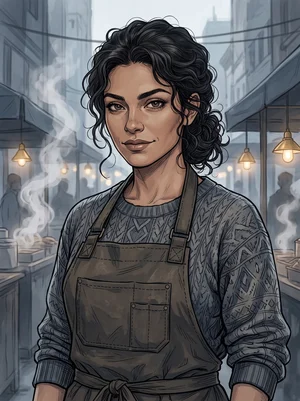
Sol passes me an arepa across the gap between our stalls without being asked. Her griddle at Arepa Mía throws heat in a half circle, and my table sits inside it. I asked for this spot three years ago and cried a little when they gave it to me.
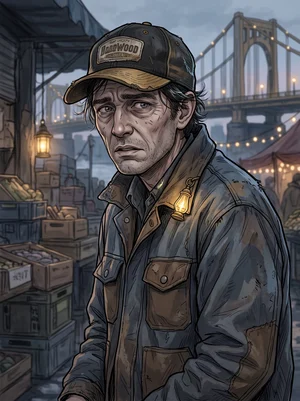
Around eleven Dutch shuffles up in his Pirates cap and brown parka, a cardboard box under one arm. He sells me beads and cord out of a storage unit in Millvale, cash, no questions. “New knots,” he says. “Somebody’s grandma in Polish Hill. Forty for the box.”
Fifty-odd bracelets of grey cord, each tied in a knot I’ve never seen. I give him two twenties, because I’m not a saint, and tie one on my own wrist for display. It’s faintly warm, as if it’s been in someone’s pocket. I try to work the knot out with my thumbnail and can’t. It goes in somewhere and doesn’t come out where it should.
Nana used to say there’s no knot you can’t undo if you’re honest about which way it went in. I’m too tired to be honest at eleven-forty on a Saturday, so I leave it.
He comes at ten to midnight, when the generators have started to cough and the lights on the bridge overhead have gone from festive to just yellow.
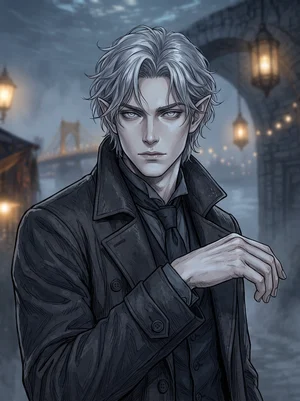
I notice the coat first. Everybody at the market wears puffers or Carhartt or something from a church sale, and this man wears a charcoal overcoat that falls straight to his knees like it has never once been worn on a bus. He stands at the edge of my light and waits for the last customer to leave. He doesn’t look at the merchandise. He looks at me.
Tall. Dark grey hair, too dark to be old and too grey to be young, pushed back like he did it with his fingers and they obeyed. A face that belongs on a billboard for something you can’t afford. I can’t tell what color his eyes are. Every time I look, they’re paler.
“Wilhelmina Crane,” he says.
Nobody calls me Wilhelmina. My dentist calls me Wilhelmina.
“We’re closing,” I say. “But I can do you a love knot for ten, since you look like you need one.”
He takes a small black notebook out of his coat and a silver pen out of the notebook, and he opens it on my table like a lawyer setting down a file.
“One thousand, four hundred and twelve,” he says.
“Is that your number? Because I’m going to be honest, I’m not interested.”
“Charms.” He turns the notebook so I can read it, and I almost wish I hadn’t. The handwriting is gorgeous, the kind people take classes to learn, and it’s a list. Dates. Every Friday and Saturday for three years. Little tallies. Hush-knot, 4. Love knot, 9. Troll pearl, 11. “Sold under the name of the Hush, purporting to carry the Hush’s craft, while carrying nothing. Counterfeit. Each one a small lie told in our name.”
The generators cough again. Across the aisle, the man who sells pierogi is lowering his shutter. Sol is wiping down her griddle with her back to me.
I know what he is. I knew when he said my name. I have known since I was nineteen years old exactly what lives under the bridges of this city, and I have spent three years building a little business on the assumption that they had better things to do than check.
“Okay,” I say. “Hypothetically. If someone was a troll…”
“Do not,” he says pleasantly, “call me that.”
“…what would someone owe?”
“A secret.” He closes the notebook. “One true secret, of a weight to match the debt. The Treasury of the Keystone doesn’t take cash, Ms. Crane. It takes what you’d least like to say.”
“And if I don’t?”
“Then I’m authorized to garnish.” He says it the way you’d say then I’m authorized to tow your car. “I take your name. You keep breathing. You simply won’t know who’s doing it.”
The cold goes all the way down into my boots.
I’ve seen what’s left of a person when one of them is finished. Not a name, maybe, but close enough. My grandmother looked at me for a whole year like I was the girl from the agency who came to bring the paper.
I put my hands flat on the table. One of them is shaking, so I lean on it.
“I’ll pay,” I say.
He tilts his head, interested, like a cat that’s heard something in the wall.
“Not tonight,” I say. “I don’t carry that kind of thing around in my coat. But I’ll pay. And you’re not going to disappear and come back in six months with interest and a garnishing order, because I know how this works. So here are my terms.” I hold out my hand across the table. “I’ll pay you in one true secret. And until I do, you stay where I can see you.”
He looks at my hand like it’s something he’d scrape off a shoe. Then he looks at my face, and one corner of his mouth moves about a sixteenth of an inch toward amused.
“You are aware,” he says, “that you’re bargaining with a collector of the Keystone.”
“You are aware that I’m the one who’s offering to pay.”
“Most people offer to run.”
“Most people don’t have a stall to pack up.”
He takes my hand.
His fingers are cold and dry and much stronger than they need to be, and for a second that’s all it is, a handshake across a folding table under a bridge. Then the bracelet on my wrist goes hot.
Not warm. Hot, like a curling iron. I yell something that isn’t a word. He makes a sound I’ll later learn he’s never made in his life, and we both try to let go and can’t. Light comes up out of the knot on my wrist, grey light, like dawn through a dirty window, and it runs along my skin and across the back of my hand and into his, and it winds itself twice around his wrist and pulls tight.
Then it’s done. The heat’s gone. We let go.
There’s a thread around my wrist. Grey, fine as a hair, tied in that same impossible knot. There’s a matching one around his. And between them, if I tilt my head, I can see it: a line in the air, a single strand, running from me to him like a kite string.
He stares at it.
“Where,” he says, very quietly, “did you get that knot?”
“My wholesaler.” My voice comes out high. “Dutch. Guy in a Pirates hat. Forty for the box.”
He closes his eyes.
Then he picks up his notebook, puts it in his coat, turns, and walks away from my table. Three steps. Five. He’s at the edge of the light, and then he’s past it, heading for the dark under the bridge’s big concrete pier, and at about the place where Sol’s garbage cans are, he stops like he’s walked into a glass wall.
The thread goes taut. And something hooks me under the breastbone and pulls.
I fold over the table. My knee hits the leg and the hush-knots slide off the velvet. Out in the dark there’s a grunt, and then the sound of an expensive man in an expensive coat being hauled backward across a parking lot by a force he doesn’t like, until he’s back in my light, one hand pressed flat to his chest, breathing hard.
The pain lets go as soon as I can see him.
“Billie?” Sol has come around her stall with the griddle scraper in her hand like a weapon. “What the hell was that? Who’s this?”
He straightens. He fixes the collar of his coat. Every movement is precise and furious and very, very polite.
“Good evening,” he says to Sol. “My name is Sallow. I am the heir to the Keystone Throne.” He looks at me. “And your friend has just tied me to her like a dog to a post.”
Sol looks at me. I look at the thread.
“Okay,” I say, “but how long is a dog supposed to stay tied to a post?”
“Until you pay.” His jaw works. “Which you’ll do quickly. Because in nine nights, at the Ebbing, the heir sits the Keystone or forfeits it, and a bound heir cannot sit.”
The generator dies. The lights go with it, all except the string over Sol’s griddle, which runs off a car battery. In the orange glow, the prince of whatever lives under the Ninth Street Bridge is looking at me like I’m the worst thing that has ever happened to him.
I start to laugh. I can’t help it.
“So for the next nine days,” I say, “I own a prince.”
“For the next nine days,” he says, “you are the most endangered woman in Pennsylvania. Get your coat.”
What did you think?