The Keystone Court, chapter 5 of The Secret She Wouldn't Spend
The underneath goes down in steps I can’t see, and every step echoes twice, once under my boot and once somewhere far below, a beat late. I hold on to his hand. I don’t look back. I want to so badly that my neck aches with it.
Then the dark thins, and I can see the river.
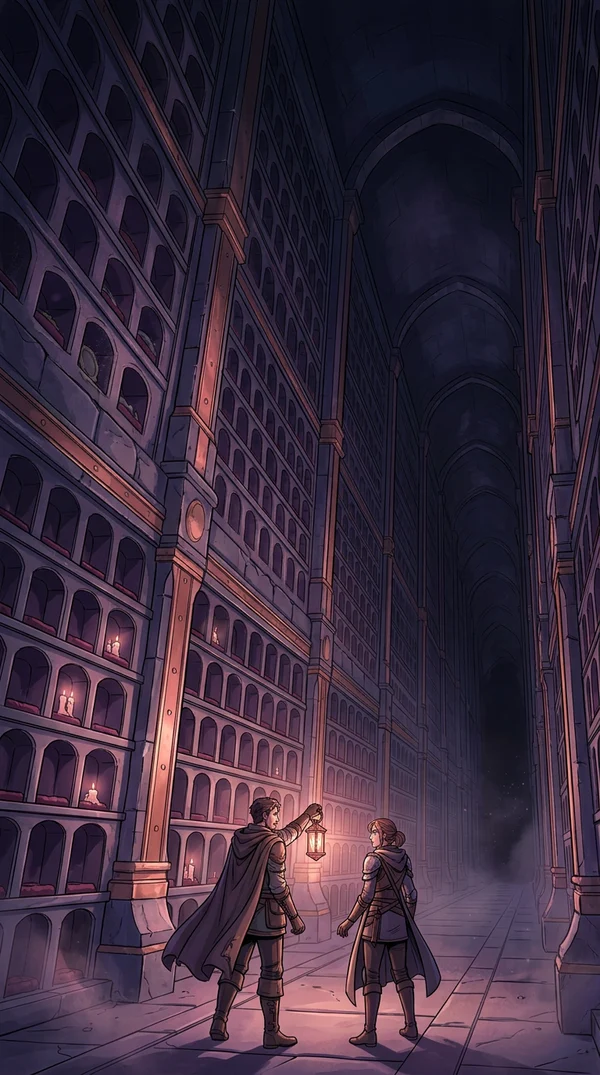
It’s above us. The whole Allegheny, black and moving, a ceiling of water held up by nothing, with the lights of the city smeared across the top of it like oil on a puddle. A fish goes by overhead, lazy and enormous. Under it, arches. Hundreds of them, stone and old iron and rusted steel, the undersides of every bridge in the city pieced together into a vault that goes on and on, and every arch is hung with lamps.
The lamps are cages. In each cage there’s a grey pearl, and each pearl gives off a soft light and a softer sound. As we walk under them, I hear it. Not words. The edges of words. Hundreds of people whispering at once, every secret ever paid to the Hush, burning to light the hall.
“Don’t listen,” Sallow says, low.
“Kind of hard not to.”
“Then don’t listen to any one of them.” His thumb moves once across the back of my hand. “You can let go now.”
I don’t, for one more step. Then I do.
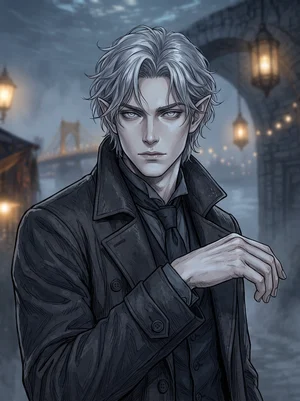
The court is waiting at the end of the hall, and the court is beautiful, which I wasn’t ready for. I’d pictured trolls. Instead there are maybe two hundred of them in clothes the colors of river weather, pewter and fog and the brown-green of the Mon after a storm, and their skin has that shell shine, and their hair is every grey there is. Some of them wear glamour like jewelry, a human face slipped half on, so that a woman with a heron’s stillness has, for a moment, the features of a weather girl from Channel 11, and then doesn’t. They turn as we come in. Four hundred pale eyes, on me, on my wrist, on the thread.
The whispering lamps go on whispering. The court doesn’t make a sound.
I find Fitch near the front, the moth-dust cloak pulled tight, giving me a tiny, horrified shake of the head that I think means chin up and might mean run. A man with antlers of tarnished wire woven into his hair leans to the woman beside him and says something behind his hand, and she looks at my thrift-store dress and laughs without opening her mouth.
I lift my chin. I’ve worked a market stall for three years. I’ve been looked at by drunk Steelers fans, by bachelorette parties, by a man who wanted a refund on a love knot because his wife left him anyway. Two hundred trolls in nice coats is just a bigger crowd.
“Breathe,” Sallow says out of the side of his mouth.
“I am breathing.”
“You’re doing a thing with it.”
I’d laugh if I weren’t so scared. I think that might be the point.
“Sallow, my boy.”
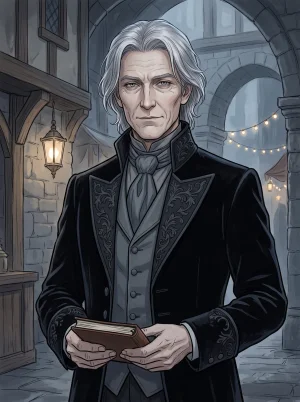
A man comes out of the crowd with his hands open, like he’s about to hug both of us. He’s older than the others, or he wears it on purpose. Silver at the temples, warm brown eyes, a soft grey coat with a watch chain across the waistcoat. He smells like bergamot and old pennies, like a library in a bank.
“Chancellor,” Sallow says.
“Oriel. Please. I taught you to read.” The man smiles at me, and it’s a good smile. It’s the smile of somebody’s favorite uncle. “And this must be the debtor who tied the heir in knots. Ms. Crane, it’s a pleasure. You must be frozen. Here.”
There’s a cup in his hand. I didn’t see him take it from anyone. It’s silver, and something amber steams in it and smells like cider and cloves and every Christmas I’ve ever wanted.
It’s the first warm thing I’ve smelled since the Ninth Street Bridge. I put both hands in my coat pockets, because of the term we wrote on a dryer sheet this afternoon, and because Nana raised me.
“No thank you,” I say. “I’m on a diet.”
Oriel laughs, delighted. “Well done. Sallow, you’ve taught her well. Or she’s teaching you.” He hands the cup off to the air, and someone takes it. “I’m afraid I must be tedious. You know the law, my boy. An unhoused debtor is held by the Treasury until she pays. For her own protection, as much as anything. We’re all aware there was an incident on Saturday night.”
“You’re well informed,” Sallow says.
“I’m the Chancellor. It’s my job to know what everything costs.” He turns those warm eyes on me. “Nobody will harm you, Ms. Crane. You’ll be perfectly comfortable. Somewhere quiet.”
“She isn’t unhoused,” Sallow says.
He says it to the whole hall. His voice doesn’t get louder, but it carries, the way a dropped glass carries.
“Wilhelmina Crane is under my roof,” he says, “as my betrothed. I ask the Keystone for the Plighting.”
The throne is at the far end of the hall, where all the arches come together.
It isn’t a chair. It’s a stone. A single wedge of grey rock, wider at the top than the bottom, set into the apex of the highest arch, where the weight of every bridge above us meets. There’s a seat cut into it, and in the seat, a woman.
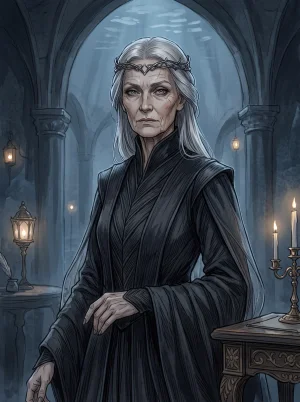
Queen Ismay is white-haired and still as a heron and old, the first one of them I’ve seen who looks it. Her edges are soft, the way Sallow’s go soft in daylight, except it’s midnight and we’re under a river. Like a photograph that’s been left in a window.
She looks at her son the way you’d look at a bill you already paid once. Then she looks at me.
“The heir asks for the Plighting,” she says. Her voice is like ice cracking on a river, high and thin and much too loud. “With a debtor. With the very debtor who has him on a string.”
“Yes, Mother.”
“How enterprising of you.” She lifts one hand. “Then let’s see it. A token, given. And the kiss, before the Keystone. Let the court judge whether it’s true.”
Whether it’s true. I glance at Sallow. He doesn’t glance at me. His face has gone smooth and blank as the front of the throne.
He takes something from inside his coat and holds it out to me. It’s the silver pen. The one he writes the ledger with, every mote and tally of every debt.
“A Collector’s pen,” he says, so only I can hear. “I’ve had it for thirty years. Don’t lose it.”
I take it. It’s warm from his coat.
Then it’s my turn, and I stand there in front of a court and a queen and the whole black weight of the Allegheny with nothing to give but what’s in my pockets. Ribbon in one. Pearl in the other.
I take out the troll pearl.
It’s a wooden bead. I painted it myself, silver and grey, with a nail polish topcoat to make it shine, and I sell them for eight dollars at the Underbridge Night Market to tourists who think it’s lucky.
Somebody in the court laughs. Then a few more. A ripple of thin, delighted sound, rising.
I hold it up. I don’t drop my eyes.
“It’s fake,” I say. “Like I’m guessing everybody here already knows. But I made it. With my hands. And I’m not giving him anything else tonight.”
The laughing stops.
Sallow holds out his wrist, the one without the thread. I take a length of cord out of my coat pocket, because I’m Nana’s granddaughter and I always have a length of cord, and I put the bead on it and tie it on him. Over, under, back through. Pull it tight from both ends so it sits flat and doesn’t bite. You could hang off it.
He looks down at the bead on his wrist. Then up at me.
“Now,” says the Queen.
He puts one hand on the side of my face.
I’ve been kissed before. I’ve been kissed in cars and at parties and once on the Duquesne Incline by a boy who smelled like Axe body spray. I know how to get through a kiss. You decide where to put your hands and you count to three and you think about whether you locked your car.
He kisses me and I don’t think about anything.
It’s slow. It’s careful, at first, like he’s asking a question with his mouth and waiting for an answer, and the answer comes out of me before I’ve decided to give it. My hand finds the front of his coat. His other hand finds the small of my back and stays there, not pulling, just holding, like he’s keeping me from falling into the river, and I can taste rain on him, cold rain on hot metal, and the whispering lamps get louder or my blood does, and somewhere far away a whole court is watching, and I forget every single one of them.
When he lifts his head, I’m holding his coat in both fists.
I let go. I smooth the wool down. It doesn’t need it.
“Well,” says the Queen, after a silence that goes on much too long. “That’s settled, then.”
They take us to a room afterward, through more arches, down a corridor lit with fewer and quieter pearls. The court is still murmuring behind us. Oriel bowed when we left and said, warmly, “Congratulations, my boy,” and he meant it, or he’s very good.
The Queen said one other thing. She called me up to the throne before we left, me alone, and leaned down from that wedge of stone so that her white hair hung around both our faces like a curtain.
“The betrothed of the heir sleeps under the Keystone,” she said. “Every night, until the Ebbing.” Then, lower, so cold it burned: “My son will lie to you, girl. It’s his trade. Make him tell you the truth anyway.”
The room has a carved door, a fire in a grate that doesn’t seem to need wood, a washstand, and one bed.
One.
It’s big. It’s hung with grey curtains. It’s very clearly one bed.
“There’s been a mistake,” I say.
“There hasn’t.” He shuts the door behind us. “Betrothed couples share a chamber. It’s meant to be a kindness.”
“To who?”
“Historically? The couple.” He crosses to the fire and holds his hands out to it, though I’ve never seen him be cold. “If it helps, I’ll take the chair.”
“Your stitches will pull.”
“Then I’ll take the floor.”
“Then your stitches will pull on the floor.” I sit down on the edge of the mattress, because my knees have decided to stop being involved. My mouth still feels like his. I touch it, and catch myself doing it, and put my hand in my pocket instead, where my fingers close around the silver pen. Thirty years of tallies. He handed it to me in front of everyone like it was nothing.
When I look up, Sallow isn’t looking at the bed, or at me. He’s sitting in the chair by the fire with his ledger open on his knee, and he’s holding the thread on his wrist between two fingers, his head tilted, listening. The way he did at Dot’s.
He’s gone very still.
“What?” I say.
He doesn’t answer. He takes his hand off the thread. He looks at the ledger. He has no pen; it’s in my pocket. He doesn’t ask for it.
“Sal. What?”
“That kiss,” he says, carefully, to the page, “paid down your debt, Ms. Crane.”
All the air leaves the room.
“By how much?”
He looks up at me. In the firelight his eyes are the palest I’ve ever seen them, and they’re not amused at all.
“Enough,” he says, “that one of us meant it.”
What did you think?