At midnight we go back down, because the Queen said every night, and because the only thing scarier than the Undercroft right now is the idea of a quiet coming through my bedroom window while Sallow is still flickering from the afternoon.
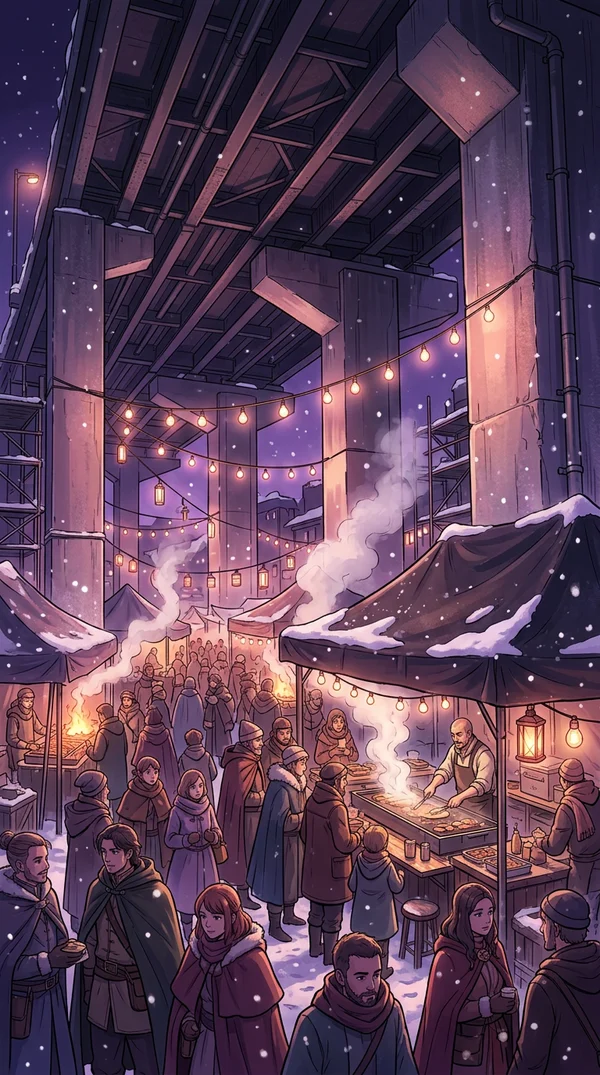
The court is gathered in the long hall under the whispering lamps, the way it apparently is every night: no dancing, no feast, just the whole court standing in little groups and talking low, like a cocktail party at a funeral home. They look at us when we come in. They look at the cut on Sallow’s hand, and at my claw clip, which I’ve put back in crooked, and they look at each other.
“They know,” Fitch says, appearing at my elbow. “About the overlook. Everybody knows everything here by the time it’s happened.” They look me up and down. “You tied a factor to a railing.”
“He started it.”
“Nobody’s ever tied a factor to anything. Factors are slippery. That’s the job.” Fitch sounds impressed against their will. “Most humans just scream.”
“I did scream. Nobody could hear it.”
Across the hall, Oriel has his hand on Sallow’s shoulder.
I didn’t see him arrive. He’s just there, the way the cider cup was just there, silver at the temples, watch chain glinting. He’s steering Sallow gently away along the gallery, talking low, his head bent close the way you’d talk to a son. Sallow lets himself be steered. They stop under an arch maybe sixty feet away. Far enough that I can’t hear. Not so far that I can’t see.
I watch Oriel’s hands. He has very nice hands, and he talks with them, the way a magician does when he wants you to look at the wrong one. At one point he takes something out of his waistcoat pocket and presses it into Sallow’s palm and closes Sallow’s fingers over it, and pats them.
Sallow looks down at his closed fist.
Then he puts it in his pocket.
“What’s that?” I say to Fitch.
Fitch’s face does something complicated. “Not my business, lady.”
“Fitch.”
“Not,” Fitch says, “my business,” and then they’re gone into the crowd, and I’m standing alone under a lamp that whispers I told her it was an accident over and over, until Sallow comes back for me.
Our room has a gutter along one wall that I didn’t notice the first night: a narrow channel cut into the stone floor, a foot wide, with black water running fast through it, in one side and out the other. A little piece of the Allegheny, Sallow says, running through every room of the Undercroft. You can wash in it. You can drop things in it. The river takes things and doesn’t give them back.
He doesn’t take off his coat. He stands by the fire and takes the thing out of his pocket and holds it out to me on his open palm.
It’s a hook. A fishhook, small and silver and very fine, with a length of grey thread knotted through the eye.
“Do you know what this is?” he says.
“Something you got from Oriel.”
“A hush-hook.” He doesn’t look at it. He looks at me. “You lay it on a sleeper’s lips. It catches the heaviest secret they carry and draws it up, like a fish on a line, and it becomes a hush, and they wake up owing nothing.” His voice is very level. “They don’t feel it. They don’t remember. They wake up a little lighter and they never know why.”
The fire pops. I don’t move.
“He said I should use it tonight,” Sallow says. “For your sake as much as mine. You’d be free. I’d be free. I’d sit the Keystone at the Ebbing and you’d go home to your laundromat, and nobody would have to suffer through the indignity of you telling me anything.” A muscle moves in his jaw. “He said it was kinder. He said I was making you carry something you didn’t need to carry, out of pride.”
“And?”
He closes his hand around the hook.
Then he crosses the room in three steps and crouches by the gutter and drops it in. It hits the black water and it’s gone, just like that, no splash, no glint, carried out under the wall and into the river.
He stays crouched there a moment with his hand open over the water.
“You’d have woken up owing me nothing,” he says, without turning around. “And I’d have owed you everything. For the rest of my life. And you’d never have known.”
I have to sit down on the bed.
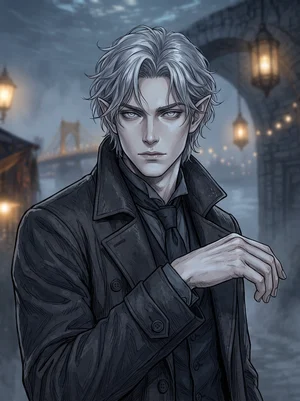
He stands. He comes and sits in the chair across from me, his elbows on his knees, his hands hanging between them. The troll pearl on his wrist catches the firelight. Up close he looks more tired than I’ve ever seen him, more tired than after the quiet, more tired than in daylight.
“He taught me,” he says. “Oriel. When I was small. My mother was always on the Keystone; she didn’t have time. He taught me to read, and to count, and he taught me that everything has a price. That kindness is the cheapest currency there is and you should spend it freely, because it buys more than fear.” He looks at his hands. “I believed him. I’ve collected for thirty years on that. And tonight he gave me a hook to use on you while you slept and called it kindness, and I’m starting to wonder what else he taught me that I never checked.”

 100 to start reading with.
What did you think?