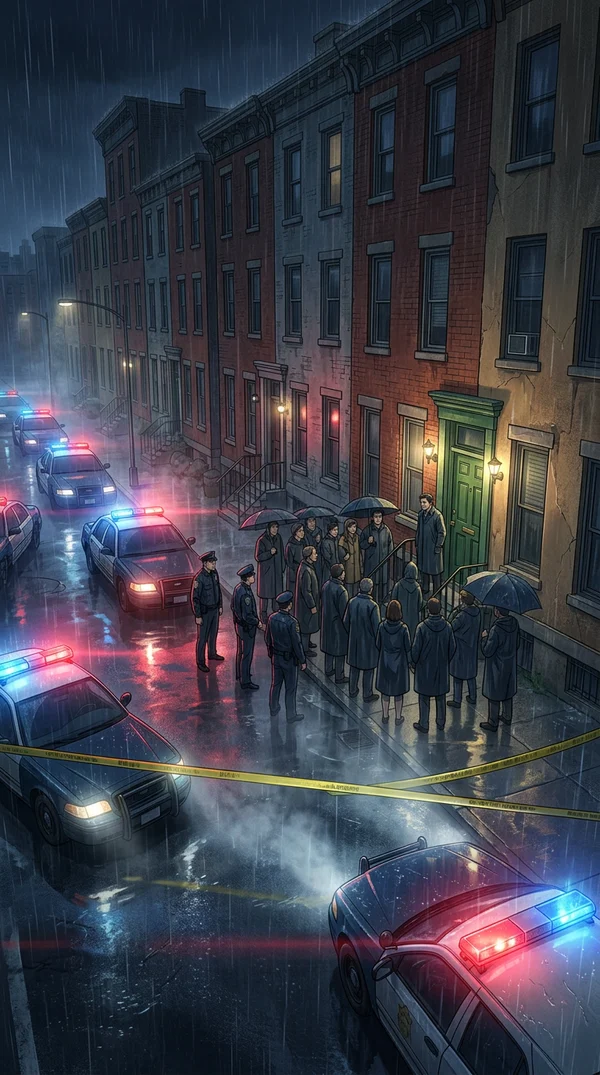
Paulie Gaeta lived in a narrow row house on Fenwick Street with a fig tree in the backyard wrapped in burlap for the winter and a front door painted the same green since 1980. I had been coming to that door my whole life. I’d sold him Girl Scout cookies at it. I’d cried on its step the night of Nico’s wake.
“I’m going in alone,” I said in the car.
“No,” Declan said.
“He won’t talk with you in the room. He’s old-world. You’re a Mallory. He’ll make coffee and talk about the weather until you leave.”
Declan looked at the green door the way he looked at every door. “Then I’ll be in the hall,” he said. “With the door open. And if he raises his voice, or you raise yours, or I don’t like the silence, I’m coming in.”
“That’s not a compromise. That’s your plan with a hallway in it.”
“Yes,” he said, and got out of the car.
I caught up with him at the gate. “What do I do,” I said, “if he tells me it’s him? All of it? The fire, Nico, everything?”
Declan stopped with his hand on the gate. He looked at me for a while in the streetlight.
“Then you’ll know,” he said. “And whatever you want done about it, you’ll be the one who decides. Not me. Not your uncle. You.”
“And if I want nothing done?”
“Then nothing gets done.” He opened the gate. “He’s your godfather, Nina. Not mine.”
I didn’t know then how much that cost him to say. Paulie Gaeta had kept the books for the war that killed his brother. I know now.
Paulie answered the door in a cardigan and his good slippers. He looked at me, and then past me at Declan on the step, and something went out of his shoulders, all at once, like air out of a tire.
“Come in, cara,” he said. “I’ll make coffee.”
He made it on the stove in the old dented pot, the way he always had. Declan stood in the doorway between the hall and the kitchen with his hands in his coat pockets and his eyes on the back door, and Paulie didn’t ask him to sit, and Declan didn’t offer. I sat at the little table under the picture of the Pope, who had been the Pope when it was hung and had been dead for twenty years since.
When the coffee was poured I took out the Bayline invoices and laid them on the table between us, the way he’d taught me. Then I took his fountain pen out of my coat pocket and laid it on top.
He looked at the pen and not at me.
“Seventeen,” I said.
Paulie put both hands around his cup. They were shaking so badly the coffee shivered.
“I made every one of them tell on me,” he said. “Every number. Five years. I thought, somebody will see. Somebody will look at a column of these and ask, who rounds like that? Nobody did.” He looked up at me. His eyes were wet and old. “Then you did. Of course it was you.”
“Tell me.”
He told me.
It had started before the war, he said. Small. A man came to him, a man from the other side, from the Mallory house, a man he’d known across the table at a dozen sit-downs. The families were already squabbling over the port then, over trucks and unions, a broken window here, a fight in a bar there. The man said: there’s going to be trouble. Both sides will pay for protection. Why not let them pay us? An invoice here, an invoice there. Security consulting. A name on letterhead. No one gets hurt. The families were going to spend the money anyway.
In the doorway, Declan took his hands out of his pockets. “A man from the Mallory house,” he said. “Who?”
Paulie didn’t turn around. “You can stand in my kitchen, Mr. Mallory. You can’t ask me questions in it.”
Declan put his hands back in his pockets. He didn’t sit.
“Bayline,” I said.
“It was just a name, then. A name on an invoice. A post office box.” Paulie stared into his coffee. “Your father was alive. I told myself it was nothing. Skimming. Every bookkeeper skims a little. God forgive me, I told myself that.”
“And Nico?”
He flinched as if I’d hit him.
“Nico came to me in April,” he said. “Five years ago. With a printout. Paulie, what’s this Bayline, why are we paying it, I can’t find who they are. And I told him it was security, it was nothing, go home. And he looked at me, cara. He looked at me the way you’re looking at me now.” His mouth worked. “And then in May the boy was dead, and the Mallory boy too—”
“Finn,” Declan said from the doorway. “His name was Finn.”
The doorframe creaked. I didn’t have to turn around to know he’d put his hand on it.
Paulie closed his eyes. “Finn,” he said. “Yes. I’m sorry. Finn.” He opened them again on his coffee. “And everybody said it was the families, and the war came. And my partner came to me and said, you see? You see what they did to each other? Now they’ll really need protection.”
“Did you believe him?”
“I wanted to.” He wiped his eyes with the heel of his hand. “And then afterward he made it a real company. Papers, the state, everything. And he put the dead boy’s name on it. The Mallory boy. Finn. He said, if anybody ever looks, they’ll find Finn Mallory, and Finn Mallory can’t argue.” Paulie shook his head slowly. “That’s when I knew what he was. And by then I was in it up to here, and the money was in my name too, and your uncle would have—” He stopped. “I was a coward. For five years, a coward.”

 100 to start reading with.

What did you think?