“He’s my ex-husband,” I said on Wednesday, at sunset, before he’d even finished opening his eyes.
Aurelien lay there a moment looking at the canopy of the bed. Then he sat up, slowly, and held out his hand for the letter, and read it again by the lamp. His face went still, the way the sky goes still before weather.
“The cardiologist,” he said. “The earrings. Napa. Scottsdale.”
I’d told him all of it that first Monday night, in pieces, with my head on his chest. I hadn’t known he’d kept every piece.
“His institute runs on your foundation’s money,” I said. “The Vasse Heart Institute. It’s on a plaque in the lobby at Trinity. He had his picture taken in front of it.”
“I know the plaque.” His voice was very quiet. “I paid for the plaque.” He folded the letter in half and in half again. “Then your husband is coming into my house.”
“Ex.”
“Your ex-husband,” he said, “is coming into my house to decide whether I’m in my right mind. With Thornton holding his coat.” He looked up at me. “You needn’t be here.”
“I’ll be here.”
“Berenice…”
“He’s my mess,” I said. “I was married to him for twenty-two years. I know what he does to a room. I’m not going to sit in my car on the square while he does it to you.”
He looked at me. Then something in his face eased, very slightly.
“Not your mess,” he said. “Your past. I’m the one he’s coming to see.”
They came at nine on Thursday, while the trolley was going around the square and the woman in the cape was telling twenty tourists about the bride on the staircase.
I heard the Lexus before I saw it. It still had the little rattle in the dash I’d been asking him to get looked at since 2021. Then Thornton’s Mercedes behind it, and two doors, and Curtis’s laugh on the front steps, the big warm one he used on families when the news was bad.
I was in the front hall when Ozella opened the door. I’d thought about what to wear for an hour. Not scrubs. I wasn’t anybody’s nurse. Not the green dress. In the end I’d worn dark jeans and a white blouse and my good flats and put my hair up, and I stood in that hall with my hands at my sides and let him see me.
Curtis Lacombe was fifty-three years old and still handsome in the way that takes a lot of money and sunscreen. Golf tan. Salt-and-pepper hair, cut every two weeks. A navy fleece vest with the Trinity Coastal logo over his shirt and tie, because he liked people to know where he worked. He came in talking, saw me, and stopped.
“Bern,” he said.
“Curtis.”
“What are you… Thornton said the nurse was off the case.”
“I am.”
“Then what are you doing here?”
“I’m a guest,” I said.
He looked at me the way he used to look at an EKG that didn’t make sense: like it was the paper’s fault. Then he laughed again, smaller, and shook his head, and Thornton touched his elbow and steered him into the parlor.
Aurelien was standing by the fireplace.
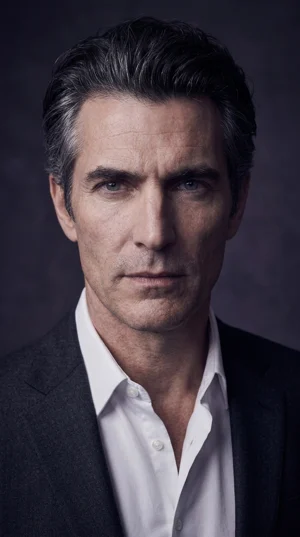
He was in a dark suit. I’d never seen it, a deep charcoal wool, old-fashioned in the cut and perfect on him, with a white shirt and no tie. His hair was brushed back from his face. It was dark now, almost black, with silver at the temples like frost on iron. His face was lean and lined and very sharp. He looked fifty, a man who’d been ill once and won.
Curtis stopped in the doorway with his tablet in his hand.
He looked at the man by the fire, and down at the tablet, and up again. I could read the screen from where I was. VASSE, AURELIEN. DOB 1936.
“Good genes,” Thornton said tightly.
“Dr. Lacombe,” Aurelien said. “Do sit down.”
Curtis sat. I don’t think he’d decided to.
He did the assessment out loud. I knew every word of it before he said it. I’d watched him do it a hundred times on the unit at three in the morning, on old men whose families wanted to know if they could still sign their own checks. The date. The place. The president. I’m going to say three words and I want you to remember them. Banana. Sunrise. Chair.
“Banana, sunrise, chair,” said Aurelien.
“Now I’d like you to draw me a clock.” Curtis held out the tablet and a stylus, then thought better of it and pulled a pad of paper out of his vest. “Put all the numbers in. Set the hands to ten past eleven.”
Aurelien took the pad and Curtis’s pen and sat down across from him and drew.
He took his time. When he handed it back, Curtis looked at it and didn’t say anything. I came around behind his chair and looked too.
It was a clock. A perfect circle, drawn freehand. Roman numerals all the way around, in that old copperplate with the iron-railing loops, evenly spaced as if he’d used a compass. The hands at ten past eleven, the minute hand fine as a needle, the hour hand ending in a little fleur-de-lis. And across the bottom of the face, in tiny script, the way the old clockmakers used to sign their work: Vasse, Savannah.
“The three words?” Aurelien said.

 100 to start reading with.
What did you think?