Steps to Reproduce, chapter 2 of The Villainess Is a Known Issue
BUG-0001 (filed in my head) · Tester has been converted into villainess. Steps to reproduce: Fall asleep at work. Severity: Critical. Workaround: None found.
When you don’t know what’s wrong with a build, you poke it. You don’t panic. Panic isn’t a test.
So I spent the rest of Day 1 poking.
I started with people. A cadet in the corridor outside the Atrium had the label CADET_F_07 and a face I’d seen on at least thirty other cadets. I asked her what year it was. She said, “I’m sorry, Your Grace?” I asked her if she knew she was in a video game. “I’m sorry, Your Grace?” I asked her to say anything else at all, please, as a personal favor. She curtsied and walked into a potted fern, then corrected and walked around it.
Result: minor characters have one emergency line and a pathfinding problem. Known.
Then I tried to leave.
The docking ring was a long curved concourse of glass and brass with shuttles hanging in cradles like sleeping bats. A guard at the end told me, “There’s nothing past the docks, Your Grace,” which was the line the game used to keep the player from wandering into areas that didn’t exist. I thanked him and walked past him and straight into an invisible wall at the speed of a determined woman.
It hurt. My nose made a small wet sound I’m not proud of. I sat on the floor holding my face, and through the glass I could see the stars, and up close, from that angle, they weren’t stars. They were dots of paint on the inside of a very large bowl.
Result: pain is implemented. Somebody had sat at a desk and implemented pain.
That was when I noticed the meters.
They appeared whenever someone looked at me long enough to have an opinion. A thin red bar floating above the head, with a label in that same gold font: HOSTILITY → ISOLDE. The guard at the docks: 22. A pair of courtiers in matching hats who watched me get up off the floor: 41 and 44. In the Academy refectory at lunch, a hush rolled across two hundred cadets as I walked in, and two hundred little red bars bloomed over two hundred heads like a field of poppies that wanted me dead.
The heroine got heart meters. The villainess got this.
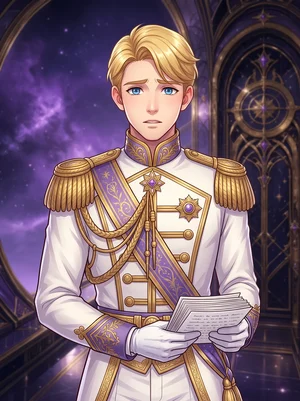
Prince Aurelian came through the refectory doors at a quarter past twelve with his guard captain one step behind him, exactly on schedule. His meter read 70. He gave me the small cold nod the script gave him for crossing paths with his fiancée, and his eyes slid off me like water off wax.
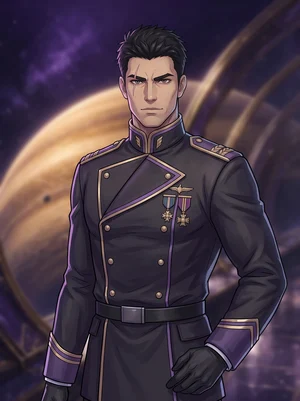
The man behind him did not slide. Commander Ravel Quist, captain of the prince’s guard, two-time champion of the Halo Run, black hair, a scar through his left eyebrow, looked at me the way a judge looks at a sentencing form. His meter was full. 100. It glowed like a stove ring left on overnight.
I knew why. Every player did; it was in his backstory scene on Day 4. Two years ago, his racer had come apart under him in the Halo ring. Marrowgrave Yards had built that racer. Isolde had stood in front of a press drone and called it pilot error.
“Commander,” I said.
“Lady Marrowgrave.” His voice could have chilled wine. Then he walked on, and so did his meter, and I remembered I had been planning to eat something and found that I no longer wanted to.
Lumi sat alone at the end of a long table with a cup of tea, smiling at the middle distance. She had no meter. Just the gold tag, and her cursor eyes, blinking.
By evening I had my notes. Between fixed events, I was free: I could walk, talk, eat, bleed, embarrass myself at the docks. At fixed events, the hand took me. I knew the event schedule because I’d played it hundreds of times. I knew how it ended.
So I went to look at the place.
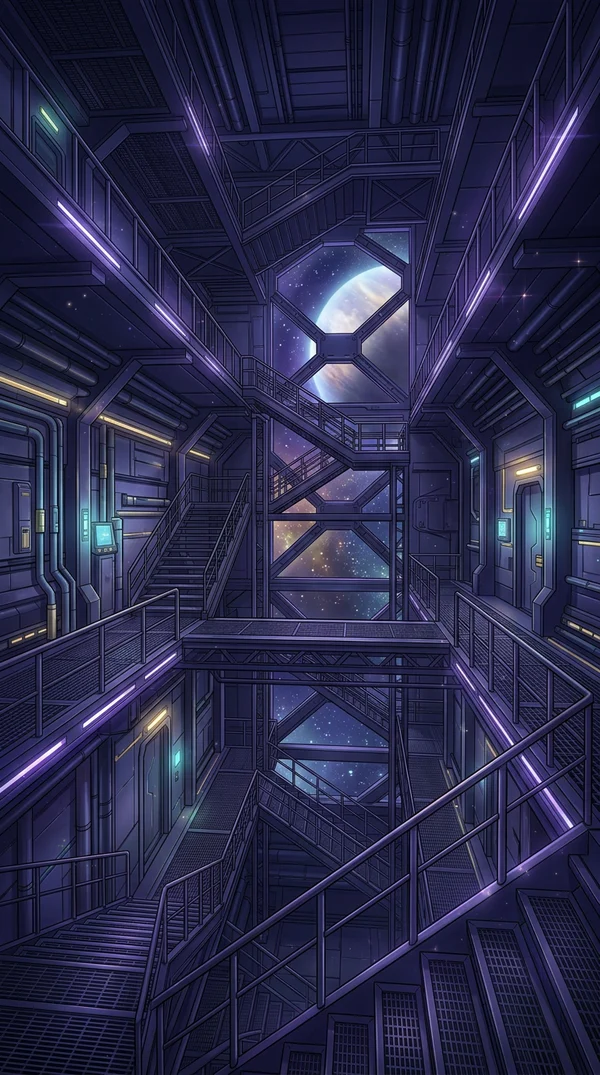
The Starfall Gallery ran along the ship’s eastern spine, a long tube of glass with a polished black floor, and beneath it Hadal filled the whole world. From the monitor it had looked pretty. In person it was too big to be pretty. The storm bands moved, slowly, each one wider than a continent, brown and amber and a yellow like old teeth. Lightning walked between them without sound.
Halfway along stood the memorial column, a pillar of clear glass etched with the names of everyone the Concord had ever thrown out of this door. I ran my glove down the list. Admiral this. Countess that. A poet. At the bottom, already cut, crisp as the day the art team made the asset: ISOLDE MARROWGRAVE. The space for the date was blank.
I stood in front of my own name for a while.
At the end of the gallery was the Lock. Etched-glass inner door. A small chamber. A heavy iris of metal plates beyond it, closed. To the right of the Lock, a narrow archway into an antechamber, and from the antechamber came a soft purple light and the sound of someone humming without a tune.
The antechamber was full of plants.
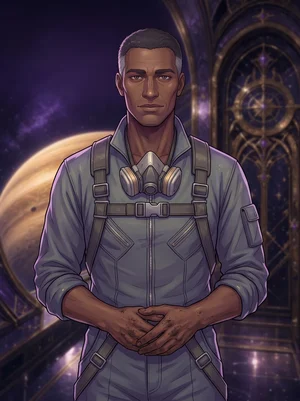
Trays of them, on racks, under grow lights. Pale blue buds on dark stems, closed tight as fists. A man in a grey uniform was watering them with a small brass can. He was tall and moved like someone used to small spaces. Brown skin, close-cropped hair going grey at one temple, a half-respirator hanging around his neck on a strap. Above his head: LOCKWARDEN_ASHE. And under that, faint as a watermark, a line ID: ASH_0001.
His meter read 0.
I stared at it. Zero. Not low. Nothing. Every person on this ship had been told to hate me, and the man whose job was to throw me into a planet had not been told anything at all.
“Your Grace,” he said, without looking up. “You’re standing in their light.”
I moved. “Sorry. What are they?”
“Voidbloom.” He tipped the can into the next tray. “They open when the pressure drops.”
“When does the pressure drop?”
He glanced at the Lock. “When the door cycles.”
“So they bloom when somebody dies.”
“They bloom when the door opens,” he said. “They don’t know the rest.”
He set the can down and looked at me properly for the first time. Dark eyes, steady, a little tired. Not curious, exactly. Patient, the way you’re patient with weather.
“Most people come after,” he said.
“I like to know where I’m going.”
Something moved at the corner of his mouth. It wasn’t a smile. It was a place where a smile had been considered and filed for later.
“Corvin Ashe,” he said. “Lockwarden.”
“Do people call you Corvin?”
“People don’t call me.”
“What do they do?”
“Walk faster past the archway.” He moved the can to the next tray. “One man fainted. He was here about a gas leak.”
ASH_0001 hovered over his head, faint gold. The Lock is ready, Your Grace. He didn’t say it. I got the strong impression he didn’t say anything he didn’t have to.
“I’m going to do something strange to your wall,” I told him. “It’s for science.”
“It’s the Concord’s wall.”
“Then I’m going to do something strange to the Concord’s wall.”
He picked up his can again. That seemed to be permission.
The corner was where I remembered it, left of the Lock, where the memorial column met the gallery’s glass. I walked into it. I bounced. I tried again at an angle, then backward, which is how Lumi always went in. I tried crouching. I tried a little run-up. I tried shuffling sideways in tiny steps, which is a real technique, and which made me look like a crab at a funeral. I tried pressing my shoulder to the seam and sliding.
On the fortieth try I hit my forehead on the column and sat down.
From the archway, Ashe said, “Are you hurting the wall, or is it hurting you?”
“It’s mutual.”
He came over with a clean folded cloth. I hadn’t noticed I’d scraped my head until he crouched in front of me, put two fingers under my chin, and tipped my face up into the purple light to look. It took perhaps a second. It was the first time anyone had touched this body without a script telling them to, and I sat very still for it, like a cat deciding whether to allow something.
He pressed the cloth to the spot and put my hand over it to hold it there. It smelled like soil and soap.
I knew why it wasn’t working. I’d known by try ten and kept going anyway, because that’s also part of the job: you make sure.
Games keep separate rulebooks for what can pass through what. The heroine has hers, the furniture has its own, the minor characters share one. The hole wasn’t in the wall. It was in Lumi’s rulebook. A gap in the line that said the heroine cannot walk here. Mine didn’t have that gap. Mine was solid all the way down.
I had found the only door in the world, and it only opened for the girl I’d just poured tea on.
“Thank you,” I said, and gave him back the cloth.
“Keep it,” said the Lockwarden, and went back to his flowers.
Day 2 had a fixed event at eleven: GARDEN_TRIP. The Gravity Garden was a dome of ferns and lemon trees at one-third gravity, with a fountain whose water rose in slow wobbling globes and burst against the leaves. Lumi was walking along the fountain’s rim with Prince Aurelian, laughing at something he hadn’t said yet. I was on a bench nearby, and then the gold box unfolded and I wasn’t.
The hand walked me over. My foot slid out, neat as a cat’s paw, and caught Lumi’s ankle.
I’d known it was coming. I’d had a whole night to think about it. So I didn’t fight my foot. I fought my left hand, the one the script wasn’t using, and I fought it the way you’d lift something heavy, with everything, from the hips.
It moved. A few inches. Enough. As Lumi pitched toward the stone rim of the fountain, my fingers closed around her elbow and held. She tipped, slow in the low gravity, and landed on her knees in the moss instead of on her face against the stone.
The gold box flickered. Then it stamped itself: GARDEN_TRIP ✓.
She had tripped. That was all it checked.
Aurelian was looking at my hand on her elbow. His meter dipped, 70 to 68, and he frowned as if he’d felt it happen.
That night, after the ship’s lights dimmed to blue, I went back to the gallery. The antechamber was dark except for the grow lights on their timer. Ashe had gone. I sat on the black floor beside the corner, with my back to the column and my own name, and Hadal turning below.
I did what I used to do at lunch. I talked to nobody.
“Okay,” I said. “So the door only opens for her. And she’s being driven by a bot I wrote. And the bot checks everything. So I need to get the bot to bring her here, at a time it isn’t watching, without breaking any checks. That’s fine. That’s a normal Tuesday.”
The glass beside my shoulder rippled like a bad TV signal.
A hand pushed through it.
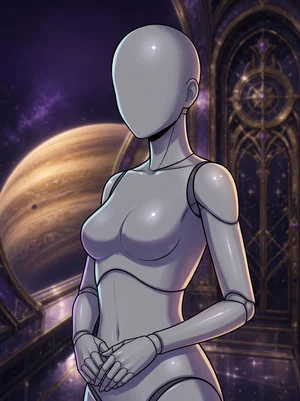
It was grey. Smooth, jointed, featureless, like an artist’s mannequin, with no nails and no lines on the palm. It reached out of the wall up to the wrist and turned, slowly, palm up, as if testing the air.
Then a voice came through the glass. It was flat and synthetic and evenly paced, like the announcement in a parking garage.
“It only opens for the heroine,” it said. “Bring her.”
What did you think?