Option D, chapter 6 of The Villainess Is a Known Issue
BUG-0005 · Some characters keep their memories across reloads. Expected: none. Actual: the ones who stopped following the script. Severity: Unclear. Feels important.
The page turned at six.
Fwip. The cloud bed. The constellation ceiling. DAY 11/30 · 06:00. And in the corner, smaller, the number I’d lain awake waiting for:
RETRIES 1/3
I lay there and hated myself in a focused, professional way. I’d been warned. I’d set the threshold. I’d let the best day of a man’s life happen inside a test that I knew would throw it out, and I’d spent a retry on it. One left. After that, the next failure didn’t reload anything. It ended the run. It wiped the world.
Someone knocked. Not MAID_02’s knock, which was three precise taps. This was one blow with the side of a fist.
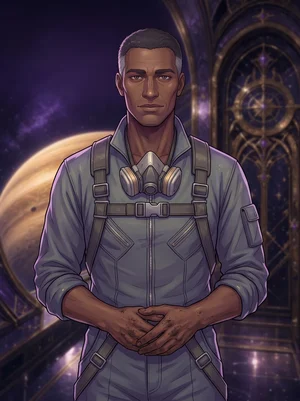
Ravel Quist stood in the corridor in full uniform, at ten past six in the morning, with a face the color of old porridge.
“I flew,” he said.
“I know.”
“Yesterday. Today.” He stopped, and I watched a soldier try to make a report on something that had no form for it. “I flew today, and then it was this morning.”
Over his head, gold and steady: NaN.
“You remember,” I said.
“Is that what this is?”
I pulled him in before MAID_02 could arrive with “I’m sorry, Commander?” and sat him on the end of the cloud bed, where he looked like a crowbar someone had left on a cake. I told him what I could. That something watched the days. That if too much went wrong in one, it took the day back and ran it again. That everyone forgot, except, apparently, people who had stopped doing what they were told.
He took it the way I imagine he took everything: with his jaw.
“Is there a protocol?” he asked.
“Today the race has to go exactly the way it’s supposed to. You save her. You tow her in. You land.”
He understood immediately. I saw it land. “No lap.”
“No lap.”
“And if I fly it anyway?”
“Then it happens again tomorrow,” I said. “And the day after that, there’s no tomorrow to spend.”
He looked at his hands. They were steady. He’d flown the ring flat out once, and he’d remember it, and nobody else ever would.
“Affirmative,” said Ravel.
So the Halo Run happened twice. The second time it was the trailer version. Lumi’s pink racer flipped at turn three, the black racer dove, the tether caught, the tow came in smooth and level and dull, and the black racer set down at the dock and stayed down. The court applauded politely. Aurelian, beside me, said “Oh,” very softly, and I realized he remembered too.
Day 11, anomalies: three. Clean.
On the promenade afterward Ravel walked past me without breaking stride, and just as he passed, his right hand came up, two fingers to his brow, the smallest salute I’ve ever seen. The hand didn’t shake at all.
That evening I went to the antechamber.
Ashe was watering. The green folding chair was in its place. I sat in it, and before I could think of something clever to say, he said, without turning around:
“How’s Pancake?”
My whole body went cold.
After the first race, in the day that no longer existed, I’d sat in this chair and told him about my cat for twenty minutes. He had timed it by the grow lights.
“When did I tell you about Pancake?” I said.
“Last night.”
“Last night didn’t happen.”
He set the can down. “I know,” said Ashe. “I was there.”
His meter wasn’t flickering anymore. It was a calm gold NaN, like the others.
I asked Aurelian the next morning, carefully, in the observatory, whether he remembered anything about the first race. He went pink to the ears and said he remembered crying into his cue cards in front of the entire court, and he would like that to remain between us, and also between the entire court.
So that was the rule. Not a guess anymore. People who stopped following the script kept their days. The reload could take back the world, but it couldn’t take back what a free person had decided to remember.
I noticed something about myself after that, and I didn’t like it, and I didn’t stop it either. I’d been reading the meters first. Every time I walked into a room, my eyes went up, to the red bars, like reading prices before reading a menu. After Ashe asked about Pancake, I started looking at faces first.
It’s a small change. It took me thirty-one years and a different body.
That night in the Grey, I asked Lumi, testing it like a floorboard, whether she remembered the race.
“Which one?” she said.
I sat down.
“The first one was better,” said Lumi. She made one spiral with her hand, slow. Then she looked at me with her whole forehead. “You said you’d ask next time.”
She had no meter to go gold. She didn’t need one. The reload had taken back the day, and she had simply kept it, the way Ashe had kept my cat.
On Day 14, I stayed in the antechamber after the grow lights went to their dim evening setting. He’d been coaxing one particular bud on the end tray, misting it, turning the pot a quarter-turn every hour.
“Where did you get them?” I asked. “The voidbloom.”
“Cargo error.” He set the mister down. “A crate of seed meant for the agricultural deck came to the Lock instead. Somebody wrote the wrong deck on the form. I opened it to see what it was.” He looked at the trays. “Nobody asked me to plant them. Nobody told me not to.”
“So they’re yours.”
“They’re the only thing on this ship I’m sure I chose.”
I thought about that. I thought about the koi.
“There’s a pond outside my office,” I said. “Back home. With a sign that says please do not feed the koi. And the koi are enormous. Somebody’s feeding them. Every day. We never found out who.” I heard my own voice go strange. “I used to eat lunch there with a friend. Then they fired her, and I stopped going, and I started eating lunch somewhere nobody could find me.”
He didn’t say I’m sorry. He waited, the way he’d waited the first night, like weather.
“What’s a cat like?” he asked.
I told him. How heavy one is on your chest. The way they decide you’re furniture and then decide you’re God. Pancake shoving his whole head into my palm when I came in the door, as if he could get inside my hand if he tried hard enough.
“I’d like that,” said Ashe.
Over his head, faint as ever, the line he’d never said to me hung in the air. ASH_0001.
“On Day Thirty,” I said. “Will you say it?”
He didn’t answer for a while.
“I don’t want to,” he said.
Our hands were on the arms of our chairs, his right, my left, about an inch apart. I looked at the inch. I was extremely aware of the inch. I could feel the warmth coming off his skin across it, which in a game is a choice someone made, and I wanted to find whoever made it and shake their hand. His knuckles had soil in the creases. His little finger moved, just slightly, in my direction, and every nerve in my arm stood up to see what it would do next.
The grow-light timer clicked. The trays went dark. The antechamber was suddenly nothing but the brown light of Hadal through the gallery glass, and the two of us sitting in it like idiots.
He laughed. It was a low, surprised sound, as if he hadn’t been sure he had one. I laughed too. The inch stayed an inch.
It was the most romantic thing that had happened to me in five years, and it was mostly about a light switch. I lay awake for an hour afterward, thinking about the inch, like a teenager, like an idiot, like someone with a future.
In the Grey that night, Lumi asked me about menus.
She’d been watching them from the inside for fifteen days, she said. Little gold windows. Three lines. One of them always lit.
“Why three?”
“Because somebody wrote three,” I said. “The menu’s only what somebody thought of on the day they wrote it. It isn’t everything you could do. You can do something that isn’t on it.”
She chewed on that, and on a putty cake.
“What’s it called?” she asked. “The thing not on it.”
I thought about the menu over her bed, the night I’d taken her. A, B, C.
“Option D,” I said.
“D,” said Lumi, trying it the way she’d tried my name. She liked it. I could see her put it somewhere safe.
On Day 16, at the fitting for the Gala, a gold menu unfolded over her head in the Atrium salon.
▸ Rose silk
Starlight satin
Sky chiffon
The top line glowed. Lumi stood on the fitting block in rose silk while a seamstress pinned the hem, her cursor eyes blinking, her smile switched on. GALA_DRESS ✓.
Across the salon, her eyes found mine.
The cursor stuttered. Her lips moved. No sound came out, but I could read it.
D later.
Then the smile came back on, and she was the heroine again.
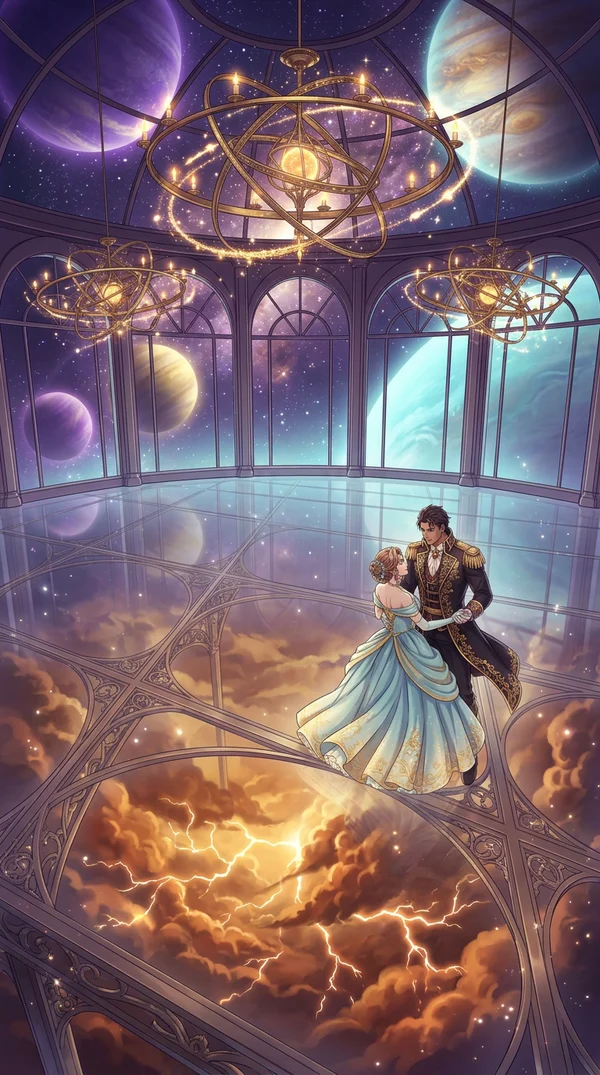
On the last night before the Gala, Polly hummed.
She was standing by the half-ballroom while Lumi slept on the grid with her head on my folded jacket, and out of the parking-garage voice came a tune. Flat, synthetic, but a tune: three rising notes and a slow fall. I knew it. It was “Hadal Rising,” the waltz from the Gala scene. I’d heard it more times than I could count through my headset.
She stopped in the middle of a phrase, like someone who’d caught herself singing in public.
“You know it?” I said.
“Everyone in Route Four knew it. We rehearsed.” The faceless head turned toward me. “Tomorrow is a Fixed Event. The rails grip hardest at Fixed Events. You won’t be able to move your eyelid. You won’t be able to move your little finger.”
“I know.”
“You’ll pour,” said Polly. “Your hand won’t shake. It never does.”
I took Lumi back at half past five. I went back to my rooms in the blue light, and MAID_02 had already laid out the Gala gown on the cloud bed: black silk, violet lining, the armored collar sharpened to points.
I picked it up because I couldn’t stop myself. Testers check.
Sewn into the bodice, just under the left arm, where a hand would naturally fall, was a small hidden pocket.
Inside it, cold against my fingers, was a glass vial.
What did you think?