The Last Lot, chapter 1 of Three Demon Lords Bought the Bride
My father put me up as the last lot at four minutes past eleven. He did it with his hand on my shoulder, and he did it in his own voice.
The clerk would have read it. That’s what clerks are for. Skell had read twelve lots already, fast and flat, so that nobody had to feel anything about any of them, and he’d have read the thirteenth just the same. Da took the ticket out of his fingers.
“Boyne,” he said, to the hall. “The bindery, Priest Street. The lot is my daughter Cleo, twenty-two years, bookbinder, sound in the hands.” He stopped and swallowed. He’d written it out that morning, and by now the words were furniture. “Against four thousand four hundred marks.”
I’d known since a quarter past six, and my throat had been tight with it ever since. He had come into the back shop with his coat still on and stood in front of the press and spoken my name, then the number, then the word calling. I put down the knife I’d been paring a spine with. “Right.” There was nothing else in the language. Then I had five hours to be angry in, and I spent them cleaning the shop, because the number had changed and what I wanted hadn’t. A year and a day. The shop still standing at the end of it, and my own name over its door. My mother was three years dead that month, and in those three years my father hadn’t once said a thing to me that wasn’t a job of work.
The Shambles is iron columns and a glass roof and a floor of blue brick. On a March morning it holds two hundred people and the wet off two hundred coats. Rain ticked on the glass. Behind the rail of the calling floor the morning’s paper was tied up neatly, all the county’s small debts called and done, and a cabbage cart was going out under the arch, and the bell still swung where Skell had rung it.
The ticket was in my father’s hand. His thumb was over the corner of it, the way a man holds a thing he doesn’t really want to hand back. My own name came out from under his thumb in his own writing, and the hand shook on the y.
Two hundred pairs of eyes came to my face and then did what a market does. They went to my hands.
It took eight seconds. Half the room had had a book off our bench since the autumn. Every one of them knew exactly what my hands were worth and exactly what my father’s paper was worth. Not one of them had put the two sums side by side until that morning.
Somebody at the back tried it out. “Four thousand?” It was the voice you use about weather.
The gallery was full of the people who come to a calling the way they’d come to a hanging. The corn merchant’s wife was there in her good coat, with two of the aldermen and the vicar’s clerk, his hat on his knees. In the second row, in grey that had never once been hurried, Swithin Cheyne of Change Row sat with his hands folded. His son sat beside him with a glass of something and a shine on his face. At eleven in the morning! Who brings a drink to a calling?
The Cheynes had called the paper. Everybody knew it, and nobody had to say it.
Skell’s eyes went to my father, then to the board. “The lot is called. Bidding opens at nine hundred.”
Nobody bid. There’s always just that gap at the start, while the room quietly works out whether it’s going to be cruel.
Nine hundred marks is two years of a journeyman’s wage. It’s a house. It was a quarter of what was owed, and it said plainly that the room thought my father’s paper was worth a quarter of what my father’s paper said.
“Nine hundred.” Skell tried it again, and the gap got longer. Was nobody going to bid at all? Was I going to stand on the brick until somebody took me for the price of a cart?
“Nine fifty,” a man called from the rail. Feet shifted, and then it was eleven hundred, and the room got its breath back and settled into being reasonable about me. Somewhere after two thousand I stopped hearing the numbers properly. A bidding market sounds like a dog worrying something, and you’re the only person in the hall who has to stand still.
The three of them had salt on them. The young one tipped a little out of a twist of paper into his palm and ate it, and the other two took a pinch off him without looking. I’d bound four of the market’s own books and seen the salt on their covers. I’d never once watched it eaten at a rail.
A woman behind me leaned to her neighbour. “Demons.” It was half a complaint.
“Malvent.” The neighbour made it sound like an answer, and it was.
Then a paddle went up at the north end, too fast, before the number was even out of Skell’s mouth. “Twenty-two hundred!”
The paddle was just a bit of deal with a number burnt on it. It had come up so quickly that the man holding it was half stood before he’d thought about it. Then he did think about it, and glanced round, and grinned at himself. Young, brown, a good coat spoiled across one shoulder with rain. He looked about my age and he wasn’t my age, and his grin was the kind that’s been got out of trouble before. My pulse went once, hard, like a needle through a fold. I hated it for not asking me first. What business did it have, jumping for a man who was bidding on me?
Skell took the bid and the man sat down, and the room’s eyes went to him instead of me. There’s a mercy in that.
Then a paddle went up at the east end, four along from the arch. A man the size of a door got up off the rail he’d been leaning his whole back against. “Twenty-four hundred.”
Soot. It was on his forearms to the elbow and had been there long enough to go into the skin. There was a burn on one of them the shape of a thumb. He held the paddle the way you’d hold a spanner: by the shaft, low, out at his side, as if it were an ordinary day. Then he turned it over and read the burnt number on its face, and his eyes came up to me.
“Twenty-four. I don’t want a bride. And she’ll want boots. That pair’s got a hole in the sole you could put a finger in.”
Half the room craned at my boots. The heat came up my throat and into my face, and I hated that worse than the pulse. Oh, for fuck’s sake. Not him too. Fuck you, I thought, very clearly, at a man I’d never met. He was right about the boots. It wasn’t kind, and it was the first thing anybody had said all morning that was about me and not about the sum.
The brown coat was up again before the chalk was down, and they went at it properly then. Twenty-six, twenty-eight, thirty: the brown coat calling out each one, and the soot barely lifting his paddle off his knee.
They weren’t bidding on me. I understood it at about thirty-two hundred, standing on the blue brick with my father’s thumb on my ticket. They were bidding on each other, and they’d been doing it since the second number. The room had understood it too and gone quiet. It was the good quiet, the one that comes before money shows its teeth.
Thirty-four. Thirty-six. Thirty-nine. Was there a ceiling on it anywhere? Did either of them even have thirty-nine hundred marks?
Skell’s chalk stopped. He had his hand up, quite calmly. “Two bids under one house. Twice.” His eyes went along the rail to the soot and came back to the brown coat. “You’re Malvent, both of you. Two paddles, two bids, and if it goes again from either of you the lot’s knocked open and we’ll all be back here in June.”
The room turned to the gallery then. There’s a third thing in that family and the Shambles knew it. The third thing was sitting in the front bench with his hat on the seat beside him, and he hadn’t put a paddle up at all.
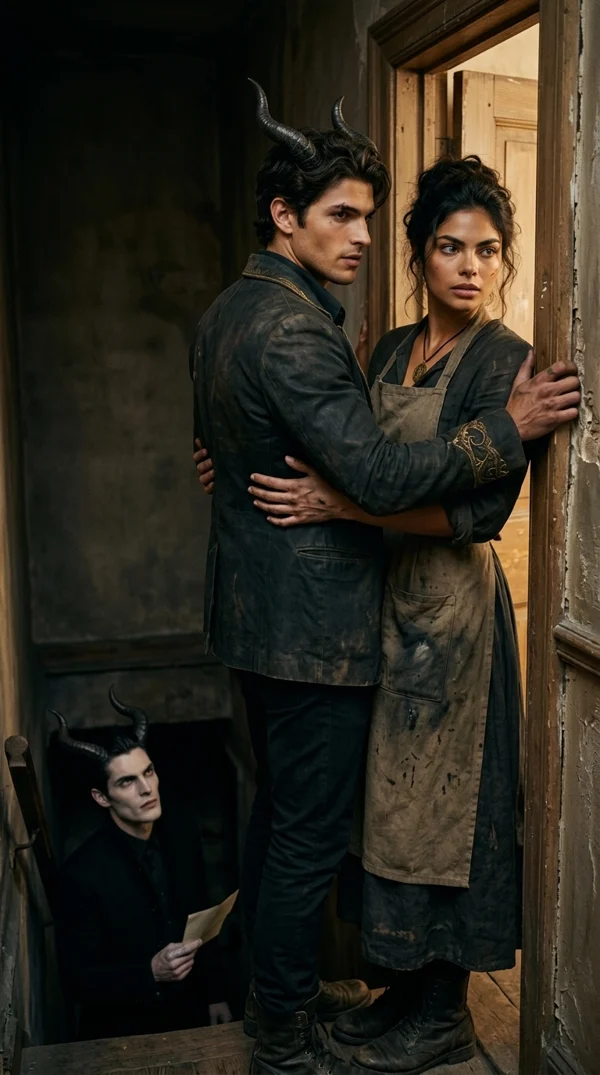
He got up. He was tall and dry and black-coated, his hands white, and he came to the rail with no hurry in him at all and put both of them on it, and the iron went white under them.
Not steam. Frost. A print of frost the shape of each hand, on a rail at eleven in the morning, with the rain ticking on the glass and two hundred people breathing. Up on the third tier a woman with a basket on her knee muttered something under hers. The cold came off that rail and down the hall to me and went along my skin under my sleeves, slowly, like a draught under a door, and every hair on my arms stood up for him. For him! I could have spat.
His eyes went to his brothers, one and then the other, down the length of the hall. Nobody on the floor spoke, and the rain went on. “Fourteen hundred apiece.”
His lips barely moved. The voice went to the glass roof anyway, and it carried the exact flat weariness of a man doing arithmetic he’d already done once in a cart.
Skell chalked it slowly. “That’s forty-two hundred the house.” Then, to the brown coat: “One bid under the house, or the lot’s open.”
The brown coat took a breath and held it hard. He was the youngest; I’d got that far. Then he let the breath go and put his paddle down.
One house. One bid: four thousand two hundred, from a house of three with its hands on the rail and its hat left behind on the bench.
Skell wrote Malvent at the top of the slip, because you buy in a house’s name and the house signs. Then he took the ticket off my father to copy the particulars from the back. My father’s hands came up empty and stayed up a moment, and then they went into his pockets.
Skell brought the hammer down. “Sold. To the house of three.”
Then the bell. Nobody clapped. There’s no clapping at a calling, because the hammer is all of it, and the quiet went up into the glass and sat there with the rain.
Four thousand two hundred marks, against four thousand four hundred owing. Two hundred short. Two hundred! I could nearly have laughed. Who sells his daughter and still comes up short on her?
“To which of you?” It was the woman with the basket. She stood up on the third tier and meant it to be heard, and it went round the room like a wasp.
Skell studied the slip in his hand, and then the three of them. The house of three had no more idea than he did. The brown one spread his hands. The soot glanced at the tall one, and the tall one read the slip and lifted his eyes from it. “Fetch the tally.”
Somebody laughed, short, at the back. Skell went to the box and came back with the brass tally on its cord, its number stamped at ten that morning in the lot-book. A man in a green apron put the cord over my head while my father watched. Just like that. The brass went down inside my collar and lay against my chest, cold, weighted like a coin. The man’s knuckle went across my collarbone getting the cord straight, and he smelled of the floor. That was the morning’s touching. My father’s hand for the selling and a stranger’s knuckle for the cord, and neither of them for me.
A tally is a leash you can see. Every soul in the Shambles knew what it meant. The room had come in that morning for the small paper and had got, for nothing, a girl.
The corn merchant’s wife leaned to the woman with the basket, not quietly. “Two hundred short.”
Skell read the rest off the slip. “Against a year and a day, and the duty paid at the door on the 24th of March 2027 next. Or the balance, after the house’s service, computed by the court. The lot will answer for the balance.”
My father came down the steps with me, because that was the custom. At the bottom he put his hand on my shoulder again and turned me so the room could see us both. Then he just stood there, being the man who’d done it in his own voice. There was nothing in his face that could be used.
At the rail the brown coat got his paddle off the floor and put it back in the rack. The soot was already reaching for his coat, as if it were just another Tuesday. The tall one spoke to nobody. “Come on. We’ll want the cart.”
The lot is sold. The lot was me. Four minutes in the middle of a morning, and the market was already turning away to its dinner. Was that really all it took? Four minutes, and a life goes in a book?
I got the tally up out of my collar and read the number on it. Then I found the three of them at a rail, at the far end of two hundred people. They had the slip and the hat and the cart. They didn’t have the two hundred marks.
“To which of you?” the woman called again, because the first time hadn’t been answered and she was the sort.
The tall one picked his hat up off the bench and turned it once in his hands and put it on.
“To all three,” he said, “if it comes to that.”
The Shambles broke into talk. Nobody had heard an answer.
Including him.
What did you think?