Highlights, chapter 4 of Two Keys in the Glovebox
Deena knew. I could tell from the sidewalk.
She was inside at 8:40 on Monday, which she never is, with her coffee and her phone, and when I unlocked the front door of Gloss and the bell went, she put both down and looked at me like I was the last ten minutes of a movie.
“Mama works nights,” she said.
“I know she does.”
“She didn’t tell me anything. She’s not allowed.” Deena came around her chair. She’s twenty-nine and she has the fastest hands in Tulsa County and no poker face at all. “She just said Shiloh Dekker was in a wreck with Zeke on Thursday, and then she made a face, and I’ve known that face my whole life, Raina. That’s her ay, pobrecita face. And it wasn’t for Shiloh.”
“Shiloh’s my nine o’clock,” I said, and went to turn the lights on.
Gloss is twelve chairs on South Main in the Rose District, in a brick building from 1925 with tall windows and a pressed-tin ceiling I spent four thousand dollars restoring. At night the windows go gold. In the morning, before anybody comes in, it smells like coffee and the ghost of yesterday’s developer, and the dryers tick as they cool from the night before, and it’s the only place on earth where I have ever known exactly what to do with my hands.
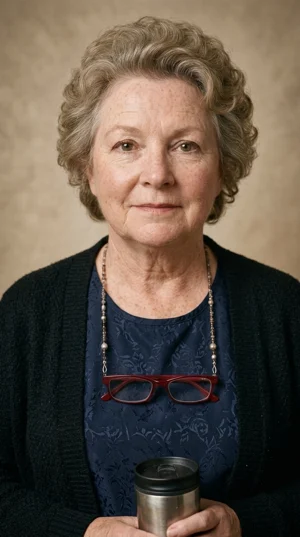
Laverne came in at 8:45 with Delmer’s travel mug and her red glasses on a chain. She’s sixty-one. She spent twenty-two years inspecting salons for the state board before she came to work for me, and she lent me forty thousand dollars to open this one, and she has never let me thank her for it. She looked at Deena. She looked at me.
“You don’t have to take her,” Laverne said.
“She’s a nine o’clock.”
“That’s not what I asked.”
“It’s what I’m answering.” I tied my apron. “I want everything to look exactly like it always looks.”
Laverne studied me over the top of her glasses for a long moment. Then she said, “All right, hon,” and went to fill the color bar, and I loved her so much I had to go stand in the back for a second.
At 8:57 a gray Ram with a rack behind the cab pulled into the spot by the dumpster.
Shiloh got out slowly. She was holding a throw pillow against her chest, a pink one with a fringe, and she walked across the lot like the ground might tip. Rocco didn’t get out. He turned the engine off and sat there behind the wheel, the way he had every six weeks for ten years.
She came through the door with the bell going and her face already arranged.
“Raina! Oh my God, hey.” She didn’t hug me. She couldn’t. She just leaned toward me with the pillow between us. “Don’t look at me, I’m a disaster. Isn’t this the craziest week? How’s Zeke? How’s his poor head?”
“He’s resting.”
“He was a lifesaver. A lifesaver. If he hadn’t been at the branch I’d have been sleeping in my car.” She lowered herself into my chair an inch at a time. “Cracked sternum. Can you believe it? They say it’s from the seat belt.”
I put the cape around her and snapped it at the back of her neck, and my fingers did not shake, and I was proud of them.
Five weeks of regrowth. The highlights still bright through the crown, fading to straw at the ends where she’d been flat-ironing them too hot. I could see the line where I’d stopped the color in August. I lifted a section and let it fall.
“Same as always?” I said.
“Brighter,” she said. “Can we go brighter? I just want to feel like me again.”
I mixed it at the bar with my back to her. Lightener and twenty-volume, one to two, by weight on the little scale, because I don’t eyeball color for anybody. I folded the first foil and then the next, sectioning fine through the crown, painting from a quarter inch off the root to the ends, folding, the same motion I’ve made a hundred thousand times. Shiloh talked. Shiloh always talks.
She told me about the wreck. The branch, her car, the rain, Zeke being so sweet. She told me the hospital food was a crime. She told me Rocco hadn’t said ten words since. “You know how he is. A stone. He just sits there and looks at me like I’m a broken transformer.”
“Mm,” I said, and folded a foil.
She told me she’d lost one of her horseshoe earrings in the wreck. She touched the empty lobe through the cape. “My mama gave me those. I could cry.”
“Mm.”
I didn’t ask her anything. Not one question in two hours. That was the hardest work I have ever done in that chair, and I’ve corrected green hair on a bride the morning of.
At twenty minutes in, she tipped her chin toward the window. “He’s still out there. Look at him. He’d sit in that truck till Christmas.”
I looked. Rocco was out there with his arm on the open window and his face turned toward the salon, and when I looked up, he didn’t look away.
“Raina,” Shiloh said, more quietly, while I worked at her part. “Zeke was so out of it at the hospital. Did he say anything weird? About me, or anything?”
There it was. Under all the talk, the thing she’d come in to find out. Every client tells you two things.
“He said you were a coworker whose car quit,” I said.
I watched her in the mirror. Her shoulders came down half an inch. She smiled.
“That’s Zeke,” she said. “A Boy Scout.”
She couldn’t lie back at the shampoo bowl. I rolled a towel and put it behind her shoulders and tipped her only halfway, and held the back of her head in my hand so her neck wouldn’t take the weight.
I turned on the water and put my wrist under it. My grandmother taught me that at her kitchen sink in Wagoner when I was nine, on Saturdays, rinsing setting lotion out of the church ladies’ hair with a coffee can, the whole house smelling of Dippity-do and beans on the stove. Primero el agua, mija, she used to say. The water first. Then you touch her.
I’ll tell you the truth about this part, because nobody else ever will. I stood there with the sprayer in my hand and the water running over the scar on my wrist, and the woman who had slept with my husband for God knew how long was lying in my bowl with her eyes closed and her throat bare. I could feel the heat climbing in the water. I could have let it climb.
I didn’t. I waited till it was right. Then I rinsed every bit of lightener out of her hair, gently, from the hairline back, the way I’d want somebody to do it for me.
You don’t hurt somebody who trusted you. Even if they shouldn’t have. Even if you shouldn’t have trusted them. That’s not about them. That’s about your hands.
She paid at the front desk with her card and signed with a heart over the i, and tipped me forty dollars, and touched her new hair in the mirror by the door. “You’re a genius,” she said. “You know that? I’d never go anywhere else.”
Through the window I watched her walk back across the lot hugging her pink pillow, and Rocco got out and came around and opened her door for her and helped her up into the cab. He didn’t look at the salon again. Then he drove her away.
When she was gone I took the green ledger off the shelf behind the front desk and opened it to D.
Shiloh Dekker. Ten years of my handwriting. Formulas, dates, toners, the year she tried red and hated it, the summer she cut bangs and cried in my chair about it. And then November of last year.
11/17/25. Wants brighter. “Something he’ll notice.” Sales conf. in OKC last wk.
After that she came every five weeks instead of six. After that she paid cash for a while, and tipped forty dollars instead of fifteen. I had written it all down and never once read it back.
November. Eleven months.
I got out my phone and texted Rocco. Come back at one. Back door. Alley.
He came at ten till. I let him in through the back, and the back room of Gloss is not much: an old brown couch, a microwave, a mini fridge with Deena’s yogurt in it, a shelf of towels, and the green door to my office. The dryers hummed through the wall. Somebody out front was laughing.
I showed him the ledger. I put my finger on November.
“Eleven months,” I said.
He read it twice. He didn’t ask how I could be sure. He looked at the words something he’ll notice for a long time, and then he closed the book and set it on the arm of the couch, very carefully, the way he’d set down the key cards in the hall.
“She asked if Zeke said anything about her,” I said. “That’s what she came in for. Not the hair.”
“What did you tell her?”
“The truth. He said she was a coworker.” I laughed. It sounded like a dryer with a shoe in it. “I rinsed her hair, Rocco. I held her head in my hand. I could have…”
“But you didn’t.”
“No.”
“I watched you,” he said. “Through the window. You never stopped being kind to her for one second. I don’t know how you did it.”
“I don’t either.”
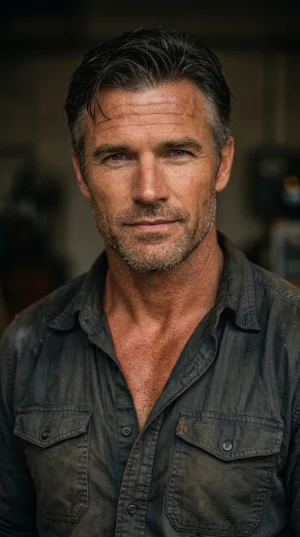
He was standing very close. He smelled like his truck, like coffee and cold air and something metal. I could see a scar through his left eyebrow I hadn’t noticed before. I could see him deciding not to touch me.
I didn’t want him to decide that.
“Rocco,” I said.
“I know.”
“No, you don’t. I’m going to kiss you. I want you to know I decided it.”
Something in his face gave way, slow, like ice going off a line.
I hooked my hand behind his neck and pulled him down to me, and he came. His mouth was warm and careful for about one second, and then it wasn’t careful at all. A breath went out of him, rough, and I felt it against my own ribs. His hand opened at the base of my spine and brought me against him, all of me, and I rose onto the balls of my feet and pushed my fingers into his hair, which was thick and short and still damp from a shower, and held on.
Nobody had kissed me like that in years. Maybe ever. Like he’d been thirsty a long time and I was the water.
He walked me back one step, two, until my shoulders touched the towel shelf. His jaw scraped my cheek. His other hand went up under the clip into the thick of my hair at the nape and closed there, gently, as if he’d wanted to know how much of it there was. His hand found my hip and stayed there, his thumb pressing into the bone through my jeans, and I wanted it lower and I wanted the apron off and I wanted the door locked, and I pulled his shirt half out of his belt and got my palm on his bare back, hot skin and muscle moving under it, and he said Raina into my mouth as if it cost him something.
The timer clipped to my apron went off. Shrill. Insistent.
I’d set it for a quarter past one so I’d remember to mix my one-thirty’s color.
We stopped. We didn’t step apart. We stood there with our foreheads together, breathing like we’d climbed something, while the timer shrieked between us, and I fumbled it off.
Somebody knocked on the door. Two raps, polite.
“Raina, hon,” Laverne said through the door. “You’ve got a one-thirty.”
Rocco didn’t let go of my hip. He looked down at me with his mouth wet and his eyes dark and something in them very close to a smile.
“She’s got a one-thirty,” he said.
What did you think?