They put the witnesses in the hall.
Haney asked for it before Judge Odom had finished sitting down. The rule, she called it. Anybody who might testify waits outside until they’re called, so nobody can shape what they say to fit what they’ve heard. Odom granted it without looking up, and a bailiff with a gray crew cut held the door of Courtroom 404 while we filed out like a class sent to the office.
I’d been served at Laverne’s on the eighteenth of December, a week before Christmas, by a woman in a minivan who said Merry Christmas when she handed it to me and then looked like she wished she hadn’t. Subpoena to appear and testify. Dekker v. Dekker. Dorinda had read it at her desk with her glasses on her nose and said, “Well. She’s thorough,” and moved her own docket so she could sit in the gallery.
So I sat on a bench outside 404 in a gray dress Laverne had chosen, with my hair in the same low twist she’d done for the last hearing, and I looked at who else Haney and Fite thought had something to say.
Vonda Milam was in a chair by the window in her quilted vest, with her toolbox of a purse on her knees. She’d been subpoenaed by Fite. She’d told him she’d have come anyway.
Charlene was at the other end of the hall, by the elevators, in the navy dress she wears to church. She held her purse in front of her with both hands. When Vonda came out of the courtroom behind me, Charlene looked up, and Vonda looked at her, and they were two women who’d sat three pews apart for twenty-two years.
“Morning, Charlene,” Vonda said.
“Vonda.”
That was all. Charlene looked at the elevator doors after that, and didn’t look at me once.
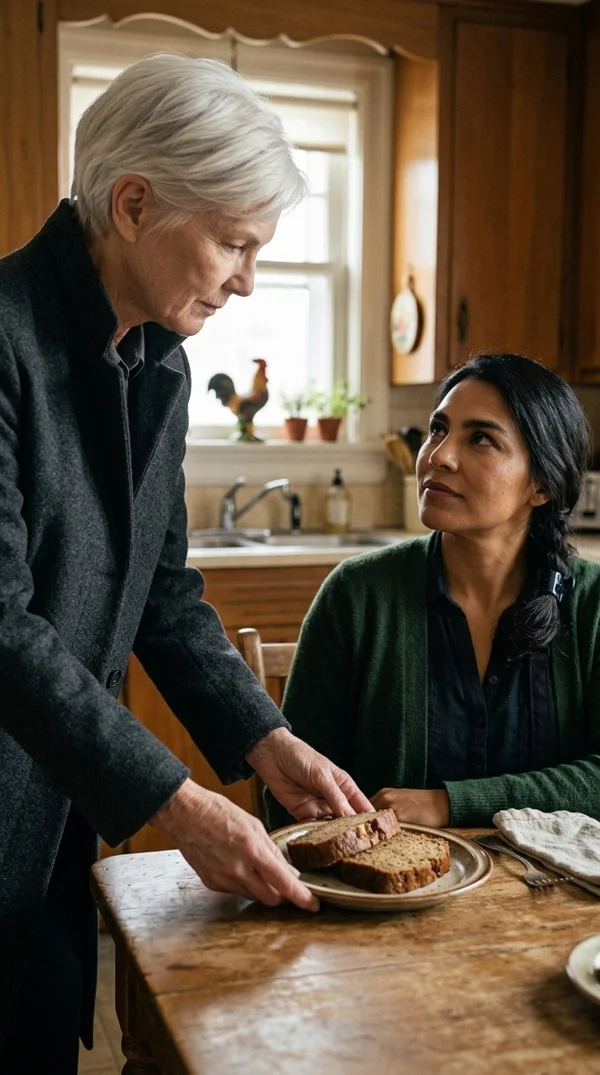
On the bench across from mine, Nelda Dekker sat very straight in a wool coat with her gloves folded in her lap. I’d never met her. I knew her from her banana bread and her son’s face. She had his eyes, gray and level, and a short white cut that a good barber had done well. She looked at me the way a school secretary looks at a parent who’s late for the third time.
“Mrs. Dunn,” she said.
“Mrs. Dekker.”
Beside her, with his elbows on his knees and a catcher’s mitt in his hands for no reason except that it was something to hold, was Bennett.
I sat where I was. I didn’t go over. Rocco had shown me how in November, at the barn, without a word: you are the woman who cut his hair, and that’s all, and you stay on your side of the hall.
Shiloh came up in the elevator at 8:55 with her lawyer.
Meredith Haney was tall and fortyish, in a charcoal suit and a camel coat, pulling a rolling briefcase that clicked on the tile. She had good skin and a very straight back and the kind of short dark haircut that costs a hundred and forty dollars and looks like it cost nothing.
Shiloh walked half a step behind her in a navy dress with a white collar, like a woman going to a christening. Her hair was the first thing I saw. It was always going to be.
Someone in Tulsa had done her highlights since October. They’d pulled them through a cap, the old way, so the pieces came out thick and spotty at the crown, and they hadn’t toned them, so they’d gone the yellow of a legal pad. Thirteen weeks of root. She’d tried to hide the line with a part on the other side.
I’d done that head every six weeks for ten years. I didn’t feel glad. I felt like I’d watched somebody drop a good pair of shears.
She didn’t look at me. She looked at Bennett on the bench, and her face did something soft and unguarded, and he looked at his mitt.
Haney called me first.
The witness chair in 404 is the same chair Zeke sat in to say he loved me. It’s oak and it’s hard and it faces the gallery. Dorinda was in the second row with her coat on her knees. Rocco was at the respondent’s table beside Fite, in the same sport coat, with his hands flat on the wood. He didn’t look at me when I took the oath. I understood that. I didn’t look at him either.
Haney stood at the lectern with a legal pad she never glanced at.
“Mrs. Dunn, are you in a sexual relationship with the Respondent, Rocco Dekker?”
“Yes.”
“Since when?”
“October.”
“Before or after your husband’s accident on October first?”
“After.”
“Has he spent the night at your residence?”
“Yes.”
“On how many occasions?”
“I didn’t count them.” I heard that and almost laughed. It was the first true thing I’d ever said that wasn’t a number. “More than three.”
She asked about the barn. She asked about the cot and the woodstove and whether I knew Mr. Dekker had been living there since October. She asked about November seventeenth. She made it sound like an address where something happened.
“I cut his son’s hair,” I said. “At his grandfather’s workbench. He had team pictures that Saturday and his mother used to take him. His father swept up.”
“Was the child aware of your relationship with his father?”
“He called me the hair lady. That’s what he knew.”
Haney let a little silence go by. Then she turned a page she didn’t need to turn.
“Mrs. Dunn. Has Mr. Dekker ever told you when he first learned about his wife’s relationship with your husband?”
There it was. I’d known it was coming since a pie pan in my sink at midnight. It still hit me like a cold rinse down the back of a cape.
“I asked him once if he’d known for eleven months,” I said. “He said yes.”
I heard a pen go in the gallery.
“And what else did he tell you?”
“Nothing. I asked him not to.” I kept my eyes on her, not on the respondent’s table. “I told him I didn’t want to hear another word of it until today was over.”
“Why?”
“Because I knew you’d ask me,” I said. “And I didn’t want to have anything to hand you but that.”

 100 to start reading with.

What did you think?