I wore my boots.
It sounds like nothing. I’d said it to him at midnight in my robe, with my shoes on, and on Saturday I stood in Laverne’s back room at one o’clock and laced up the brown boots I wear to funerals and house calls, the ones with the good soles, and I tied them twice. Then I put on my coat and checked that my purse was zipped, and that the inside pocket was zipped, and drove out 131st past the turnpike with both hands on the wheel.
Bennett was at an indoor catching clinic in Tulsa until four. Nelda had driven him. Rocco had told me that in a text at eight that morning, the only text he’d sent since the courthouse.
Clinic till 4. Barn at 1:30 if you’ll come.
I’d written back one word. Yes.
The side door was propped with the brick. The stove was going hard and the barn was still cold, the kind of cold that lives in a metal building in January and doesn’t leave because you’ve lit a fire. The one window had grown a skin of frost on the inside. The overhead lights were on.
The tarp was off the Ford. Its hood was up. On the fender, on a shop rag, sat a cardboard box with a red stick-on bow on the lid, the kind they sell by the bag at the drugstore. HOLLEY 4160, the box said, and a picture of a carburetor.
He saw me look at it.
“Christmas,” he said. “He was at Sycamore Christmas Day. I was going to give it to him this weekend. Out here.” He didn’t finish.
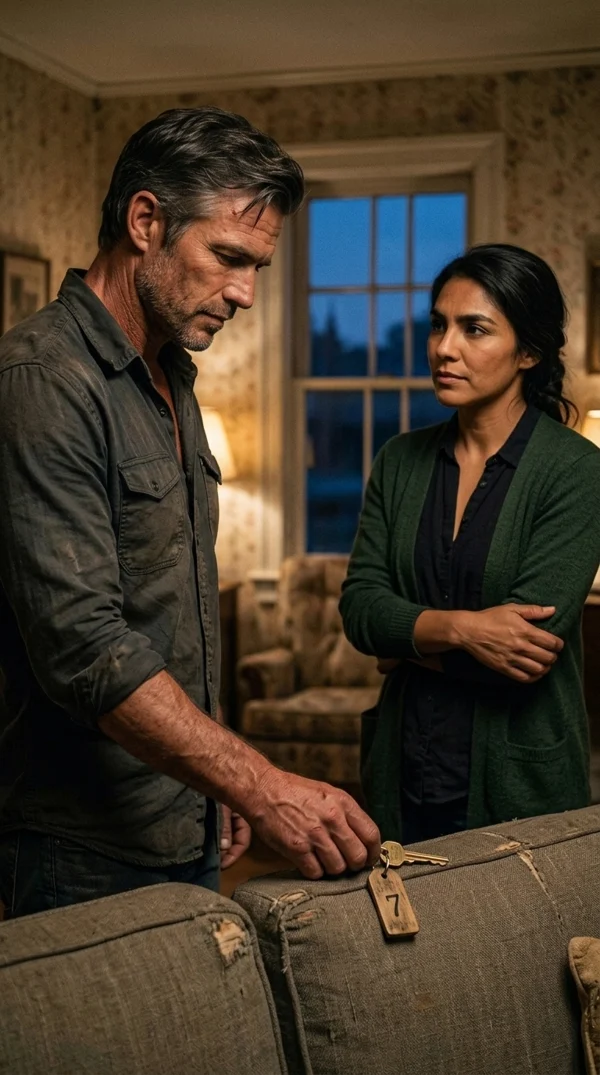
He’d set a chair for me by the stove. A real one, wooden, with arms, that I’d never seen in the barn before. He’d brought it from somewhere. He stood by the workbench with his arms at his sides, not folded, in a flannel shirt and his work jeans, and his face looked like he hadn’t slept since Thursday.
I didn’t sit.
“Your mother says you told the judge the day,” I said.
“I did.”
“Then tell me.”
He nodded. He looked at the stove for a second, the way a man looks at a switch he’s about to throw. Then he looked back at me.
“Once,” he said. “All of it. You can stop me.”
“I won’t stop you.”
“Thanksgiving a year ago,” Rocco said. “She started putting on perfume to go to her mother’s. That was the first thing. I didn’t think anything. I thought, Vonda’s not much for perfume.
“December, the Hargis Christmas party. They hold it at the warehouse, catered, with a band on a flatbed. You weren’t there. Zeke said you had a bride the next morning.”
“The Kowalczyk wedding,” I said. I said it before I’d decided to. “Seven a.m. Six bridesmaids.”
He nodded as if he’d expected that.
“I saw him get her coat for her off the rack. He held it for her and he kept his hand on her back after it was on. A second too long. That was all. I’ve seen men do worse to my wife at a party and not cared.” He looked at his hands. “I cared that time. I didn’t know why. I went out and sat in my truck in the driveway that night for an hour. Bennett saw me. He’s told you that, I think.”
“He told me.”
“January ninth,” Rocco said. “A Friday. Nine degrees. I got up at five-thirty, same as always, and she was in bed asleep. I went out with the scraper to do her windshield first. Every windshield on the street was white. Hers was clear.”
He stopped there for a second. I didn’t move.
“I put my hand on the hood,” he said. “It was warm. She’d said she went to bed at ten. She’d been home maybe twenty minutes.” His voice didn’t change. “I went back in the house and stood in the bedroom door and looked at her asleep. Then I went back out and opened her car and wrote down what the odometer said on the back of a gas receipt. That’s the first line in the notebook. I wrote it in the notebook later.”
“41,206.”
He looked at me.
“I read it in your truck,” I said. “On the expressway. You told me it was your mileage.”
“I lied to you about that. I’m sorry.” He let a breath out. “I saw Fite that Monday. You know what he said.”
“Wait. Write it down. Tell nobody.”
“Not the man’s wife.” He said it flat. “I didn’t know yet who the man was. I wrote down her miles every Friday. A hundred and eighty, two hundred more than work and her mother’s. She had inventory at Hargis on Wednesday nights, she said. Late. So one Wednesday in March I followed her.”
The stove ticked. Out past the cedars a truck went by on 131st and was gone.
“Catoosa,” he said. “Off Cherokee Street. A brick ranch with a carport. A concrete goose by the door in a green bonnet with a shamrock on it.” He watched my face when he said that. I didn’t let it do anything. “There was a white F-250 under the carport with a Hargis sticker on the back glass. I sat at the end of the street with my lights off and watched them through the front window, sitting down to eat at a kitchen table. Her and him and an older woman. Then I drove home and looked up the address on the county site. Charlene Dunn. And then I looked up Dunn.”
“And found me.”
“And found you. Zeke Dunn, married to Raina Dunn, owner of Gloss on South Main.” He was quiet a second. “I’d sat in your lot every six weeks for ten years. I’d never once known your last name was his.”
I sat down then. In the chair he’d brought from somewhere. I sat on the front edge of it with my purse on my knees.
“Her next appointment was March twenty-third,” he said. “A Monday. I drove her. I parked by your dumpster and turned the engine off, same as always. And I watched you through the window put her in the chair and cape her and mix her color with your back to her, and paint it in, and fold every foil, and I knew whose bed she’d been in on Wednesday, and you didn’t. And I didn’t get out of the truck.”

 100 to start reading with.
What did you think?